 Add to Chrome
 Add to Firefox
 Add to Edge
Stochastic Expectation Maximization for Robust State-Space Radio Interferometric Imaging
Jun 22, 2026
State--space models provide a flexible framework for analyzing dynamical systems, yet they often rely on Gaussian assumptions that fail to capture heavy-tailed or outlier-prone measurement noise. We propose a robust estimation scheme for linear state--space models subject to compound-Gaussian noise, as encountered for instance in radio interferometry affected by radio-frequency interference (RFI). The method relies on a Stochastic Approximation Expectation--Maximization (SAEM) algorithm in which the standard E-step is replaced by Monte Carlo sampling of the latent states and noise texture through closed-form Gibbs updates, enabling tractable inference despite the heavy-tailed likelihood. Numerical experiments show that the proposed method significantly improves reconstruction fidelity and robustness to RFI, outperforming a Gaussian EM algorithm and even an oracle RTS smoother. These results highlight the benefits of heavy-tailed state--space modeling and SAEM-based inference in interference-dominated imaging scenarios.

Multifrequency Array Calibration in Presence of Radio Frequency Interferences
Feb 15, 2022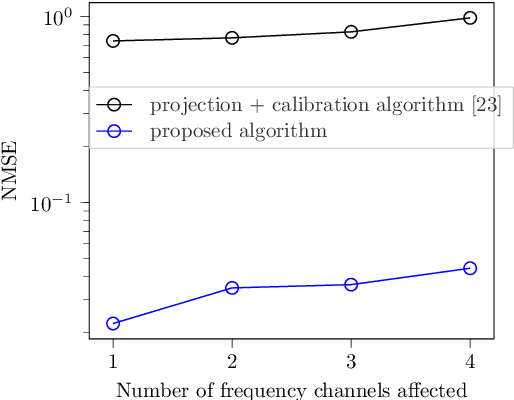
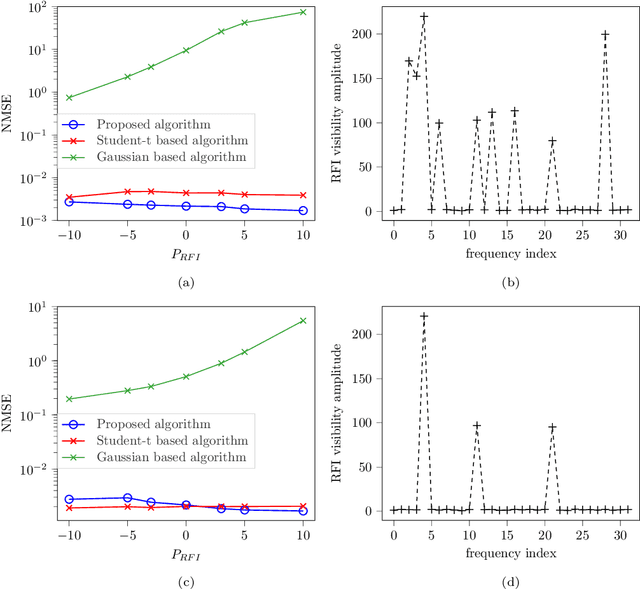
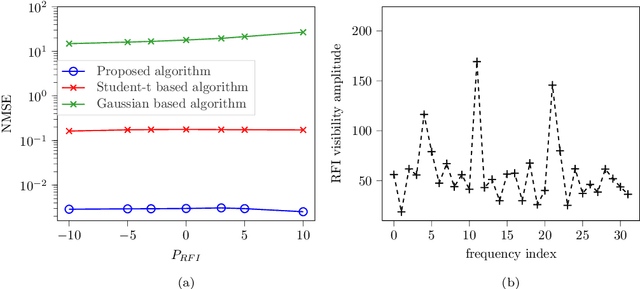
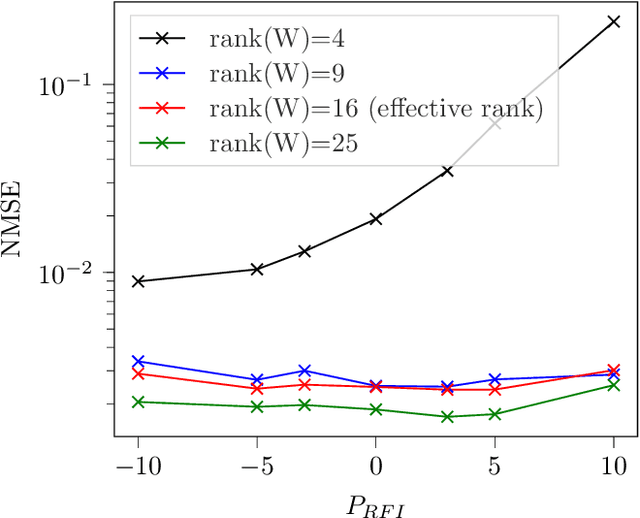
Radio interferometers are phased arrays producing high-resolution images from the covariance matrix of measurements. Calibration of such instruments is necessary and is a critical task. This is how the estimation of instrumental errors is usually done thanks to the knowledge of referenced celestial sources. However, the use of high sensitive antennas in modern radio interferometers (LOFAR, SKA) brings a new challenge in radio astronomy because there are more sensitive to Radio Frequency Interferences (RFI). The presence of RFI during the calibration process generally induces biases in state-of-the-art solutions. The purpose of this paper is to propose an alternative to alleviate the effects of RFI. For that, we first propose a model to take into account the presence of RFI in the data across multiple frequency channels thanks to a low-rank structured noise. We then achieve maximum likelihood estimation of the calibration parameters with a Space Alternating Generalized Expectation-Maximization (SAGE) algorithm for which we derive originally two sets of complete data allowing close form expressions for the updates. Numerical simulations show a significant gain in performance for RFI corrupted data in comparison with some more classical methods.
Multi-frequency calibration for DOA estimation with distributed sensors
Feb 24, 2020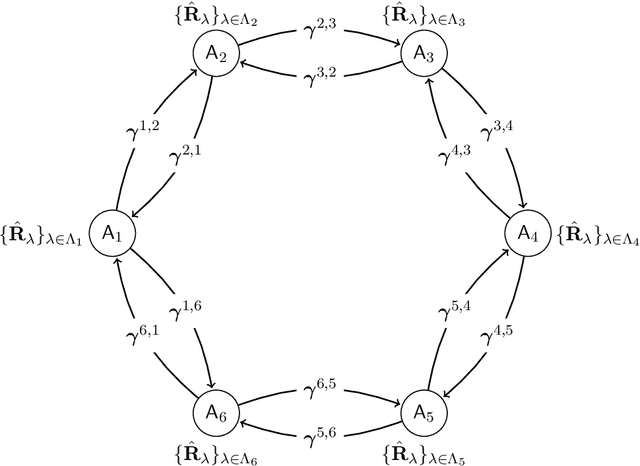
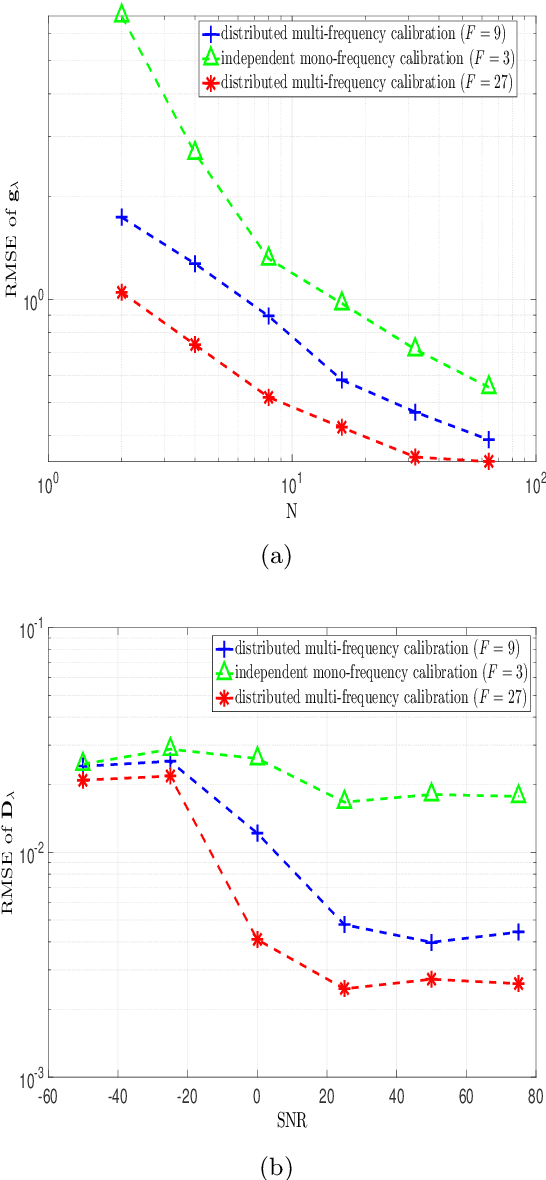
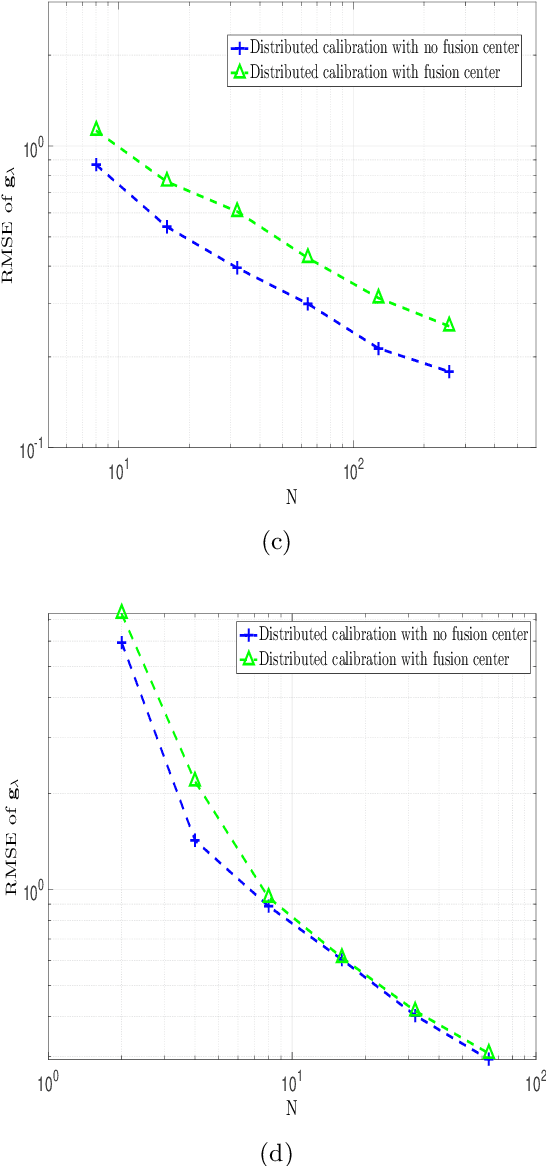
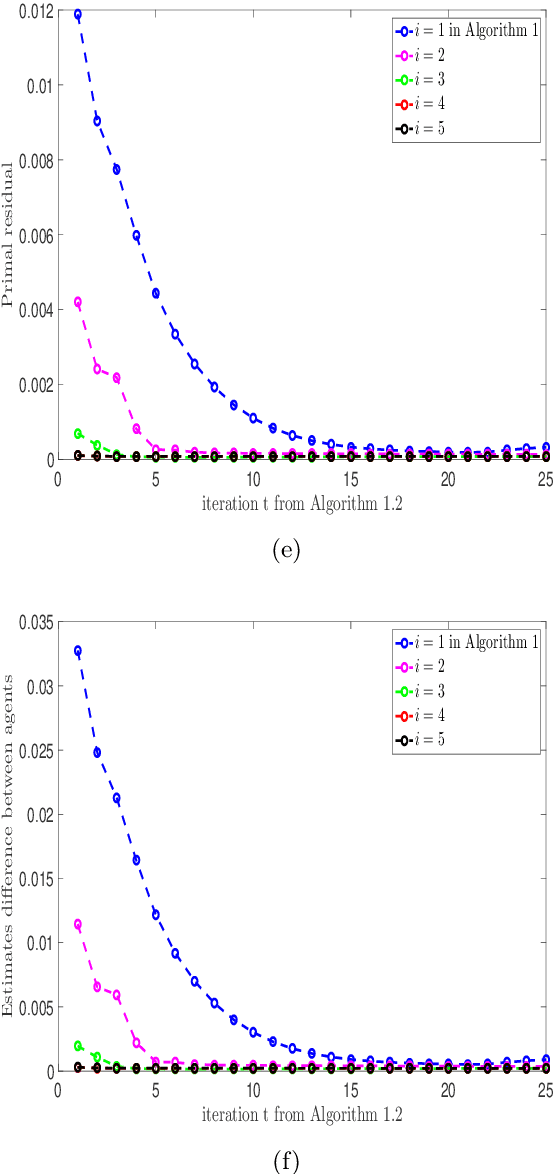
In this work, we investigate direction finding in the presence of sensor gain uncertainties and directional perturbations for sensor array processing in a multi-frequency scenario. Specifically, we adopt a distributed optimization scheme in which coherence models are incorporated and local agents exchange information only between connected nodes in the network, i.e., without a fusion center. Numerical simulations highlight the advantages of the proposed parallel iterative technique in terms of statistical and computational efficiency.