 Add to Chrome
 Add to Firefox
 Add to Edge
Lightweight Single-Antenna Direction-of-Arrival Estimation for Curvilinear Trajectories in Mobile Embedded Systems
Aug 12, 2026
Accurate direction-of-arrival (DOA) estimation is valuable for spatially selective communication in noisy industrial environments. This work investigates a lightweight single-antenna framework in which receiver motion forms a virtual aperture. The receiver uses onboard inertial measurement unit (IMU) headings and two-way-ranging (TWR) measurements to a known fixed beacon, avoiding GPS, optical tracking, and high-precision external tracking of the mobile receiver. The curvilinear virtual-array MUSIC formulation is evaluated numerically using phase-coherent narrowband snapshots over arbitrary trajectories. Hardware experiments validate a range- domain TWR-IMU bearing estimator using corrected and averaged ranging observations. In a campaign of 100 consecutive four-revolution sweeps, all trials are retained. Phase-aligned accumulation recovers a 123 mm range-modulation amplitude, in close agreement with the measured 120 mm antenna lever arm. The single-sweep bearing precision is 8.2° absolute world-frame accuracy is limited by systematic BNO055 magnetometer drift in the motorized setup. The embedded bearing-estimation computation consumes 144.9 mJ per estimate, approximately 3 % of the measured cycle energy in the tested configuration. These results establish the feasibility of onboard range-domain bearing estimation and motivate future experimental validation of phase-coherent MUSIC during free-form mobile trajectories.

WiP: Towards a Secure SECP256K1 for Crypto Wallets: Hardware Architecture and Implementation
Nov 06, 2024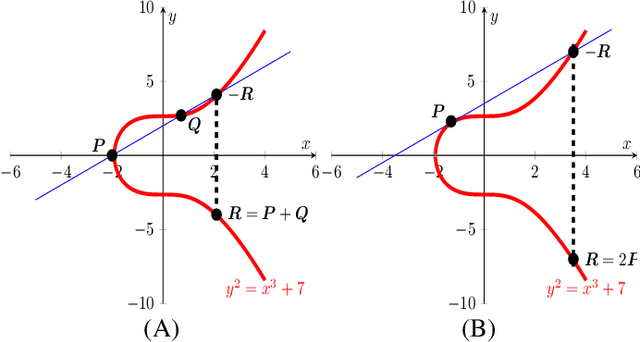
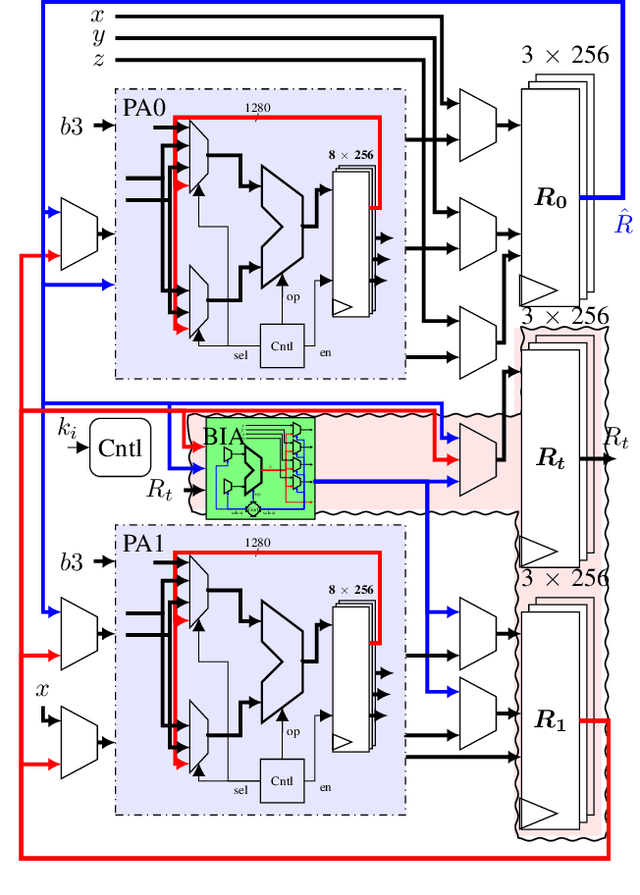
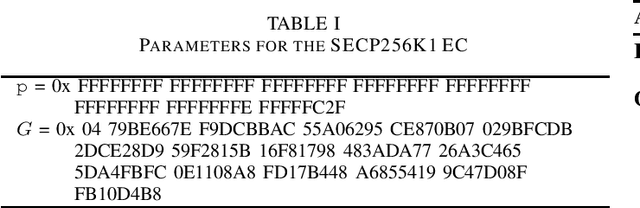
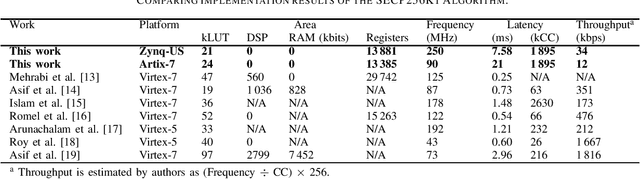
The SECP256K1 elliptic curve algorithm is fundamental in cryptocurrency wallets for generating secure public keys from private keys, thereby ensuring the protection and ownership of blockchain-based digital assets. However, the literature highlights several successful side-channel attacks on hardware wallets that exploit SECP256K1 to extract private keys. This work proposes a novel hardware architecture for SECP256K1, optimized for side-channel attack resistance and efficient resource utilization. The architecture incorporates complete addition formulas, temporary registers, and parallel processing techniques, making elliptic curve point addition and doubling operations indistinguishable. Implementation results demonstrate an average reduction of 45% in LUT usage compared to similar works, emphasizing the design's resource efficiency.
An Early-Stopping Mechanism for DSCF Decoding of Polar Codes
Jan 12, 2021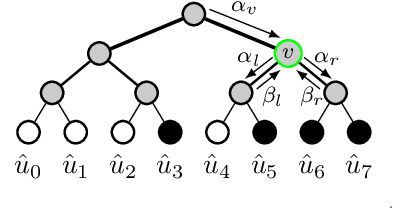
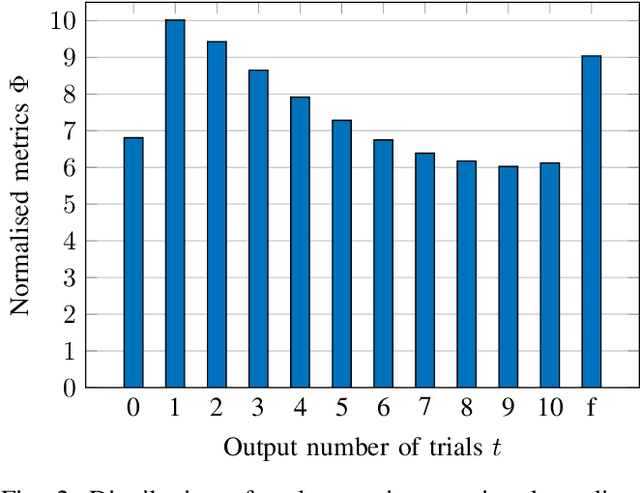
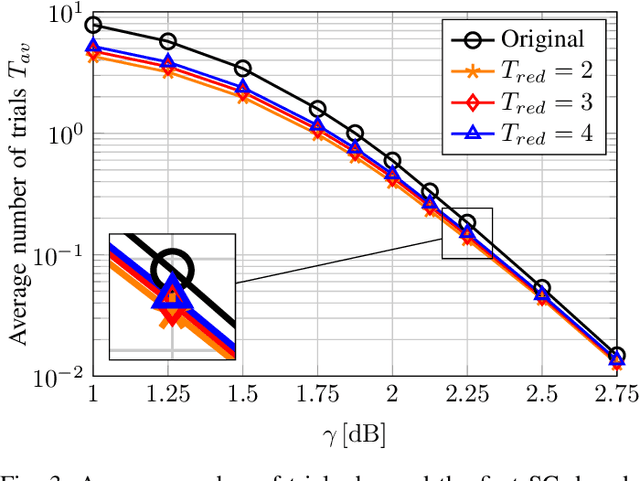
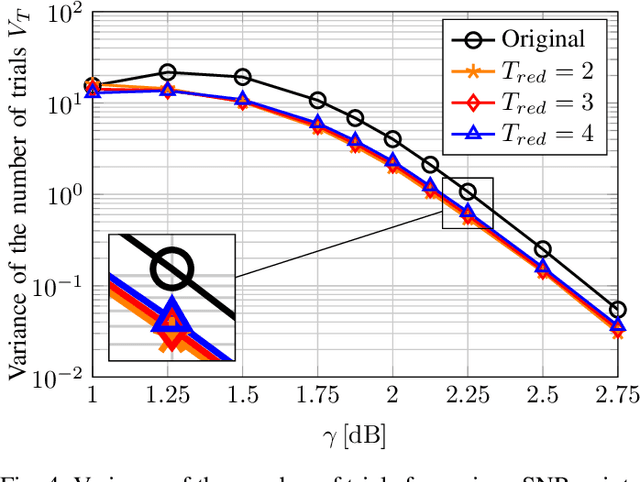
Polar codes can be decoded with the low-complexity successive-cancellation flip (SCF) algorithm. To improve error-correction performance, the dynamic successive-cancellation flip (DSCF) variant was proposed, where the resulting error-correction performance is similar to that of the successive-cancellation list algorithm with low to moderate list sizes. Regardless of the variant, the SCF algorithm exhibits a variable execution time with a high (worst-case) latency. In this work, we propose an early-stopping metric used to detect codewords that are likely undecodable such that the decoder can be stopped at earlier stages for those codewords. We then propose a modified version of the DSCF algorithm that integrates our early-stopping metric that exploits the specific properties of DSCF. Compared to the original DSCF algorithm, in the region of interest for wireless communications, simulation results show that our proposed modifications can lead to reductions of 22% to the average execution time and of 45% to the execution-time variance at the cost of a minor error-correction loss of approximately 0.05 dB.