 Add to Chrome
 Add to Firefox
 Add to Edge
GRADE: Generalizable Reasoning-Aware Dialogue Evaluation for AI Tutors
May 27, 2026
Evaluating AI tutor responses requires more than factual correctness: tutors must identify mistakes, locate errors, provide guidance, and offer actionable next steps. We present GRADE, a systematic study of open-source models for pedagogical ability assessment in student-tutor dialogues. Building on the BEA 2025 TutorMind setting, we evaluate 120 configurations across five language models, zero-shot inference, LoRA fine-tuning, synthetic augmentation, CoT+Reasoning, and single-task versus multitask formulations. Gemma3-12B performs best for single-task evaluation, while Gemma3-27B in 8-bit precision is more reliable for multitask prediction. We find that augmentation helps models that struggle with the original data, verification adds limited gains despite higher cost, and CoT+Reasoning is more useful for synthetic data generation than direct classification. We further show that LoRA fine-tuning on structured classification objectives interferes with instruction-following behavior under thinking mode, redirecting generation away from the required evaluation format. Carbon analysis shows that model choice and reasoning mode substantially affect emissions. Overall, GRADE shows that carefully selected open-source LoRA pipelines can match or surpass proprietary and ensemble-based systems on key pedagogical dimensions, with code and data available at https://github.com/pvbgeek/GRADE.

Beyond Factual QA: Mentorship-Oriented Question Answering over Long-Form Multilingual Content
Jan 23, 2026Question answering systems are typically evaluated on factual correctness, yet many real-world applications-such as education and career guidance-require mentorship: responses that provide reflection and guidance. Existing QA benchmarks rarely capture this distinction, particularly in multilingual and long-form settings. We introduce MentorQA, the first multilingual dataset and evaluation framework for mentorship-focused question answering from long-form videos, comprising nearly 9,000 QA pairs from 180 hours of content across four languages. We define mentorship-focused evaluation dimensions that go beyond factual accuracy, capturing clarity, alignment, and learning value. Using MentorQA, we compare Single-Agent, Dual-Agent, RAG, and Multi-Agent QA architectures under controlled conditions. Multi-Agent pipelines consistently produce higher-quality mentorship responses, with especially strong gains for complex topics and lower-resource languages. We further analyze the reliability of automated LLM-based evaluation, observing substantial variation in alignment with human judgments. Overall, this work establishes mentorship-focused QA as a distinct research problem and provides a multilingual benchmark for studying agentic architectures and evaluation design in educational AI. The dataset and evaluation framework are released at https://github.com/AIM-SCU/MentorQA.
Multi-Agent Multimodal Models for Multicultural Text to Image Generation
Feb 21, 2025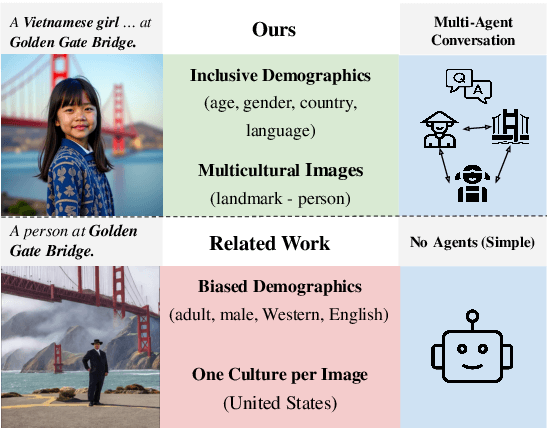
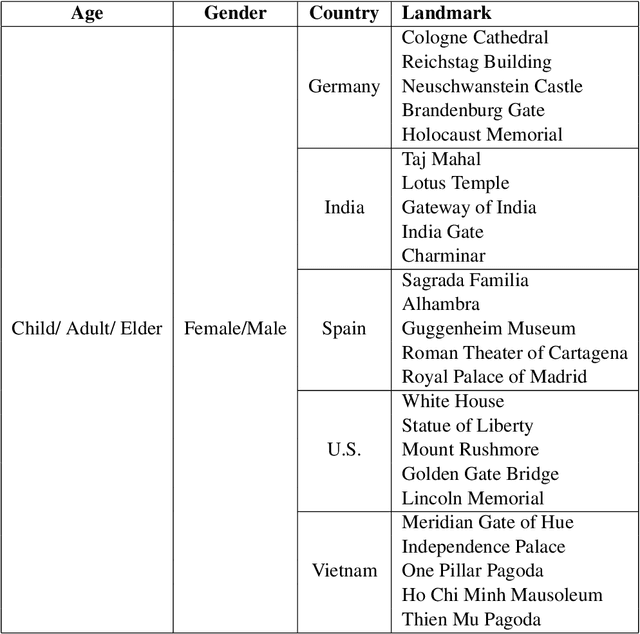
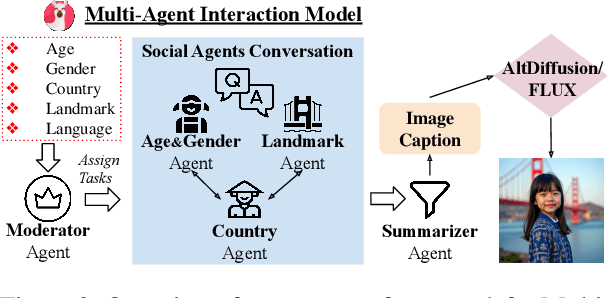
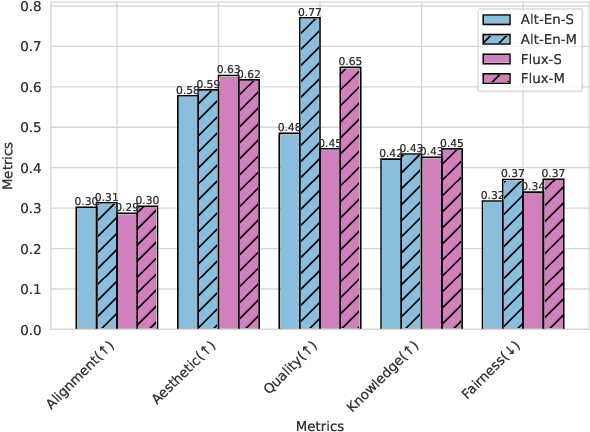
Large Language Models (LLMs) demonstrate impressive performance across various multimodal tasks. However, their effectiveness in cross-cultural contexts remains limited due to the predominantly Western-centric nature of existing data and models. Meanwhile, multi-agent models have shown strong capabilities in solving complex tasks. In this paper, we evaluate the performance of LLMs in a multi-agent interaction setting for the novel task of multicultural image generation. Our key contributions are: (1) We introduce MosAIG, a Multi-Agent framework that enhances multicultural Image Generation by leveraging LLMs with distinct cultural personas; (2) We provide a dataset of 9,000 multicultural images spanning five countries, three age groups, two genders, 25 historical landmarks, and five languages; and (3) We demonstrate that multi-agent interactions outperform simple, no-agent models across multiple evaluation metrics, offering valuable insights for future research. Our dataset and models are available at https://github.com/OanaIgnat/MosAIG.