 Add to Chrome
 Add to Firefox
 Add to Edge
REPOT: Recoverable Program-of-Thought via Checkpoint Repair
May 28, 2026
One-shot Program-of-Thought (PoT) emits a Python program that prints a primitive-action plan; a single invalid action silently invalidates the trajectory. We introduce RePoT (Recoverable PoT): a deterministic verified replay that walks the plan through the environment to its first invalid transition, then one LLM call that resumes from the verified prefix. RePoT costs at most one extra LLM call on the ~14% of problems where PoT fails. RePoT beats PoT by +3 to +11pp across four closed-model configurations on PuzzleZoo-775 and peaks at 96.9% vs 86.3% on gpt-5.4-mini-medium; against the matched-budget PoT-retry baseline, RePoT wins decisively on Gemini (+3.8pp, 95% CI [+2.2,+5.4]), is within sampling noise on GPT-medium and Claude, and loses on GPT-mini -- a capability-scaling pattern we begin to address with Adaptive RePoT, a rule-based dispatcher that routes between suffix repair and a fresh PoT retry based on verified-prefix length (preliminary). We replicate on PlanBench Blocksworld (+1.1 to +11.4pp) and on four open-weights models (+3.3 to +20.0pp on three of four). On Derail-550, our controlled recovery benchmark, every condition with access to checkpoint information clears >=30% on GPT-medium and >=70% on Gemini, vs <=3.1% for error-only feedback -- showing that checkpoint information, not the specific verified-prefix tail, is the load-bearing recovery signal.

AgentAtlas: Beyond Outcome Leaderboards for LLM Agents
May 19, 2026Large language model agents now act on codebases, browsers, operating systems, calendars, files, and tool ecosystems, but the benchmarks used to evaluate them are fragmented: each emphasizes a different unit of measurement (final task success, tool-call validity, repeated-pass consistency, trajectory safety, or attack robustness). A line of 2024-2025 work has converged on the diagnosis that a single accuracy column is no longer the right unit of comparison for deployable agents. AgentAtlas extends this line of work with four components: (i) a six-state control-decision taxonomy (Act / Ask / Refuse / Stop / Confirm / Recover); (ii) a nine-category trajectory-failure taxonomy with two orthogonal hierarchical labels (primary_error_source, impact); (iii) a taxonomy-aware vs. taxonomy-blind methodology that measures how much of a model's apparent capability comes from the supervision in the prompt; and (iv) a benchmark-coverage audit mapping fifteen agent benchmarks against six behavioral axes. To demonstrate the methodology we run a small fixed eight-model set (1,342 generated items, four frontier closed and four open-weight) under both prompt modes. Removing the explicit label menu drops every model's trajectory accuracy by 14-40 pp to a tight 0.54-0.62 floor regardless of family, and no single model wins on all three of control accuracy, trajectory diagnosis, and tool-context utility retention. We treat the synthetic run as a measurement-protocol demonstration, not a benchmark release.
Don't Believe Everything You Read: Enhancing Summarization Interpretability through Automatic Identification of Hallucinations in Large Language Models
Dec 22, 2023
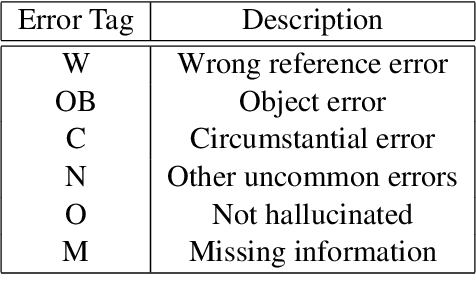


Large Language Models (LLMs) are adept at text manipulation -- tasks such as machine translation and text summarization. However, these models can also be prone to hallucination, which can be detrimental to the faithfulness of any answers that the model provides. Recent works in combating hallucinations in LLMs deal with identifying hallucinated sentences and categorizing the different ways in which models hallucinate. This paper takes a deep dive into LLM behavior with respect to hallucinations, defines a token-level approach to identifying different kinds of hallucinations, and further utilizes this token-level tagging to improve the interpretability and faithfulness of LLMs in dialogue summarization tasks. Through this, the paper presents a new, enhanced dataset and a new training paradigm.