 Add to Chrome
 Add to Firefox
 Add to Edge
EVT-Based Generative AI for Tail-Aware Channel Estimation
Apr 27, 2026
Ultra-reliable and low-latency communication (URLLC) will play a key role in fifth-generation (5G) and beyond networks, enabling mission-critical applications. Meeting the stringent URLLC requirements, characterized by extremely low packet error rates and minimal latency, calls for advanced statistical modeling to accurately capture rare events in wireless channels. Traditional methods, such as those that rely on large datasets and computationally intensive estimation techniques, often fail in real-time scenarios. In this paper, a novel framework is proposed to meet URLLC requirements through a synergistic integration of extreme value theory (EVT) with generative artificial intelligence (AI). EVT is used to model channel tail distributions, providing an accurate characterization of rare events. Concurrently, generative AI enables data augmentation and channel parameter estimation from limited samples. The integration of EVT with generative AI can thus help overcome the limitations of generative models in capturing extreme events during channel characterization. Using an experimental dataset collected from an automotive environment, it is demonstrated that this integration enhances data augmentation for extreme quantiles, while requiring fewer samples than traditional analytical EVT methods and generative baselines in online estimation of channel distribution.

GANs for EVT Based Model Parameter Estimation in Real-time Ultra-Reliable Communication
Jan 12, 2024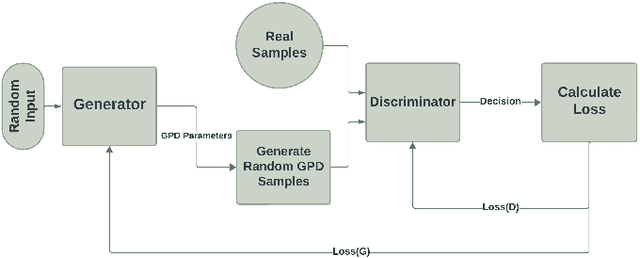
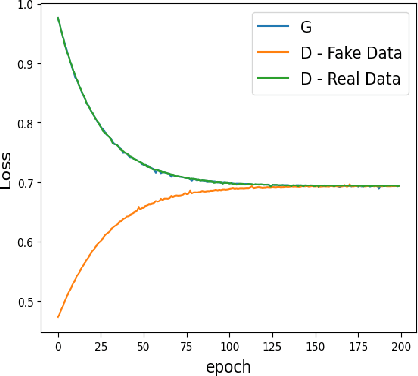
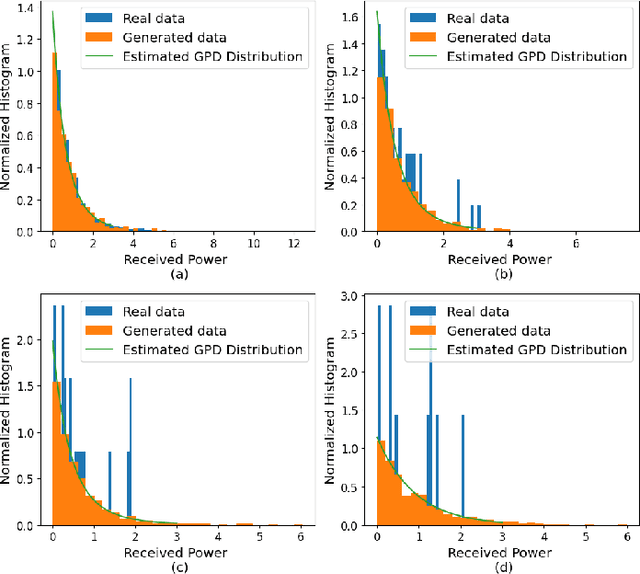
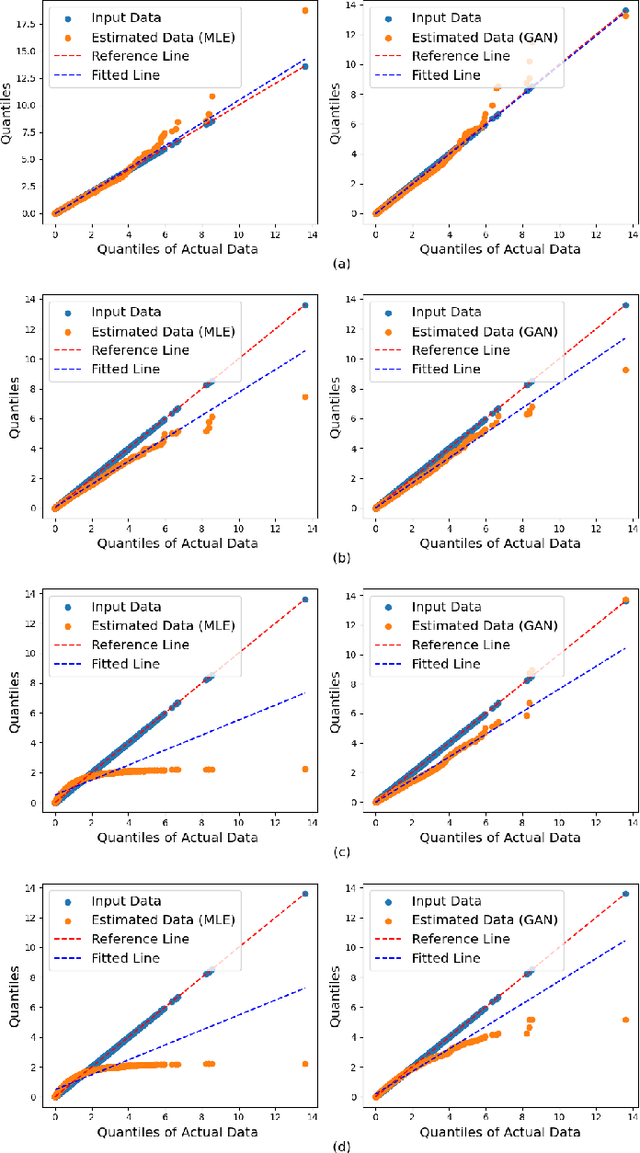
The Ultra-Reliable Low-Latency Communications (URLLC) paradigm in sixth-generation (6G) systems heavily relies on precise channel modeling, especially when dealing with rare and extreme events within wireless communication channels. This paper explores a novel methodology integrating Extreme Value Theory (EVT) and Generative Adversarial Networks (GANs) to achieve the precise channel modeling in real-time. The proposed approach harnesses EVT by employing the Generalized Pareto Distribution (GPD) to model the distribution of extreme events. Subsequently, Generative Adversarial Networks (GANs) are employed to estimate the parameters of the GPD. In contrast to conventional GAN configurations that focus on estimating the overall distribution, the proposed approach involves the incorporation of an additional block within the GAN structure. This specific augmentation is designed with the explicit purpose of directly estimating the parameters of the Generalized Pareto Distribution (GPD). Through extensive simulations across different sample sizes, the proposed GAN based approach consistently demonstrates superior adaptability, surpassing Maximum Likelihood Estimation (MLE), particularly in scenarios with limited sample sizes.