 Add to Chrome
 Add to Firefox
 Add to Edge
Interpretable Similarity of Synthetic Image Utility
Dec 18, 2025
Synthetic medical image data can unlock the potential of deep learning (DL)-based clinical decision support (CDS) systems through the creation of large scale, privacy-preserving, training sets. Despite the significant progress in this field, there is still a largely unanswered research question: "How can we quantitatively assess the similarity of a synthetically generated set of images with a set of real images in a given application domain?". Today, answers to this question are mainly provided via user evaluation studies, inception-based measures, and the classification performance achieved on synthetic images. This paper proposes a novel measure to assess the similarity between synthetically generated and real sets of images, in terms of their utility for the development of DL-based CDS systems. Inspired by generalized neural additive models, and unlike inception-based measures, the proposed measure is interpretable (Interpretable Utility Similarity, IUS), explaining why a synthetic dataset could be more useful than another one in the context of a CDS system based on clinically relevant image features. The experimental results on publicly available datasets from various color medical imaging modalities including endoscopic, dermoscopic and fundus imaging, indicate that selecting synthetic images of high utility similarity using IUS can result in relative improvements of up to 54.6% in terms of classification performance. The generality of IUS for synthetic data assessment is demonstrated also for greyscale X-ray and ultrasound imaging modalities. IUS implementation is available at https://github.com/innoisys/ius

Clinical Evaluation of Medical Image Synthesis: A Case Study in Wireless Capsule Endoscopy
Oct 31, 2024
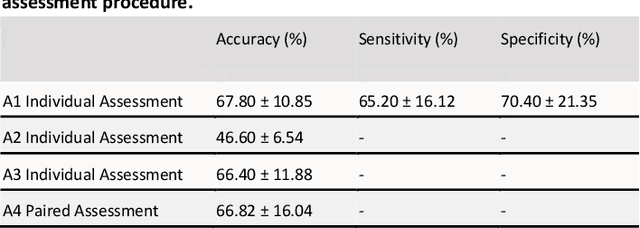

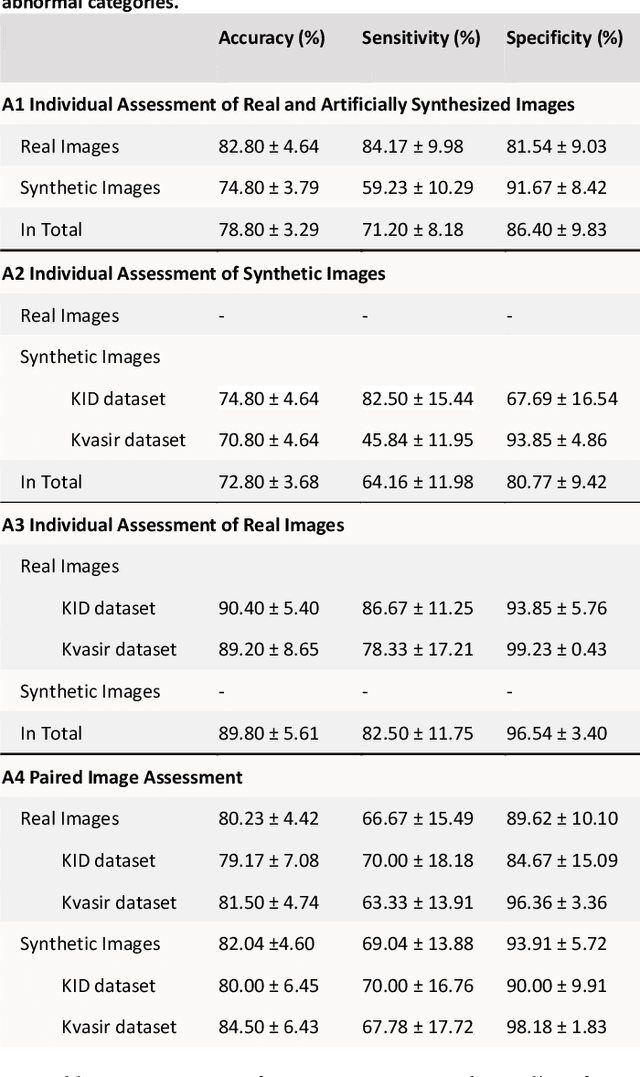
Sharing retrospectively acquired data is essential for both clinical research and training. Synthetic Data Generation (SDG), using Artificial Intelligence (AI) models, can overcome privacy barriers in sharing clinical data, enabling advancements in medical diagnostics. This study focuses on the clinical evaluation of medical SDG, with a proof-of-concept investigation on diagnosing Inflammatory Bowel Disease (IBD) using Wireless Capsule Endoscopy (WCE) images. The paper contributes by a) presenting a protocol for the systematic evaluation of synthetic images by medical experts and b) applying it to assess TIDE-II, a novel variational autoencoder-based model for high-resolution WCE image synthesis, with a comprehensive qualitative evaluation conducted by 10 international WCE specialists, focusing on image quality, diversity, realism, and clinical decision-making. The results show that TIDE-II generates clinically relevant WCE images, helping to address data scarcity and enhance diagnostic tools. The proposed protocol serves as a reference for future research on medical image-generation techniques.
This Intestine Does Not Exist: Multiscale Residual Variational Autoencoder for Realistic Wireless Capsule Endoscopy Image Generation
Feb 07, 2023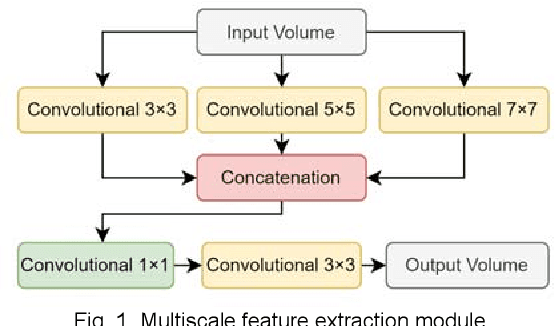
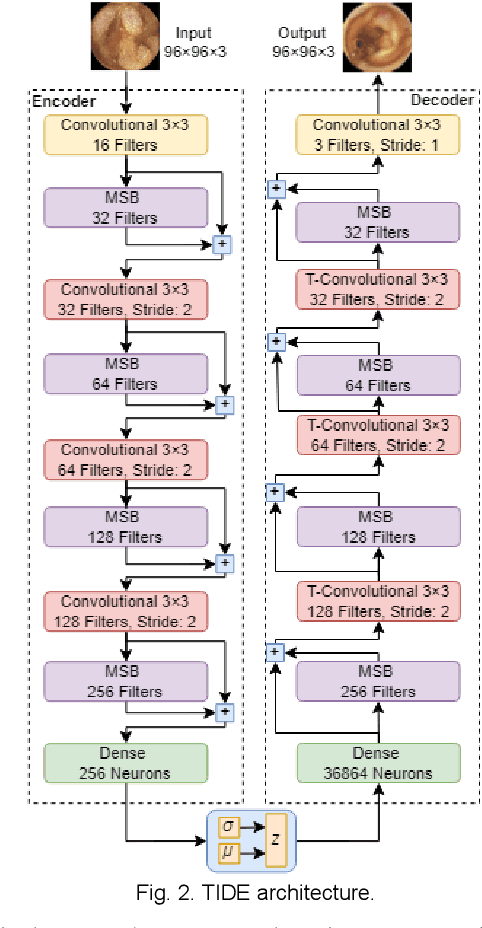
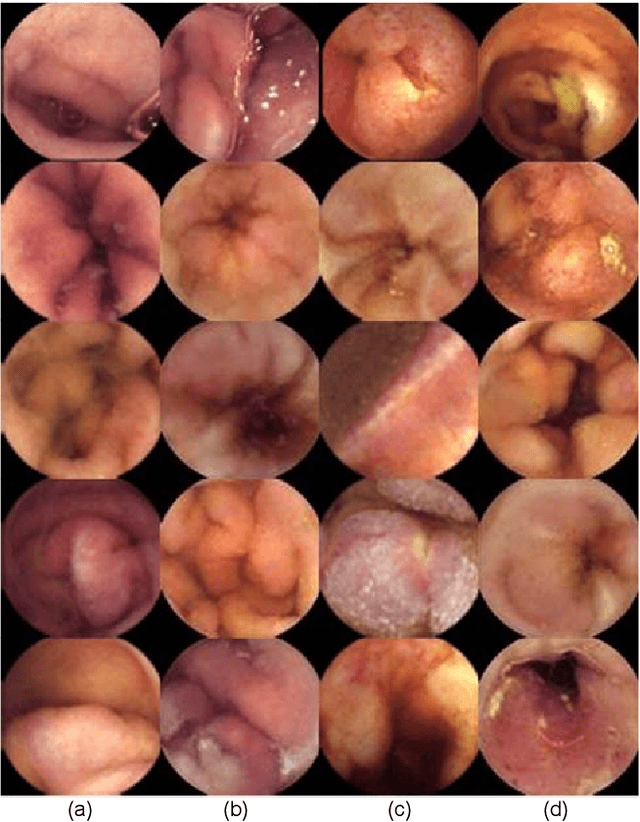
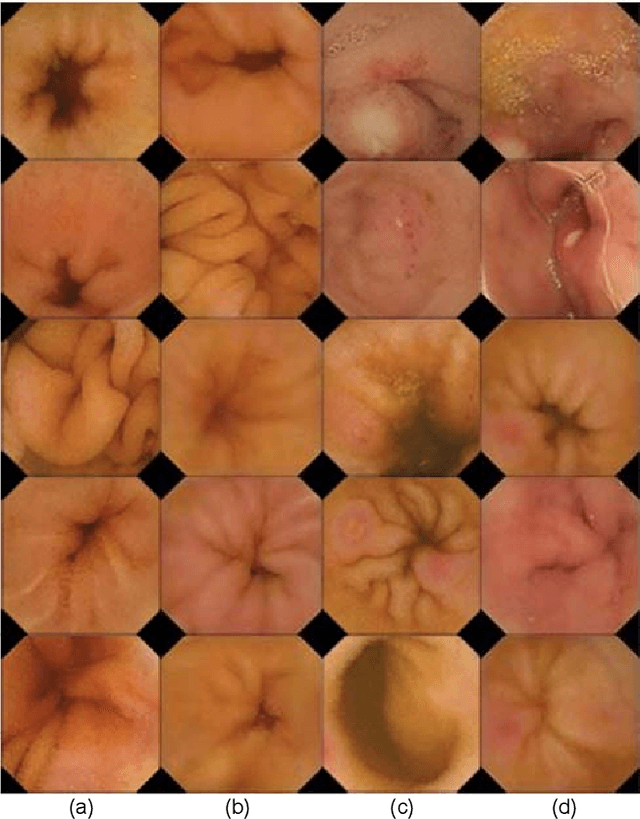
Medical image synthesis has emerged as a promising solution to address the limited availability of annotated medical data needed for training machine learning algorithms in the context of image-based Clinical Decision Support (CDS) systems. To this end, Generative Adversarial Networks (GANs) have been mainly applied to support the algorithm training process by generating synthetic images for data augmentation. However, in the field of Wireless Capsule Endoscopy (WCE), the limited content diversity and size of existing publicly available annotated datasets, adversely affect both the training stability and synthesis performance of GANs. Aiming to a viable solution for WCE image synthesis, a novel Variational Autoencoder architecture is proposed, namely "This Intestine Does not Exist" (TIDE). The proposed architecture comprises multiscale feature extraction convolutional blocks and residual connections, which enable the generation of high-quality and diverse datasets even with a limited number of training images. Contrary to the current approaches, which are oriented towards the augmentation of the available datasets, this study demonstrates that using TIDE, real WCE datasets can be fully substituted by artificially generated ones, without compromising classification performance. Furthermore, qualitative and user evaluation studies by experienced WCE specialists, validate from a medical viewpoint that both the normal and abnormal WCE images synthesized by TIDE are sufficiently realistic.