 Add to Chrome
 Add to Firefox
 Add to Edge
Carbon-Taxed Transformers: A Green Compression Pipeline for Overgrown Language Models
Apr 28, 2026
The accelerating adoption of Large Language Models (LLMs) in software engineering (SE) has brought with it a silent crisis: unsustainable computational cost. While these models demonstrate remarkable capabilities in different SE tasks, they are unmanageably large, slow to deploy, memory-intensive, and carbon-heavy. This reality threatens not only the scalability and accessibility of AI-powered SE, but also its long-term environmental sustainability. The research challenge is clear: we must go beyond accuracy and address efficiency and environmental cost as first-class design constraints. To meet this challenge, we introduce Carbon-Taxed Transformers (CTT), a systematic multi-architectural compression principled pipeline ordering inspired by economic carbon taxation principles. Drawing from the economic concept of carbon pricing, CTT operationalizes a computational carbon tax that penalizes architectural inefficiencies and rewards deployment-ready compression. We evaluate CTT across three core SE tasks: code clone detection, code summarization, and code generation, with models spanning encoder-only, encoder-decoder, and decoder-only architecture. Our results show that CTT delivers on inference: (1) up to 49x memory reduction, (2) time reduction up to 8-10x for clone detection, up to 3x for summarization, and 4-7x for generation, (3) up to 81% reduction in CO2 emissions and (4) CTT retains around 98% accuracy on clone detection, around 89% on summarization, and up to 91% (textual metrics) and 68% (pass@1) for generation. Two ablation studies show that pipeline ordering and individual component contributions are both essential, providing empirical justification for CTT's design and effectiveness. This work establishes a viable path toward responsible AI in SE through aggressive yet performance-preserving compression.

Optimizing UAV-UGV Coalition Operations: A Hybrid Clustering and Multi-Agent Reinforcement Learning Approach for Path Planning in Obstructed Environment
Jan 03, 2024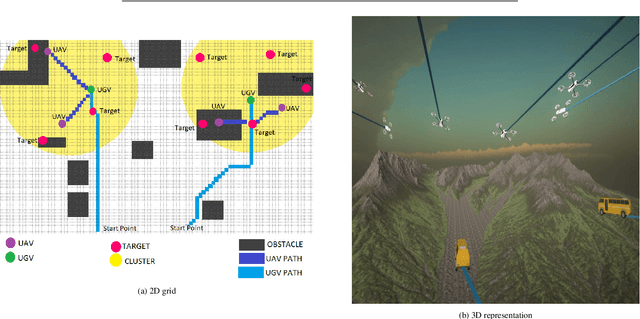

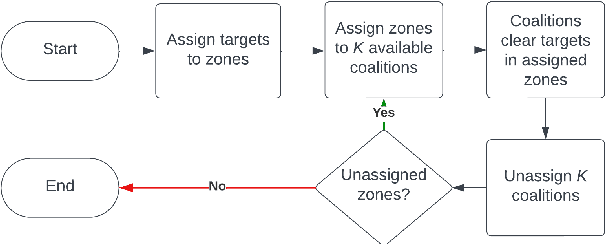

One of the most critical applications undertaken by coalitions of Unmanned Aerial Vehicles (UAVs) and Unmanned Ground Vehicles (UGVs) is reaching predefined targets by following the most time-efficient routes while avoiding collisions. Unfortunately, UAVs are hampered by limited battery life, and UGVs face challenges in reachability due to obstacles and elevation variations. Existing literature primarily focuses on one-to-one coalitions, which constrains the efficiency of reaching targets. In this work, we introduce a novel approach for a UAV-UGV coalition with a variable number of vehicles, employing a modified mean-shift clustering algorithm to segment targets into multiple zones. Each vehicle utilizes Multi-agent Deep Deterministic Policy Gradient (MADDPG) and Multi-agent Proximal Policy Optimization (MAPPO), two advanced reinforcement learning algorithms, to form an effective coalition for navigating obstructed environments without collisions. This approach of assigning targets to various circular zones, based on density and range, significantly reduces the time required to reach these targets. Moreover, introducing variability in the number of UAVs and UGVs in a coalition enhances task efficiency by enabling simultaneous multi-target engagement. The results of our experimental evaluation demonstrate that our proposed method substantially surpasses current state-of-the-art techniques, nearly doubling efficiency in terms of target navigation time and task completion rate.