 Add to Chrome
 Add to Firefox
 Add to Edge
Deep Learning Architectures for FSCV, a Comparison
Dec 05, 2022
We examined multiple deep neural network (DNN) architectures for suitability in predicting neurotransmitter concentrations from labeled in vitro fast scan cyclic voltammetry (FSCV) data collected on carbon fiber electrodes. Suitability is determined by the predictive performance in the "out-of-probe" case, the response to artificially induced electrical noise, and the ability to predict when the model will be errant for a given probe. This work extends prior comparisons of time series classification models by focusing on this specific task. It extends previous applications of machine learning to FSCV task by using a much larger data set and by incorporating recent advancements in deep neural networks. The InceptionTime architecture, a deep convolutional neural network, has the best absolute predictive performance of the models tested but was more susceptible to noise. A naive multilayer perceptron architecture had the second lowest prediction error and was less affected by the artificial noise, suggesting that convolutions may not be as important for this task as one might suspect.

Monte Carlo Planning method estimates planning horizons during interactive social exchange
May 26, 2015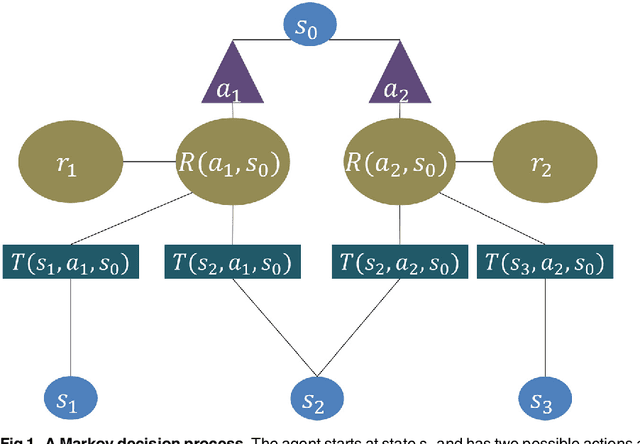
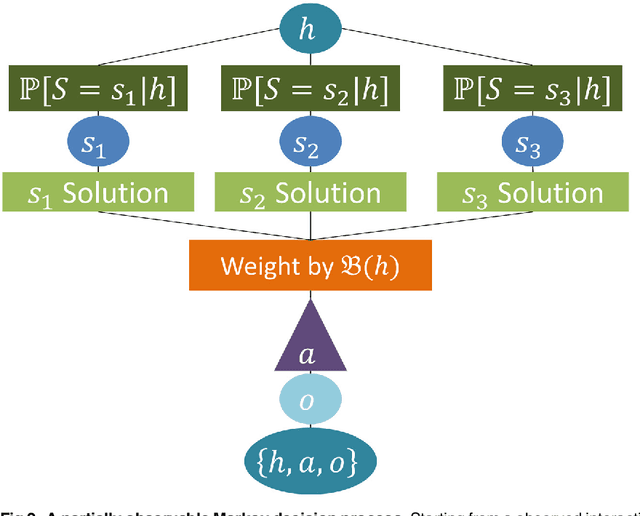
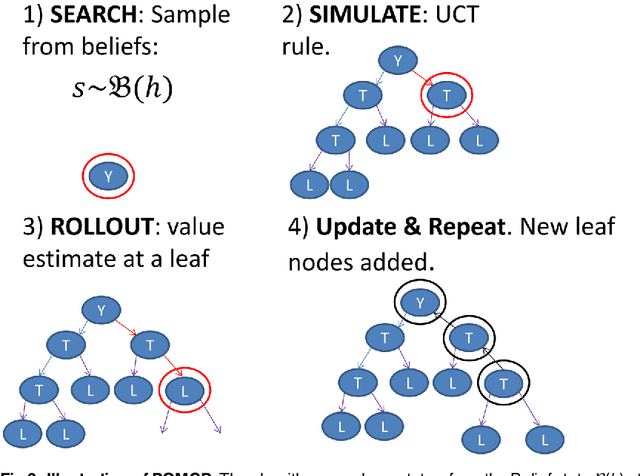
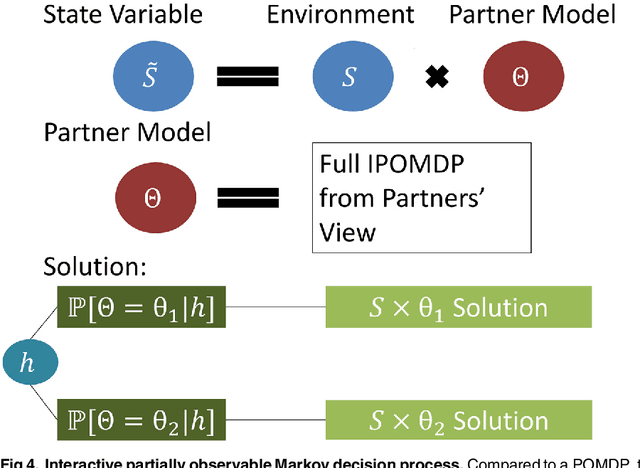
Reciprocating interactions represent a central feature of all human exchanges. They have been the target of various recent experiments, with healthy participants and psychiatric populations engaging as dyads in multi-round exchanges such as a repeated trust task. Behaviour in such exchanges involves complexities related to each agent's preference for equity with their partner, beliefs about the partner's appetite for equity, beliefs about the partner's model of their partner, and so on. Agents may also plan different numbers of steps into the future. Providing a computationally precise account of the behaviour is an essential step towards understanding what underlies choices. A natural framework for this is that of an interactive partially observable Markov decision process (IPOMDP). However, the various complexities make IPOMDPs inordinately computationally challenging. Here, we show how to approximate the solution for the multi-round trust task using a variant of the Monte-Carlo tree search algorithm. We demonstrate that the algorithm is efficient and effective, and therefore can be used to invert observations of behavioural choices. We use generated behaviour to elucidate the richness and sophistication of interactive inference.