 Add to Chrome
 Add to Firefox
 Add to Edge
Adversarial Attacks on Deep Neural Networks for Time Series Classification
Mar 17, 2019
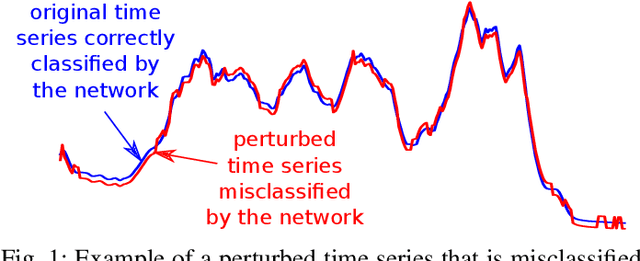
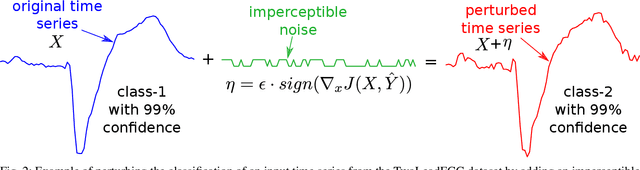
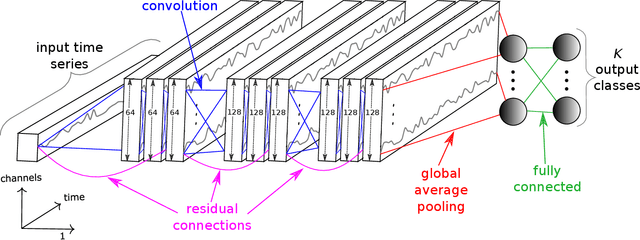
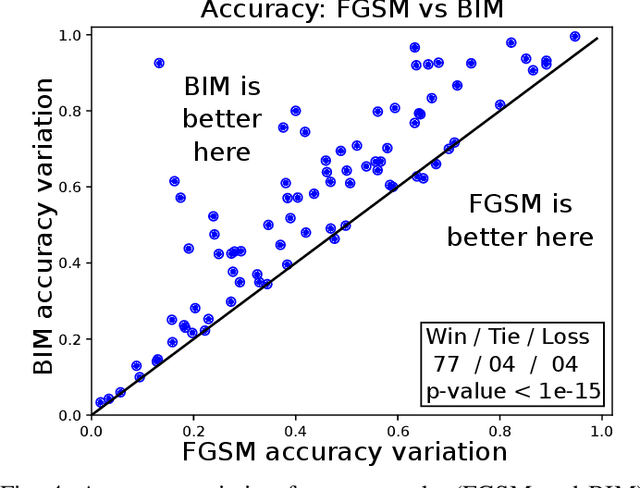
Time Series Classification (TSC) problems are encountered in many real life data mining tasks ranging from medicine and security to human activity recognition and food safety. With the recent success of deep neural networks in various domains such as computer vision and natural language processing, researchers started adopting these techniques for solving time series data mining problems. However, to the best of our knowledge, no previous work has considered the vulnerability of deep learning models to adversarial time series examples, which could potentially make them unreliable in situations where the decision taken by the classifier is crucial such as in medicine and security. For computer vision problems, such attacks have been shown to be very easy to perform by altering the image and adding an imperceptible amount of noise to trick the network into wrongly classifying the input image. Following this line of work, we propose to leverage existing adversarial attack mechanisms to add a special noise to the input time series in order to decrease the network's confidence when classifying instances at test time. Our results reveal that current state-of-the-art deep learning time series classifiers are vulnerable to adversarial attacks which can have major consequences in multiple domains such as food safety and quality assurance.

Deep Neural Network Ensembles for Time Series Classification
Mar 15, 2019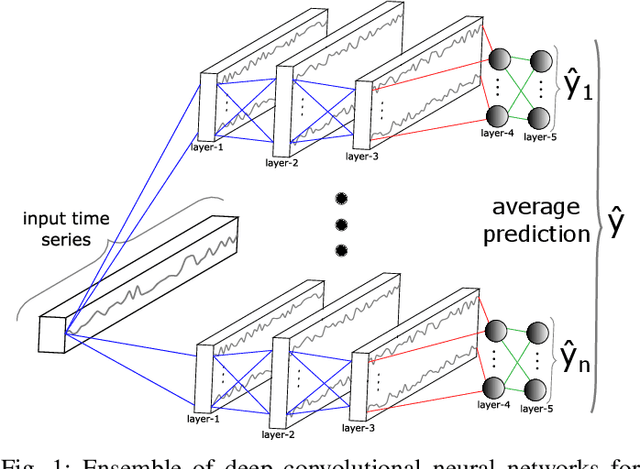
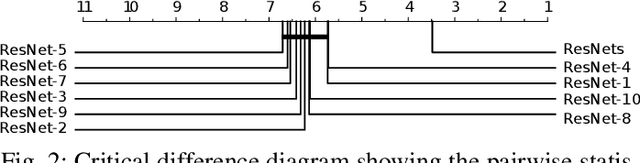
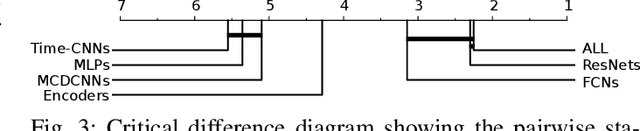
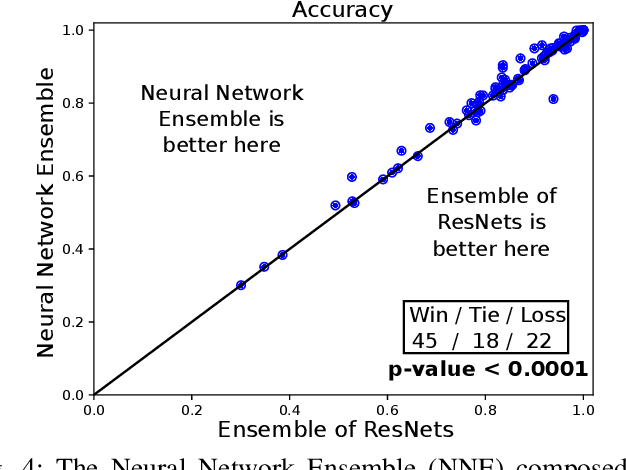
Deep neural networks have revolutionized many fields such as computer vision and natural language processing. Inspired by this recent success, deep learning started to show promising results for Time Series Classification (TSC). However, neural networks are still behind the state-of-the-art TSC algorithms, that are currently composed of ensembles of 37 non deep learning based classifiers. We attribute this gap in performance due to the lack of neural network ensembles for TSC. Therefore in this paper, we show how an ensemble of 60 deep learning models can significantly improve upon the current state-of-the-art performance of neural networks for TSC, when evaluated over the UCR/UEA archive: the largest publicly available benchmark for time series analysis. Finally, we show how our proposed Neural Network Ensemble (NNE) is the first time series classifier to outperform COTE while reaching similar performance to the current state-of-the-art ensemble HIVE-COTE.