 Add to Chrome
 Add to Firefox
 Add to Edge
Discounted Cuts: A Stackelberg Approach to Network Disruption
Nov 13, 2025

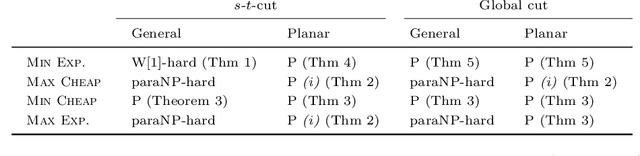
We study a Stackelberg variant of the classical Most Vital Links problem, modeled as a one-round adversarial game between an attacker and a defender. The attacker strategically removes up to $k$ edges from a flow network to maximally disrupt flow between a source $s$ and a sink $t$, after which the defender optimally reroutes the remaining flow. To capture this attacker--defender interaction, we introduce a new mathematical model of discounted cuts, in which the cost of a cut is evaluated by excluding its $k$ most expensive edges. This model generalizes the Most Vital Links problem and uncovers novel algorithmic and complexity-theoretic properties. We develop a unified algorithmic framework for analyzing various forms of discounted cut problems, including minimizing or maximizing the cost of a cut under discount mechanisms that exclude either the $k$ most expensive or the $k$ cheapest edges. While most variants are NP-complete on general graphs, our main result establishes polynomial-time solvability for all discounted cut problems in our framework when the input is restricted to bounded-genus graphs, a relevant class that includes many real-world networks such as transportation and infrastructure networks. With this work, we aim to open collaborative bridges between artificial intelligence, algorithmic game theory, and operations research.

Leveraging Fixed-Parameter Tractability for Robot Inspection Planning
Jun 28, 2024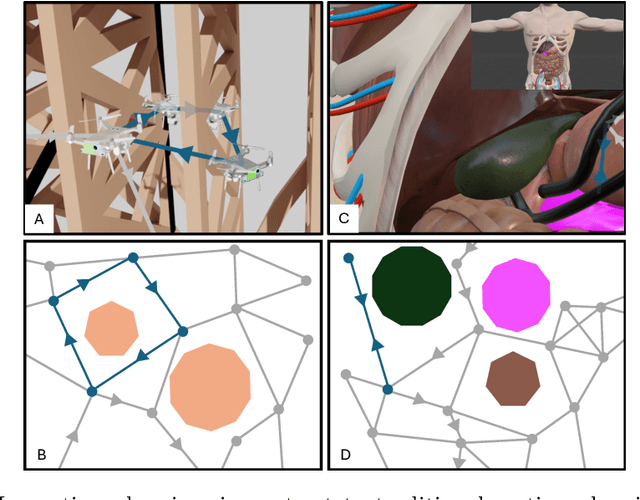
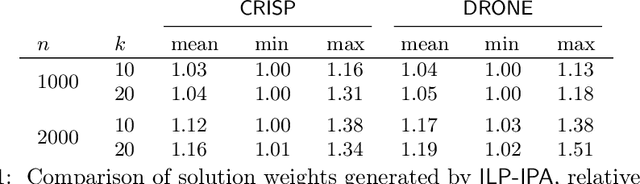
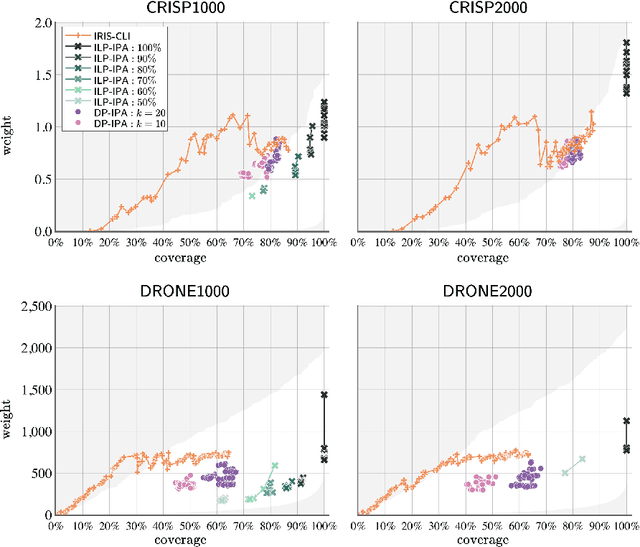
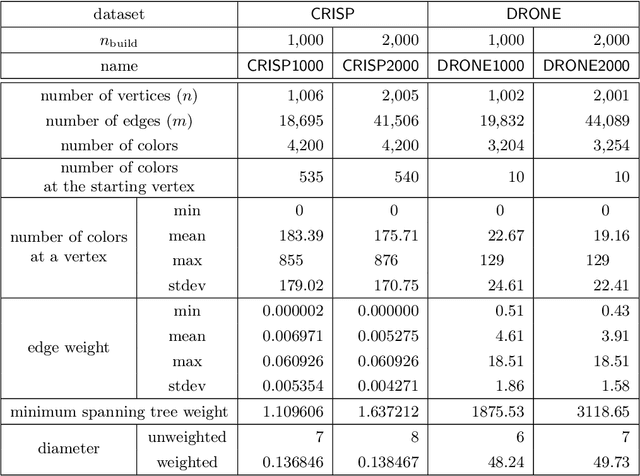
Autonomous robotic inspection, where a robot moves through its environment and inspects points of interest, has applications in industrial settings, structural health monitoring, and medicine. Planning the paths for a robot to safely and efficiently perform such an inspection is an extremely difficult algorithmic challenge. In this work we consider an abstraction of the inspection planning problem which we term Graph Inspection. We give two exact algorithms for this problem, using dynamic programming and integer linear programming. We analyze the performance of these methods, and present multiple approaches to achieve scalability. We demonstrate significant improvement both in path weight and inspection coverage over a state-of-the-art approach on two robotics tasks in simulation, a bridge inspection task by a UAV and a surgical inspection task using a medical robot.