 Add to Chrome
 Add to Firefox
 Add to Edge
Automating Clinical Information Retrieval from Finnish Electronic Health Records Using Large Language Models
Mar 27, 2026
Clinicians often need to retrieve patient-specific information from electronic health records (EHRs), a task that is time-consuming and error-prone. We present a locally deployable Clinical Contextual Question Answering (CCQA) framework that answers clinical questions directly from EHRs without external data transfer. Open-source large language models (LLMs) ranging from 4B to 70B parameters were benchmarked under fully offline conditions using 1,664 expert-annotated question-answer pairs derived from records of 183 patients. The dataset consisted predominantly of Finnish clinical text. In free-text generation, Llama-3.1-70B achieved 95.3% accuracy and 97.3% consistency across semantically equivalent question variants, while the smaller Qwen3-30B-A3B-2507 model achieved comparable performance. In a multiple-choice setting, models showed similar accuracy but variable calibration. Low-precision quantization (4-bit and 8-bit) preserved predictive performance while reducing GPU memory requirements and improving deployment feasibility. Clinical evaluation identified clinically significant errors in 2.9% of outputs, and semantically equivalent questions occasionally yielded discordant responses, including instances where one formulation was correct and the other contained a clinically significant error (0.96% of cases). These findings demonstrate that locally hosted open-source LLMs can accurately retrieve patient-specific information from EHRs using natural-language queries, while highlighting the need for validation and human oversight in clinical deployment.

Rician Denoising Diffusion Probabilistic Models For Sodium Breast MRI Enhancement
Oct 15, 2024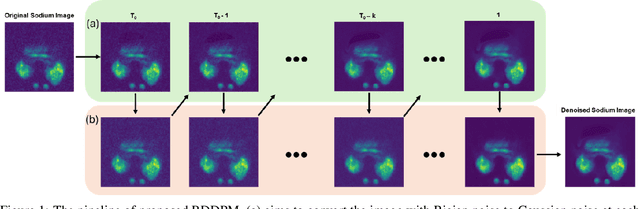
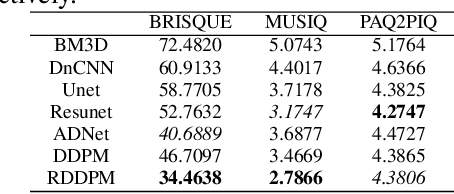
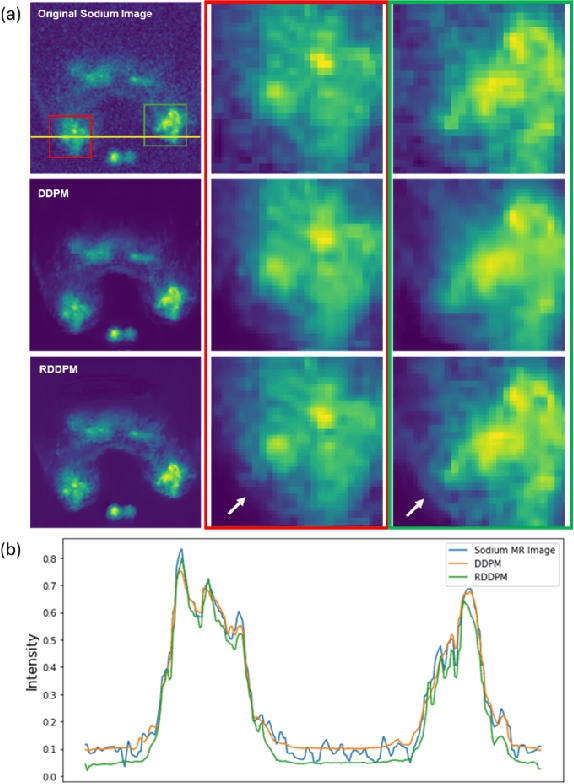
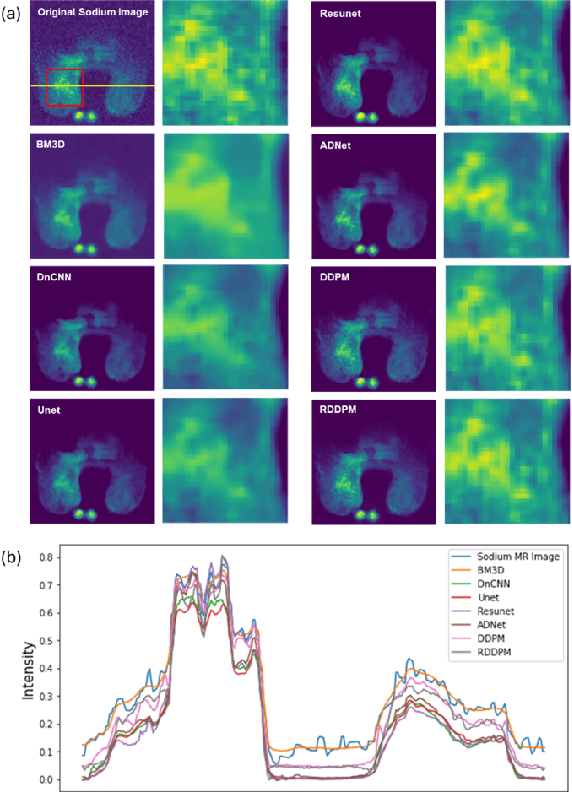
Sodium MRI is an imaging technique used to visualize and quantify sodium concentrations in vivo, playing a role in many biological processes and potentially aiding in breast cancer characterization. Sodium MRI, however, suffers from inherently low signal-to-noise ratios (SNR) and spatial resolution, compared with conventional proton MRI. A deep-learning method, the Denoising Diffusion Probabilistic Models (DDPM), has demonstrated success across a wide range of denoising tasks, yet struggles with sodium MRI's unique noise profile, as DDPM primarily targets Gaussian noise. DDPM can distort features when applied to sodium MRI. This paper advances the DDPM by introducing the Rician Denoising Diffusion Probabilistic Models (RDDPM) for sodium MRI denoising. RDDPM converts Rician noise to Gaussian noise at each timestep during the denoising process. The model's performance is evaluated using three non-reference image quality assessment metrics, where RDDPM consistently outperforms DDPM and other CNN-based denoising methods.
A Deep-Learning-Based Label-free No-Reference Image Quality Assessment Metric: Application in Sodium MRI Denoising
Sep 02, 2024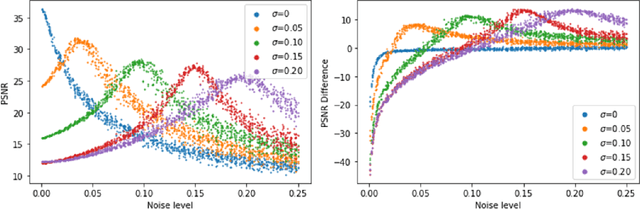
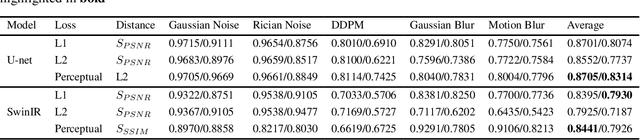
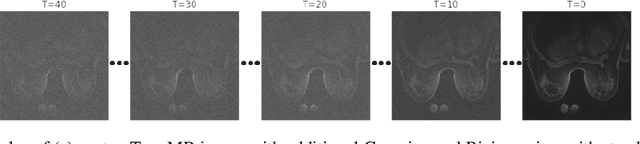
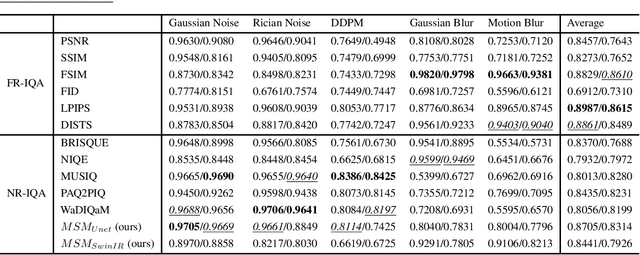
New multinuclear MRI techniques, such as sodium MRI, generally suffer from low image quality due to an inherently low signal. Postprocessing methods, such as image denoising, have been developed for image enhancement. However, the assessment of these enhanced images is challenging especially considering when there is a lack of high resolution and high signal images as reference, such as in sodium MRI. No-reference Image Quality Assessment (NR-IQA) metrics are approaches to solve this problem. Existing learning-based NR-IQA metrics rely on labels derived from subjective human opinions or metrics like Signal-to-Noise Ratio (SNR), which are either time-consuming or lack accurate ground truths, resulting in unreliable assessment. We note that deep learning (DL) models have a unique characteristic in that they are specialized to a characteristic training set, meaning that deviations between the input testing data from the training data will reduce prediction accuracy. Therefore, we propose a novel DL-based NR-IQA metric, the Model Specialization Metric (MSM), which does not depend on ground-truth images or labels. MSM measures the difference between the input image and the model's prediction for evaluating the quality of the input image. Experiments conducted on both simulated distorted proton T1-weighted MR images and denoised sodium MR images demonstrate that MSM exhibits a superior evaluation performance on various simulated noises and distortions. MSM also has a substantial agreement with the expert evaluations, achieving an averaged Cohen's Kappa coefficient of 0.6528, outperforming the existing NR-IQA metrics.