 Add to Chrome
 Add to Firefox
 Add to Edge
TANGCO: Learning Topology-Aware Capacity Allocation for Overload-driven Cascading Failures
Aug 13, 2026
Networked systems, from power grids to traffic networks and cloud clusters, carry loads across nodes with limited capacity. A node whose load exceeds its capacity fails and sheds its load onto its neighbors, which can trigger a system-wide cascade. We study how to allocate a fixed capacity budget across nodes to resist these cascades under local load redistribution. The problem is difficult because no optimal allocation is known, and the fail-or-survive objective is non-differentiable and piecewise constant, so exact and gradient-based optimization methods do not directly apply. We introduce TANGCO (Topology-Aware Neural Graph-Guided Capacity Optimization), which uses a graph neural network policy trained through the cascade simulator with policy-gradient learning and a heuristic anchor. We evaluate TANGCO on five synthetic graph families and five real networks spanning power, road, air, and Internet topologies. The learned policy improves on the best of four hand-designed heuristics in all 450 synthetic instances and in 40 of 45 real-network conditions, with robustness gains ranging from 1.6% to 246%. The learned policies transfer to unseen graphs within a family and partially across related topologies, and TANGCO$^{pre}$, pre-trained on synthetic graphs, matches per-network training on unseen real networks. Training scales near-linearly with graph size, and TANGCO$^{pre}$ allocates on a new network with no per-target training, matching the deployment cost of a hand-designed heuristic. Free-vector variants without the GNN, stay close to the heuristics, so the graph representation carries the gain beyond numerical search. Finally, analysis of the learned allocations identifies when local risk is sufficient, leads to an improved closed-form heuristic, and reveals the regimes where a topology-aware learned policy remains necessary.

Cost-aware LLM-based Online Dataset Annotation
May 21, 2025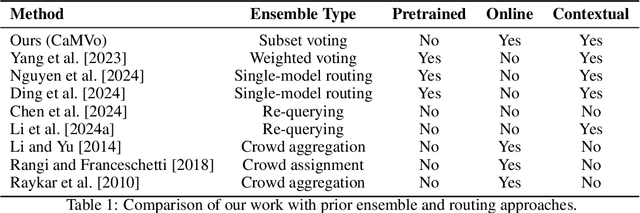
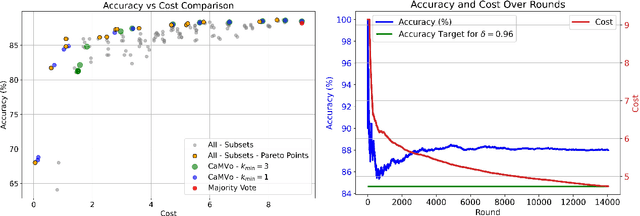
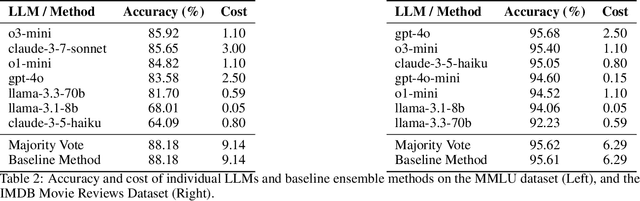
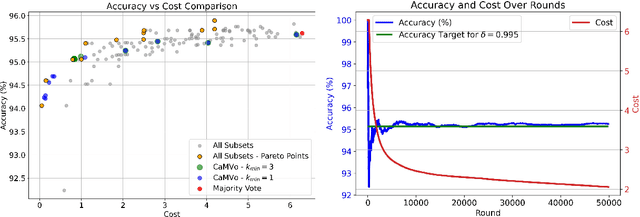
Recent advances in large language models (LLMs) have enabled automated dataset labeling with minimal human supervision. While majority voting across multiple LLMs can improve label reliability by mitigating individual model biases, it incurs high computational costs due to repeated querying. In this work, we propose a novel online framework, Cost-aware Majority Voting (CaMVo), for efficient and accurate LLM-based dataset annotation. CaMVo adaptively selects a subset of LLMs for each data instance based on contextual embeddings, balancing confidence and cost without requiring pre-training or ground-truth labels. Leveraging a LinUCB-based selection mechanism and a Bayesian estimator over confidence scores, CaMVo estimates a lower bound on labeling accuracy for each LLM and aggregates responses through weighted majority voting. Our empirical evaluation on the MMLU and IMDB Movie Review datasets demonstrates that CaMVo achieves comparable or superior accuracy to full majority voting while significantly reducing labeling costs. This establishes CaMVo as a practical and robust solution for cost-efficient annotation in dynamic labeling environments.
Bandits with Anytime Knapsacks
Jan 30, 2025
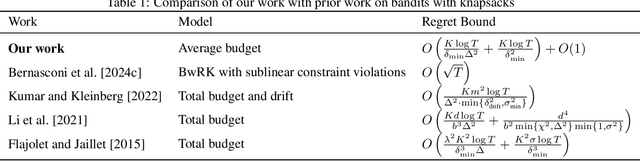


We consider bandits with anytime knapsacks (BwAK), a novel version of the BwK problem where there is an \textit{anytime} cost constraint instead of a total cost budget. This problem setting introduces additional complexities as it mandates adherence to the constraint throughout the decision-making process. We propose SUAK, an algorithm that utilizes upper confidence bounds to identify the optimal mixture of arms while maintaining a balance between exploration and exploitation. SUAK is an adaptive algorithm that strategically utilizes the available budget in each round in the decision-making process and skips a round when it is possible to violate the anytime cost constraint. In particular, SUAK slightly under-utilizes the available cost budget to reduce the need for skipping rounds. We show that SUAK attains the same problem-dependent regret upper bound of $ O(K \log T)$ established in prior work under the simpler BwK framework. Finally, we provide simulations to verify the utility of SUAK in practical settings.
FedSPD: A Soft-clustering Approach for Personalized Decentralized Federated Learning
Oct 24, 2024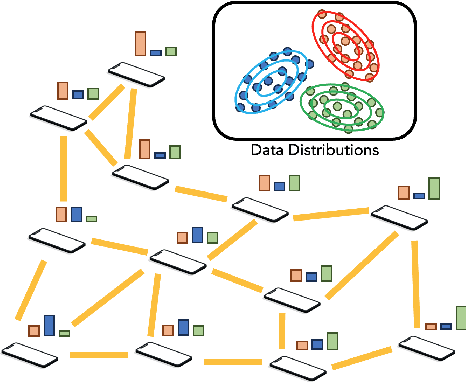
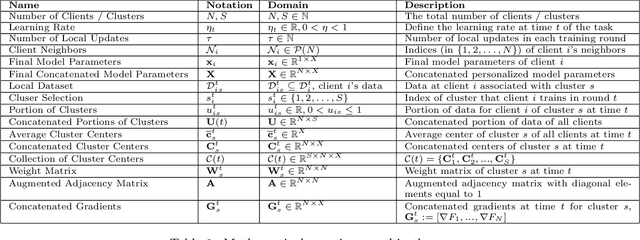
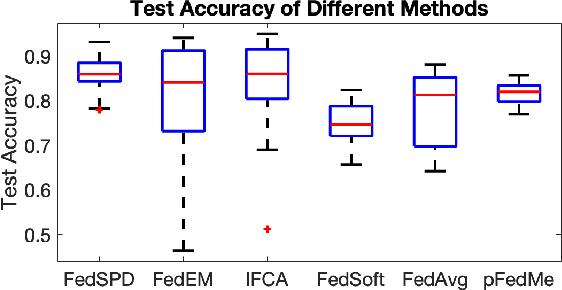

Federated learning has recently gained popularity as a framework for distributed clients to collaboratively train a machine learning model using local data. While traditional federated learning relies on a central server for model aggregation, recent advancements adopt a decentralized framework, enabling direct model exchange between clients and eliminating the single point of failure. However, existing decentralized frameworks often assume all clients train a shared model. Personalizing each client's model can enhance performance, especially with heterogeneous client data distributions. We propose FedSPD, an efficient personalized federated learning algorithm for the decentralized setting, and show that it learns accurate models even in low-connectivity networks. To provide theoretical guarantees on convergence, we introduce a clustering-based framework that enables consensus on models for distinct data clusters while personalizing to unique mixtures of these clusters at different clients. This flexibility, allowing selective model updates based on data distribution, substantially reduces communication costs compared to prior work on personalized federated learning in decentralized settings. Experimental results on real-world datasets show that FedSPD outperforms multiple decentralized variants of personalized federated learning algorithms, especially in scenarios with low-connectivity networks.