 Add to Chrome
 Add to Firefox
 Add to Edge
Digging Deeper: Learning Multi-Level Concept Hierarchies
Mar 10, 2026
Although concept-based models promise interpretability by explaining predictions with human-understandable concepts, they typically rely on exhaustive annotations and treat concepts as flat and independent. To circumvent this, recent work has introduced Hierarchical Concept Embedding Models (HiCEMs) to explicitly model concept relationships, and Concept Splitting to discover sub-concepts using only coarse annotations. However, both HiCEMs and Concept Splitting are restricted to shallow hierarchies. We overcome this limitation with Multi-Level Concept Splitting (MLCS), which discovers multi-level concept hierarchies from only top-level supervision, and Deep-HiCEMs, an architecture that represents these discovered hierarchies and enables interventions at multiple levels of abstraction. Experiments across multiple datasets show that MLCS discovers human-interpretable concepts absent during training and that Deep-HiCEMs maintain high accuracy while supporting test-time concept interventions that can improve task performance.

Hierarchical Concept-based Interpretable Models
Feb 27, 2026Modern deep neural networks remain challenging to interpret due to the opacity of their latent representations, impeding model understanding, debugging, and debiasing. Concept Embedding Models (CEMs) address this by mapping inputs to human-interpretable concept representations from which tasks can be predicted. Yet, CEMs fail to represent inter-concept relationships and require concept annotations at different granularities during training, limiting their applicability. In this paper, we introduce Hierarchical Concept Embedding Models (HiCEMs), a new family of CEMs that explicitly model concept relationships through hierarchical structures. To enable HiCEMs in real-world settings, we propose Concept Splitting, a method for automatically discovering finer-grained sub-concepts from a pretrained CEM's embedding space without requiring additional annotations. This allows HiCEMs to generate fine-grained explanations from limited concept labels, reducing annotation burdens. Our evaluation across multiple datasets, including a user study and experiments on PseudoKitchens, a newly proposed concept-based dataset of 3D kitchen renders, demonstrates that (1) Concept Splitting discovers human-interpretable sub-concepts absent during training that can be used to train highly accurate HiCEMs, and (2) HiCEMs enable powerful test-time concept interventions at different granularities, leading to improved task accuracy.
Enhancing the Security & Privacy of Wearable Brain-Computer Interfaces
Jan 19, 2022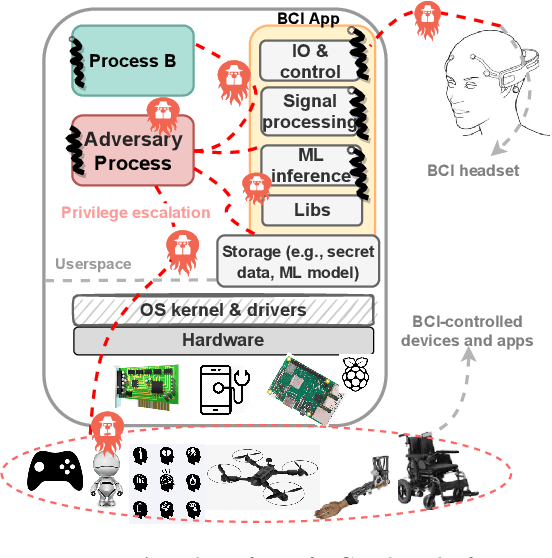
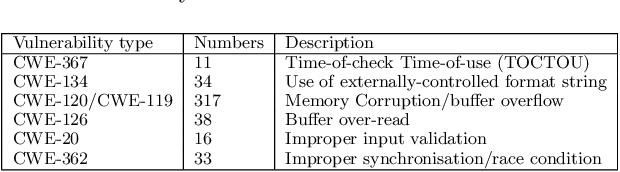
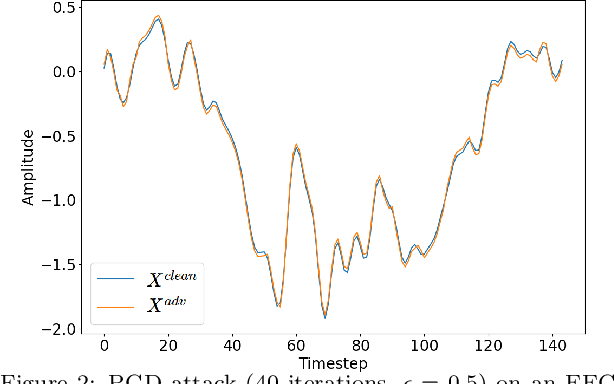
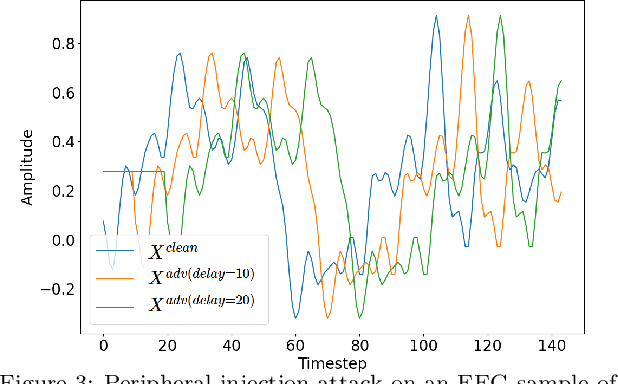
Brain computing interfaces (BCI) are used in a plethora of safety/privacy-critical applications, ranging from healthcare to smart communication and control. Wearable BCI setups typically involve a head-mounted sensor connected to a mobile device, combined with ML-based data processing. Consequently, they are susceptible to a multiplicity of attacks across the hardware, software, and networking stacks used that can leak users' brainwave data or at worst relinquish control of BCI-assisted devices to remote attackers. In this paper, we: (i) analyse the whole-system security and privacy threats to existing wearable BCI products from an operating system and adversarial machine learning perspective; and (ii) introduce Argus, the first information flow control system for wearable BCI applications that mitigates these attacks. Argus' domain-specific design leads to a lightweight implementation on Linux ARM platforms suitable for existing BCI use-cases. Our proof of concept attacks on real-world BCI devices (Muse, NeuroSky, and OpenBCI) led us to discover more than 300 vulnerabilities across the stacks of six major attack vectors. Our evaluation shows Argus is highly effective in tracking sensitive dataflows and restricting these attacks with an acceptable memory and performance overhead (<15%).