 Add to Chrome
 Add to Firefox
 Add to Edge
Bootstrapping Audiovisual Speech Recognition in Zero-AV-Resource Scenarios with Synthetic Visual Data
Mar 09, 2026
Audiovisual speech recognition (AVSR) combines acoustic and visual cues to improve transcription robustness under challenging conditions but remains out of reach for most under-resourced languages due to the lack of labeled video corpora for training. We propose a zero-AV-resource AVSR framework that relies on synthetic visual streams generated by lip-syncing static facial images with real audio. We first evaluate synthetic visual augmentation on Spanish benchmarks, then apply it to Catalan, a language with no annotated audiovisual corpora. We synthesize over 700 hours of talking-head video and fine-tune a pre-trained AV-HuBERT model. On a manually annotated Catalan benchmark, our model achieves near state-of-the-art performance with much fewer parameters and training data, outperforms an identically trained audio-only baseline, and preserves multimodal advantages in noise. Scalable synthetic video thus offers a viable substitute for real recordings in zero-AV-resource AVSR.

Quantifying Cross-Lingual Transfer in Paralinguistic Speech Tasks
Mar 09, 2026Paralinguistic speech tasks are often considered relatively language-agnostic, as they rely on extralinguistic acoustic cues rather than lexical content. However, prior studies report performance degradation under cross-lingual conditions, indicating non-negligible language dependence. Still, these studies typically focus on isolated language pairs or task-specific settings, limiting comparability and preventing a systematic assessment of task-level language dependence. We introduce the Cross-Lingual Transfer Matrix (CLTM), a systematic method to quantify cross-lingual interactions between pairs of languages within a given task. We apply the CLTM to two paralinguistic tasks, gender identification and speaker verification, using a multilingual HuBERT-based encoder, to analyze how donor-language data affects target-language performance during fine-tuning. Our results reveal distinct transfer patterns across tasks and languages, reflecting systematic, language-dependent effects.
Speech-to-Text Translation with Phoneme-Augmented CoT: Enhancing Cross-Lingual Transfer in Low-Resource Scenarios
May 30, 2025We propose a Speech-to-Text Translation (S2TT) approach that integrates phoneme representations into a Chain-of-Thought (CoT) framework to improve translation in low-resource and zero-resource settings. By introducing phoneme recognition as an intermediate step, we enhance cross-lingual transfer, enabling translation even for languages with no labeled speech data. Our system builds on a multilingual LLM, which we extend to process speech and phonemes. Training follows a curriculum learning strategy that progressively introduces more complex tasks. Experiments on multilingual S2TT benchmarks show that phoneme-augmented CoT improves translation quality in low-resource conditions and enables zero-resource translation, while slightly impacting high-resource performance. Despite this trade-off, our findings demonstrate that phoneme-based CoT is a promising step toward making S2TT more accessible across diverse languages.
Breaking Language Barriers in Visual Language Models via Multilingual Textual Regularization
Mar 28, 2025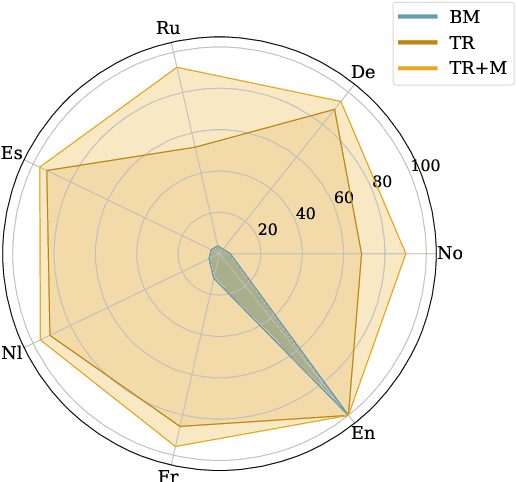
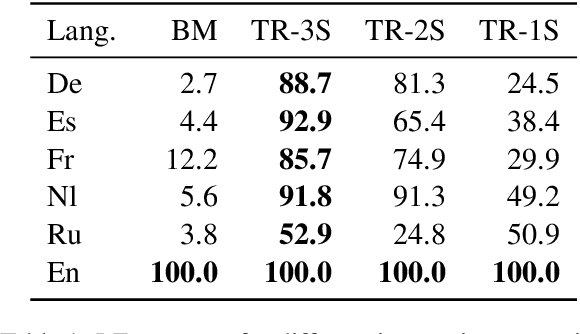
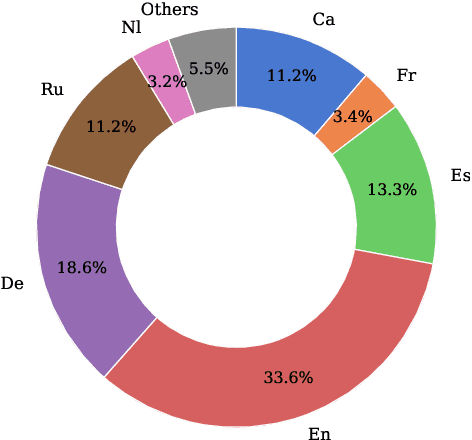
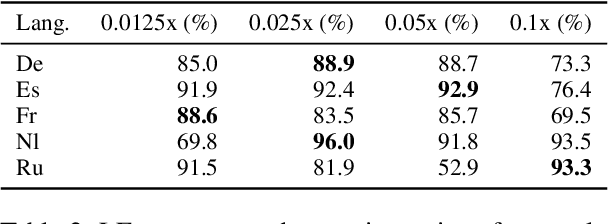
Rapid advancements in Visual Language Models (VLMs) have transformed multimodal understanding but are often constrained by generating English responses regardless of the input language. This phenomenon has been termed as Image-induced Fidelity Loss (IFL) and stems from limited multimodal multilingual training data. To address this, we propose a continuous multilingual integration strategy that injects text-only multilingual data during visual instruction tuning, preserving the language model's original multilingual capabilities. Extensive evaluations demonstrate that our approach significantly improves linguistic fidelity across languages without degradation in visual performance. We also explore model merging, which improves language fidelity but comes at the cost of visual performance. In contrast, our core method achieves robust multilingual alignment without trade-offs, offering a scalable and effective path to mitigating IFL for global VLM adoption.