 Add to Chrome
 Add to Firefox
 Add to Edge
Exploring Wavelet Transformations for Deep Learning-based Machine Condition Diagnosis
Aug 19, 2024
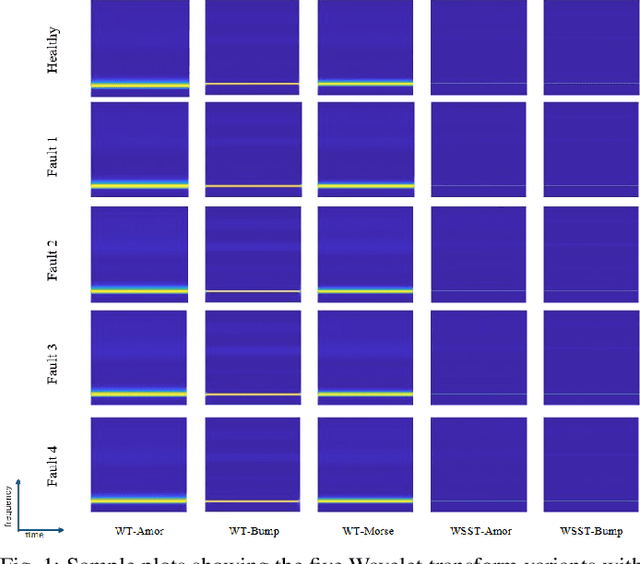
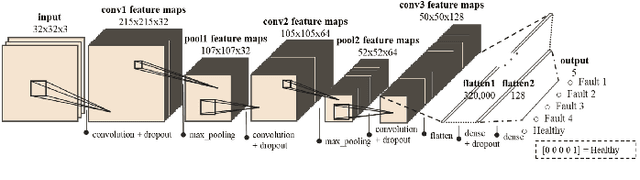


Deep learning (DL) strategies have recently been utilized to diagnose motor faults by simply analyzing motor phase current signals, offering a less costly and non-intrusive alternative to vibration sensors. This research transforms these time-series current signals into time-frequency 2D representations via Wavelet Transform (WT). The dataset for motor current signals includes 3,750 data points across five categories: one representing normal conditions and four representing artificially induced faults, each under five different load conditions: 0, 25, 50, 75, and 100%. The study employs five WT-based techniques: WT-Amor, WT-Bump, WT-Morse, WSST-Amor, and WSST-Bump. Subsequently, five DL models adopting prior Convolutional Neural Network (CNN) architecture were developed and tested using the transformed 2D plots from each method. The DL models for WT-Amor, WT-Bump, and WT-Morse showed remarkable effectiveness with peak model accuracy of 90.93, 89.20, and 93.73%, respectively, surpassing previous 2D-image-based methods that recorded accuracy of 80.25, 74.80, and 82.80% respectively using the identical dataset and validation protocol. Notably, the WT-Morse approach slightly exceeded the formerly highest ML technique, achieving a 93.20% accuracy. However, the two WSST methods that utilized synchrosqueezing techniques faced difficulty accurately classifying motor faults. The performance of Wavelet-based deep learning methods offers a compelling alternative for machine condition monitoring.

Deep Learning-based Machine Condition Diagnosis using Short-time Fourier Transformation Variants
Aug 19, 2024In motor condition diagnosis, electrical current signature serves as an alternative feature to vibration-based sensor data, which is a more expensive and invasive method. Machine learning (ML) techniques have been emerging in diagnosing motor conditions using only motor phase current signals. This study converts time-series motor current signals to time-frequency 2D plots using Short-time Fourier Transform (STFT) methods. The motor current signal dataset consists of 3,750 sample points with five classes - one healthy and four synthetically-applied motor fault conditions, and with five loading conditions: 0, 25, 50, 75, and 100%. Five transformation methods are used on the dataset: non-overlap and overlap STFTs, non-overlap and overlap realigned STFTs, and synchrosqueezed STFT. Then, deep learning (DL) models based on the previous Convolutional Neural Network (CNN) architecture are trained and validated from generated plots of each method. The DL models of overlap-STFT, overlap R-STFT, non-overlap STFT, non-overlap R-STFT, and synchrosqueezed-STFT performed exceptionally with an average accuracy of 97.65, 96.03, 96.08, 96.32, and 88.27%, respectively. Four methods outperformed the previous best ML method with 93.20% accuracy, while all five outperformed previous 2D-plot-based methods with accuracy of 80.25, 74.80, and 82.80%, respectively, using the same dataset, same DL architecture, and validation steps.
Data-driven Small-signal Modeling for Converter-based Power Systems
Aug 30, 2021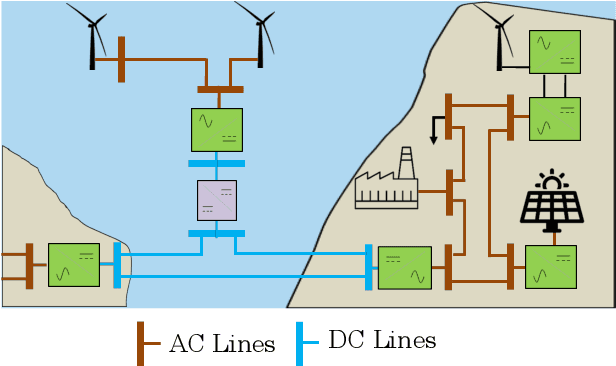
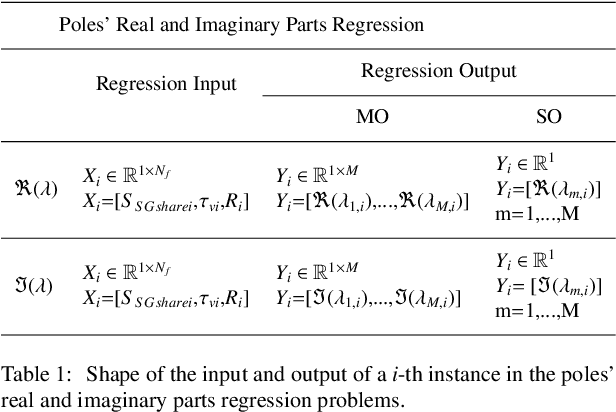
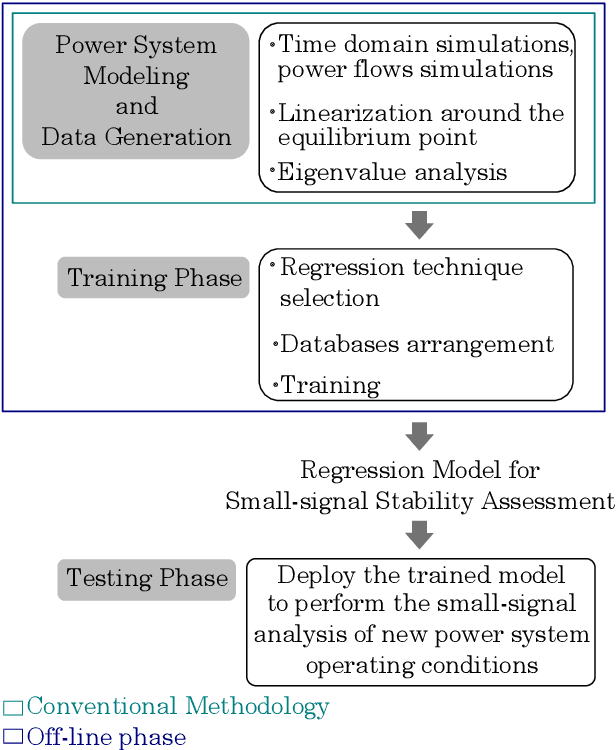
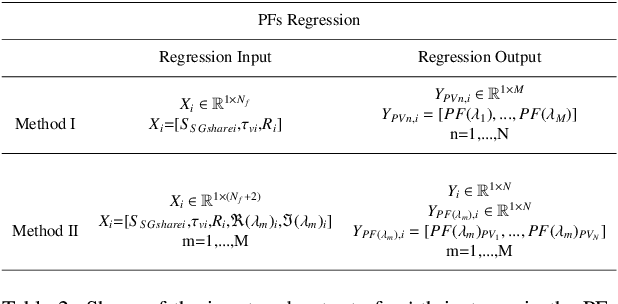
This article details a complete procedure to derive a data-driven small-signal-based model useful to perform converter-based power system related studies. To compute the model, Decision Tree (DT) regression, both using single DT and ensemble DT, and Spline regression have been employed and their performances have been compared, in terms of accuracy, training and computing time. The methodology includes a comprehensive step-by-step procedure to develop the model: data generation by conventional simulation and mathematical models, databases (DBs) arrangement, regression training and testing, realizing prediction for new instances. The methodology has been developed using an essential network and then tested on a more complex system, to show the validity and usefulness of the suggested approach. Both power systems test cases have the essential characteristics of converter-based power systems, simulating high penetration of converter interfaced generation and the presence of HVDC links. Moreover, it is proposed how to represent in a visual manner the results of the small-signal stability analysis for a wide range of system operating conditions, exploiting DT regressions. Finally, the possible applications of the model are discussed, highlighting the potential of the developed model in further power system small-signal related studies.