 Add to Chrome
 Add to Firefox
 Add to Edge
Policy-based Tuning of Autoregressive Image Models with Instance- and Distribution-Level Rewards
Mar 24, 2026
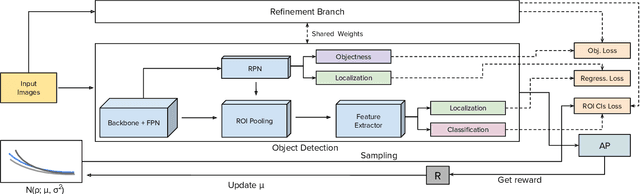
Autoregressive (AR) models are highly effective for image generation, yet their standard maximum-likelihood estimation training lacks direct optimization for sample quality and diversity. While reinforcement learning (RL) has been used to align diffusion models, these methods typically suffer from output diversity collapse. Similarly, concurrent RL methods for AR models rely strictly on instance-level rewards, often trading off distributional coverage for quality. To address these limitations, we propose a lightweight RL framework that casts token-based AR synthesis as a Markov Decision Process, optimized via Group Relative Policy Optimization (GRPO). Our core contribution is the introduction of a novel distribution-level Leave-One-Out FID (LOO-FID) reward; by leveraging an exponential moving average of feature moments, it explicitly encourages sample diversity and prevents mode collapse during policy updates. We integrate this with composite instance-level rewards (CLIP and HPSv2) for strict semantic and perceptual fidelity, and stabilize the multi-objective learning with an adaptive entropy regularization term. Extensive experiments on LlamaGen and VQGAN architectures demonstrate clear improvements across standard quality and diversity metrics within only a few hundred tuning iterations. The results also show that the model can be updated to produce competitive samples even without Classifier-Free Guidance, and bypass its 2x inference cost.

Meta-tuning Loss Functions and Data Augmentation for Few-shot Object Detection
Apr 24, 2023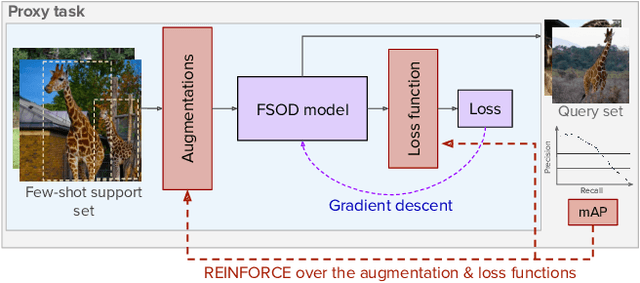


Few-shot object detection, the problem of modelling novel object detection categories with few training instances, is an emerging topic in the area of few-shot learning and object detection. Contemporary techniques can be divided into two groups: fine-tuning based and meta-learning based approaches. While meta-learning approaches aim to learn dedicated meta-models for mapping samples to novel class models, fine-tuning approaches tackle few-shot detection in a simpler manner, by adapting the detection model to novel classes through gradient based optimization. Despite their simplicity, fine-tuning based approaches typically yield competitive detection results. Based on this observation, we focus on the role of loss functions and augmentations as the force driving the fine-tuning process, and propose to tune their dynamics through meta-learning principles. The proposed training scheme, therefore, allows learning inductive biases that can boost few-shot detection, while keeping the advantages of fine-tuning based approaches. In addition, the proposed approach yields interpretable loss functions, as opposed to highly parametric and complex few-shot meta-models. The experimental results highlight the merits of the proposed scheme, with significant improvements over the strong fine-tuning based few-shot detection baselines on benchmark Pascal VOC and MS-COCO datasets, in terms of both standard and generalized few-shot performance metrics.
Semantics-driven Attentive Few-shot Learning over Clean and Noisy Samples
Jan 09, 2022


Over the last couple of years few-shot learning (FSL) has attracted great attention towards minimizing the dependency on labeled training examples. An inherent difficulty in FSL is the handling of ambiguities resulting from having too few training samples per class. To tackle this fundamental challenge in FSL, we aim to train meta-learner models that can leverage prior semantic knowledge about novel classes to guide the classifier synthesis process. In particular, we propose semantically-conditioned feature attention and sample attention mechanisms that estimate the importance of representation dimensions and training instances. We also study the problem of sample noise in FSL, towards the utilization of meta-learners in more realistic and imperfect settings. Our experimental results demonstrate the effectiveness of the proposed semantic FSL model with and without sample noise.