 Add to Chrome
 Add to Firefox
 Add to Edge
Optimal control of a swimming robot based on Purcell's microswimmer model
Aug 18, 2026
Purcell's swimmer is a well-known planar model of a swimming microorganism, governed by low Reynolds number hydrodynamics, which is comprised of three rigid links connected by actuated rotary joints. This model has been analyzed as a robotic locomotion system governed by first-order nonlinear dynamics with a periodic input (gait) of the two joint angles. In this work, we present a robotic macro-scale realization of this three-link swimmer moving in a highly viscous fluid. We propose a simple variant of Purcell's theoretical model with non-slender links and a central rigid sphere which represents the added drag of the robot's central flotation block, and calibrate the model's parameters to fit experimental measurements. Next, we apply optimal control formulation based on Pontryagin's Maximum Principle (PMP) in order to find optimal gaits that maximize the displacement per cycle under bounds on the joint angles. Employing a differential geometric method that transforms the problem to area integral enclosed by the gait trajectory in the plane of joint angles, enables visual interpretation which explains topological changes in displacement-optimal gaits upon varying the bound on the joint angles. We then apply PMP formulation to the problem of maximizing Lighthill's energy efficiency in order to obtain a boundary value problem (BVP) whose solution gives efficiency-optimal gaits for Purcell's swimmer model, as well as its variant with a central sphere. Finally, we utilize numerical methods such as parameterizing the input gait as a truncated Fourier series, as well as GPOPS-II solver, to produce sufficient initial guess values for solving the BVPs and obtaining efficiency-optimal gaits.

Geometric analysis of gaits and optimal control for three-link kinematic swimmers
Sep 14, 2021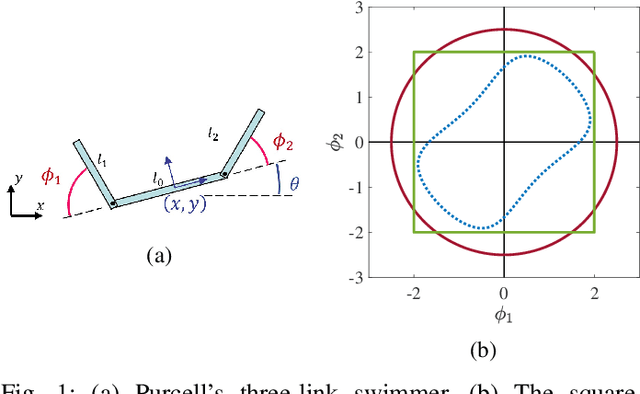
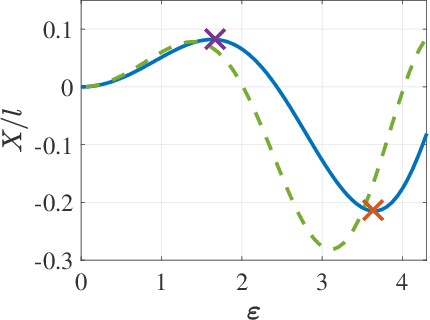
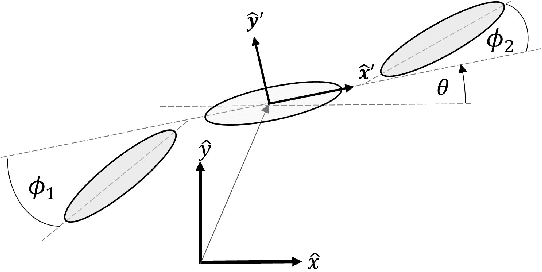
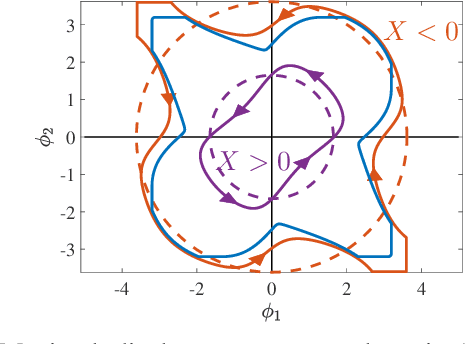
Many robotic systems locomote using gaits - periodic changes of internal shape, whose mechanical interaction with the robot`s environment generate characteristic net displacements. Prominent examples with two shape variables are the low Reynolds number 3-link "Purcell swimmer" with inputs of 2 joint angles and the "ideal fluid" swimmer. Gait analysis of these systems allows for intelligent decisions to be made about the swimmer`s locomotive properties, increasing the potential for robotic autonomy. In this work, we present comparative analysis of gait optimization using two different methods. The first method is variational approach of "Pontryagin`s maximum principle" (PMP) from optimal control theory. We apply PMP for several variants of 3-link swimmers, with and without incorporation of bounds on joint angles. The second method is differential-geometric analysis of the gaits based on curvature (total Lie bracket) of the local connection for 3-link swimmers. Using optimized body-motion coordinates, contour plots of the curvature in shape space gives visualization that enables identifying distance-optimal gaits as zero level sets. Combining and comparing results of the two methods enables better understanding of changes in existence, shape and topology of distance-optimal gait trajectories, depending on the swimmers' parameters.