 Add to Chrome
 Add to Firefox
 Add to Edge
An Analysis of Regularization and Fokker-Planck Residuals in Diffusion Models for Image Generation
Apr 16, 2026
Recent work has shown that diffusion models trained with the denoising score matching (DSM) objective often violate the Fokker--Planck (FP) equation that governs the evolution of the true data density. Directly penalizing these deviations in the objective function reduces their magnitude but introduces a significant computational overhead. It is also observed that enforcing strict adherence to the FP equation does not necessarily lead to improvements in the quality of the generated samples, as often the best results are obtained with weaker FP regularization. In this paper, we investigate whether simpler penalty terms can provide similar benefits. We empirically analyze several lightweight regularizers, study their effect on FP residuals and generation quality, and show that the benefits of FP regularization are available at substantially lower computational cost. Our code is available at https://github.com/OnnoNiemann/fp_diffusion_analysis.

Towards Comparable Knowledge Distillation in Semantic Image Segmentation
Sep 07, 2023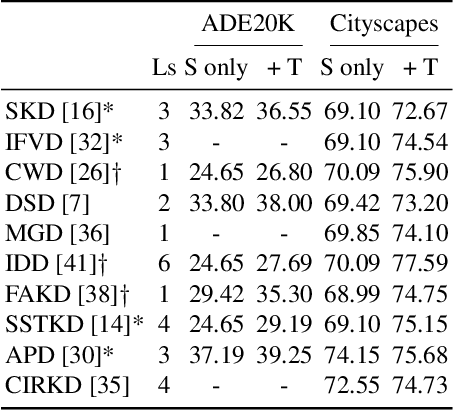
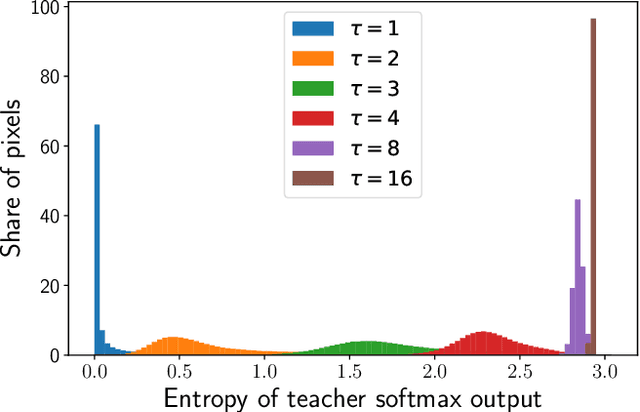
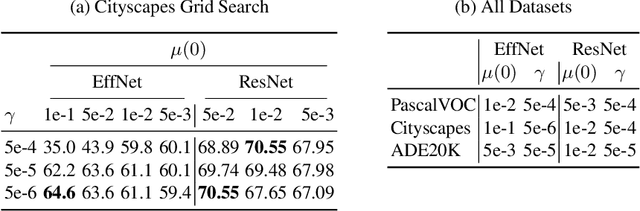
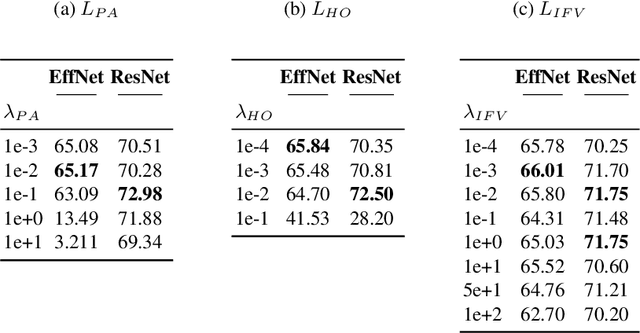
Knowledge Distillation (KD) is one proposed solution to large model sizes and slow inference speed in semantic segmentation. In our research we identify 25 proposed distillation loss terms from 14 publications in the last 4 years. Unfortunately, a comparison of terms based on published results is often impossible, because of differences in training configurations. A good illustration of this problem is the comparison of two publications from 2022. Using the same models and dataset, Structural and Statistical Texture Distillation (SSTKD) reports an increase of student mIoU of 4.54 and a final performance of 29.19, while Adaptive Perspective Distillation (APD) only improves student performance by 2.06 percentage points, but achieves a final performance of 39.25. The reason for such extreme differences is often a suboptimal choice of hyperparameters and a resulting underperformance of the student model used as reference point. In our work, we reveal problems of insufficient hyperparameter tuning by showing that distillation improvements of two widely accepted frameworks, SKD and IFVD, vanish when hyperparameters are optimized sufficiently. To improve comparability of future research in the field, we establish a solid baseline for three datasets and two student models and provide extensive information on hyperparameter tuning. We find that only two out of eight techniques can compete with our simple baseline on the ADE20K dataset.