 Add to Chrome
 Add to Firefox
 Add to Edge
Learning to Segment using Summary Statistics and Weak Supervision
May 04, 2026
Medical experts often manually segment images to obtain diagnostic statistics and discard the resulting annotations. We aim to train segmentation models to alleviate this burden, but constrained to the retained summary statistics (e.g., the area of the annotated region). Empirical results suggest that statistics alone are insufficient for this task, but adding weak information in the form of a few pixels within the area of interest significantly improves performance. We use a novel loss function that combines terms for image reconstruction quality, matching to summary statistics, and overlap between the predicted foreground and the weak supervisory signal. Experiments on standard image, ultrasound (breast cancer), and Computed Tomography (CT) scan (kidney tumors) data demonstrate the utility and potential of the approach.

Constrained Cohort Intelligence using Static and Dynamic Penalty Function Approach for Mechanical Components Design
Sep 26, 2016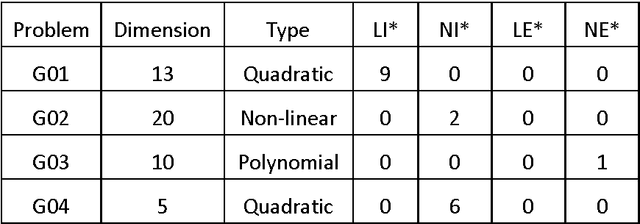
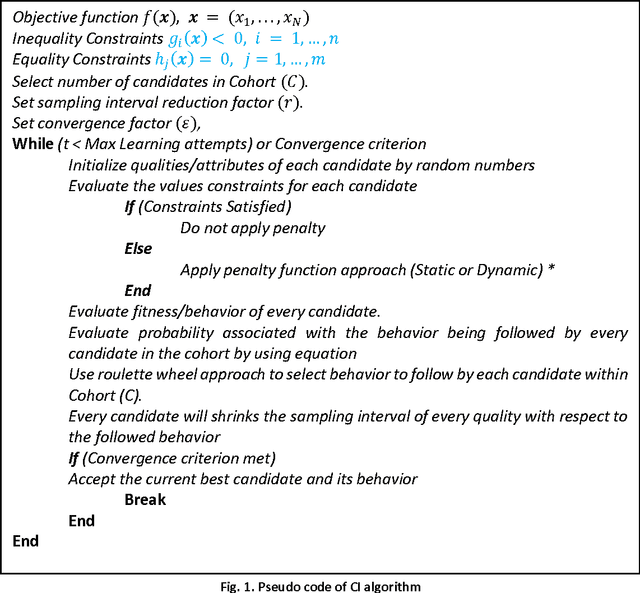
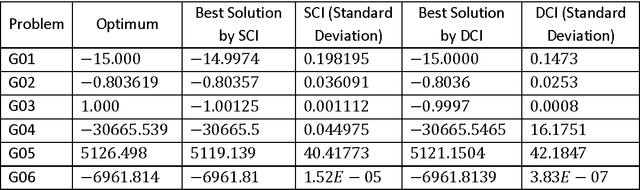
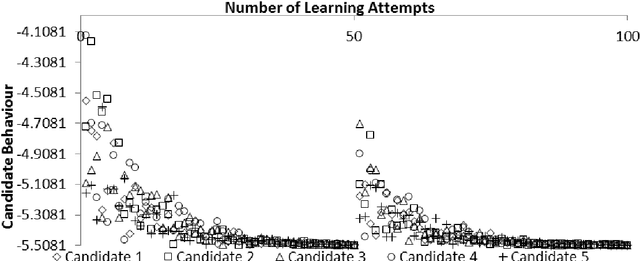
Most of the metaheuristics can efficiently solve unconstrained problems; however, their performance may degenerate if the constraints are involved. This paper proposes two constraint handling approaches for an emerging metaheuristic of Cohort Intelligence (CI). More specifically CI with static penalty function approach (SCI) and CI with dynamic penalty function approach (DCI) are proposed. The approaches have been tested by solving several constrained test problems. The performance of the SCI and DCI have been compared with algorithms like GA, PSO, ABC, d-Ds. In addition, as well as three real world problems from mechanical engineering domain with improved solutions. The results were satisfactory and validated the applicability of CI methodology for solving real world problems.