 Add to Chrome
 Add to Firefox
 Add to Edge
Introducing the structural bases of typicality effects in deep learning
Jul 07, 2021
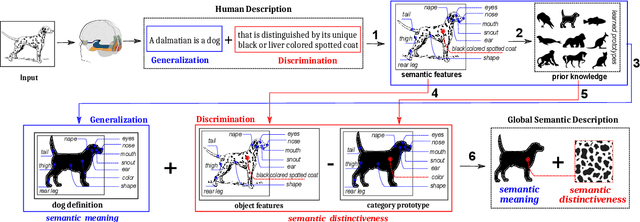
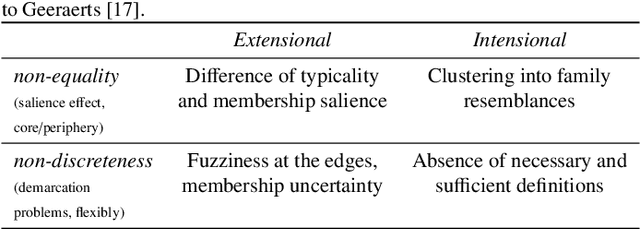
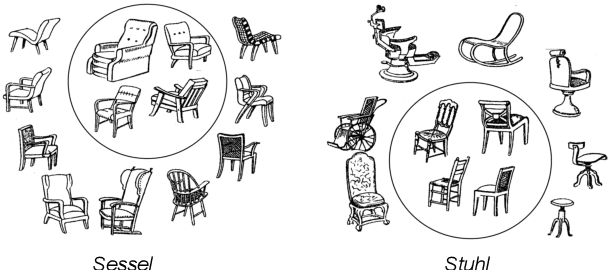
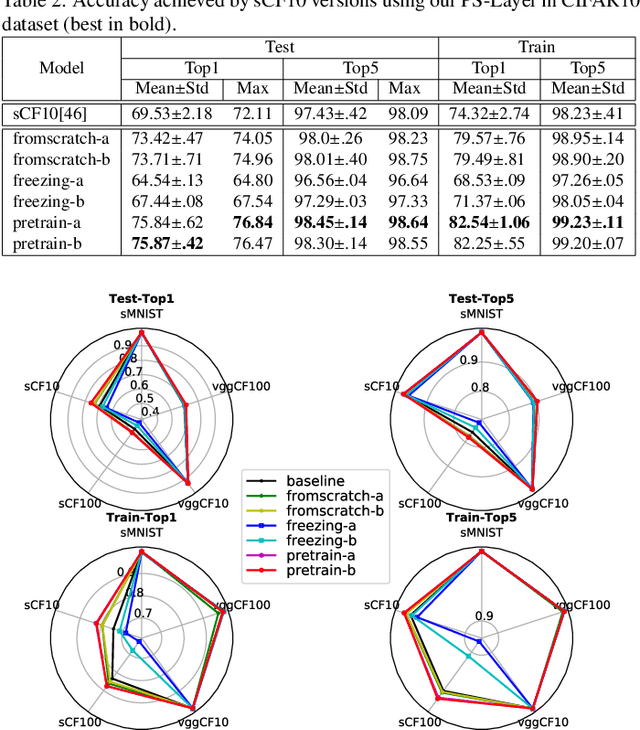
In this paper, we hypothesize that the effects of the degree of typicality in natural semantic categories can be generated based on the structure of artificial categories learned with deep learning models. Motivated by the human approach to representing natural semantic categories and based on the Prototype Theory foundations, we propose a novel Computational Prototype Model (CPM) to represent the internal structure of semantic categories. Unlike other prototype learning approaches, our mathematical framework proposes a first approach to provide deep neural networks with the ability to model abstract semantic concepts such as category central semantic meaning, typicality degree of an object's image, and family resemblance relationship. We proposed several methodologies based on the typicality's concept to evaluate our CPM-model in image semantic processing tasks such as image classification, a global semantic description, and transfer learning. Our experiments on different image datasets, such as ImageNet and Coco, showed that our approach might be an admissible proposition in the effort to endow machines with greater power of abstraction for the semantic representation of objects' categories.

Global Semantic Description of Objects based on Prototype Theory
Jun 08, 2019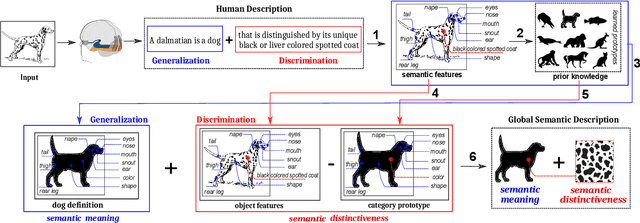


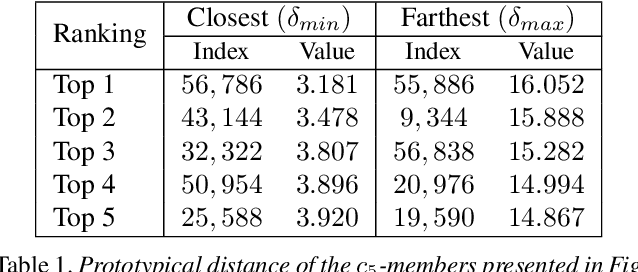
In this paper, we introduce a novel semantic description approach inspired on Prototype Theory foundations. We propose a Computational Prototype Model (CPM) that encodes and stores the central semantic meaning of objects category: the semantic prototype. Also, we introduce a Prototype-based Description Model that encodes the semantic meaning of an object while describing its features using our CPM model. Our description method uses semantic prototypes computed by CNN-classifications models to create discriminative signatures that describe an object highlighting its most distinctive features within the category. Our experiments show that: i) our CPM model (semantic prototype + distance metric) is able to describe the internal semantic structure of objects categories; ii) our semantic distance metric can be understood as the object visual typicality score within a category; iii) our descriptor encoding is semantically interpretable and significantly outperforms other image global encodings in clustering and classification tasks.
Prototypicality effects in global semantic description of objects
Mar 22, 2018


We introduce a new global semantic descriptor for objects based on the prototypicality effects of the Prototype Theory. Our descriptor encodes and stores the semantic meaning of the object's category while describing its features using the semantic prototype computed with CNN-classifications models. Our method uses semantic prototypes to create discriminative descriptor signatures while simulating the prototypicality organization within a given category. A dimensionality reduction function has been created to keep the semantic meaning within the signature of our descriptor. Our experiments showed that i) our descriptor preserved the semantic information used by the CNN-models for classification tasks and ii) our distance metric enables the simulation of the prototypicality organization.