 Add to Chrome
 Add to Firefox
 Add to Edge
Risk reversal for least squares estimators under nested convex constraints
Jan 22, 2026
In constrained stochastic optimization, one naturally expects that imposing a stricter feasible set does not increase the statistical risk of an estimator defined by projection onto that set. In this paper, we show that this intuition can fail even in canonical settings. We study the Gaussian sequence model, a deliberately austere test best, where for a compact, convex set $Θ\subset \mathbb{R}^d$ one observes \[ Y = θ^\star + σZ, \qquad Z \sim N(0, I_d), \] and seeks to estimate an unknown parameter $θ^\star \in Θ$. The natural estimator is the least squares estimator (LSE), which coincides with the Euclidean projection of $Y$ onto $Θ$. We construct an explicit example exhibiting \emph{risk reversal}: for sufficiently large noise, there exist nested compact convex sets $Θ_S \subset Θ_L$ and a parameter $θ^\star \in Θ_S$ such that the LSE constrained to $Θ_S$ has strictly larger risk than the LSE constrained to $Θ_L$. We further show that this phenomenon can persist at the level of worst-case risk, with the supremum risk over the smaller constraint set exceeding that over the larger one. We clarify this behavior by contrasting noise regimes. In the vanishing-noise limit, the risk admits a first-order expansion governed by the statistical dimension of the tangent cone at $θ^\star$, and tighter constraints uniformly reduce risk. In contrast, in the diverging-noise regime, the risk is determined by global geometric interactions between the constraint set and random noise directions. Here, the embedding of $Θ_S$ within $Θ_L$ can reverse the risk ordering. These results reveal a previously unrecognized failure mode of projection-based estimators: in sufficiently noisy settings, tightening a constraint can paradoxically degrade statistical performance.

Functional Multi-Reference Alignment via Deconvolution
Jun 13, 2025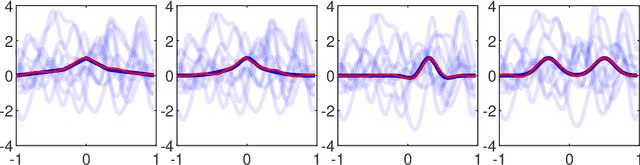
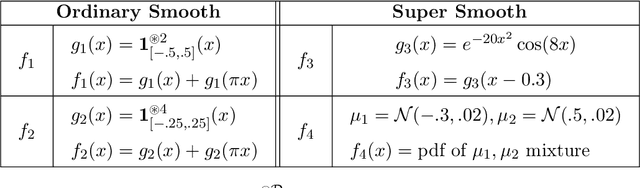
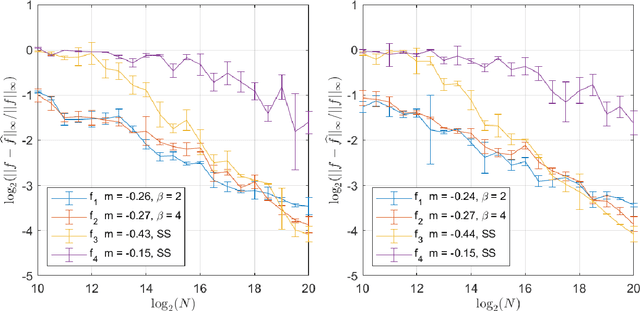
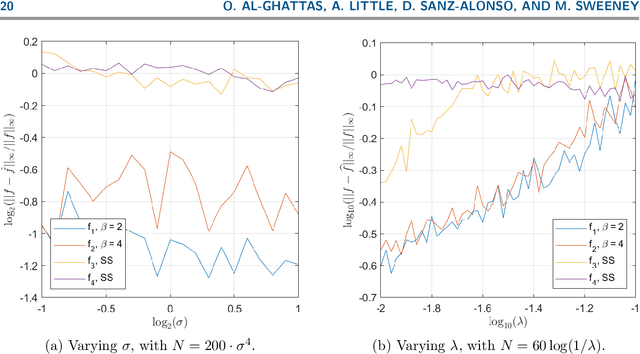
This paper studies the multi-reference alignment (MRA) problem of estimating a signal function from shifted, noisy observations. Our functional formulation reveals a new connection between MRA and deconvolution: the signal can be estimated from second-order statistics via Kotlarski's formula, an important identification result in deconvolution with replicated measurements. To design our MRA algorithms, we extend Kotlarski's formula to general dimension and study the estimation of signals with vanishing Fourier transform, thus also contributing to the deconvolution literature. We validate our deconvolution approach to MRA through both theory and numerical experiments.