 Add to Chrome
 Add to Firefox
 Add to Edge
WOLF-VLA: Whole-Body Humanoid Optimal Locomotion Framework for Vision-Language-Action Learning
Jun 24, 2026
Vision-Language-Action (VLA) models have recently demonstrated strong generalization in robotic manipulation, yet their applicability to whole-body, contact-rich humanoid locomotion remains severely underexplored due to data scarcity, the absence of dynamically consistent demonstrations, and the difficulty of encoding optimality and safety in learning-based pipelines. This work introduces a unified framework WOLF-VLA that integrates whole-body optimal-control (OC) motion synthesis with large-scale multi-modal dataset to train VLAs capable of generating humanoid locomotion policies directly from natural-language instructions. We construct a comprehensive dataset of dynamically feasible humanoid trajectories across six locomotion-related task families, each parameterized by environmental variations, object colors, placements, and visual distractors. We train a VLA model using the collected joint trajectories, ego-centric visual observations and natural language instruction, yielding a policy that exhibits strong reasoning and robustness to initial-condition variability, and competitive performance across several tasks and environment settings. A systematic ablation study demonstrates the impact of each modality on the model performance. The full dataset, model checkpoints, and benchmarking simulation suite will be openly released, establishing a reproducible dynamically consistent benchmark for whole-body humanoid locomotion rich VLA control and enabling future research in scalable transfer of instruction-driven locomotion policies.

Multimodal Entity Linking for Tweets
Apr 07, 2021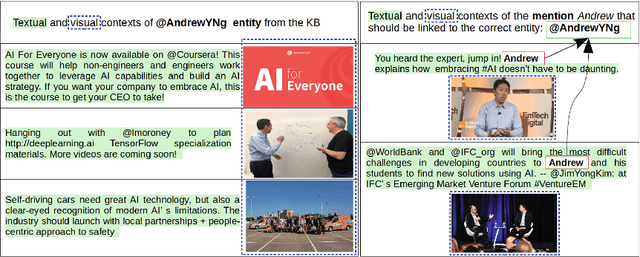

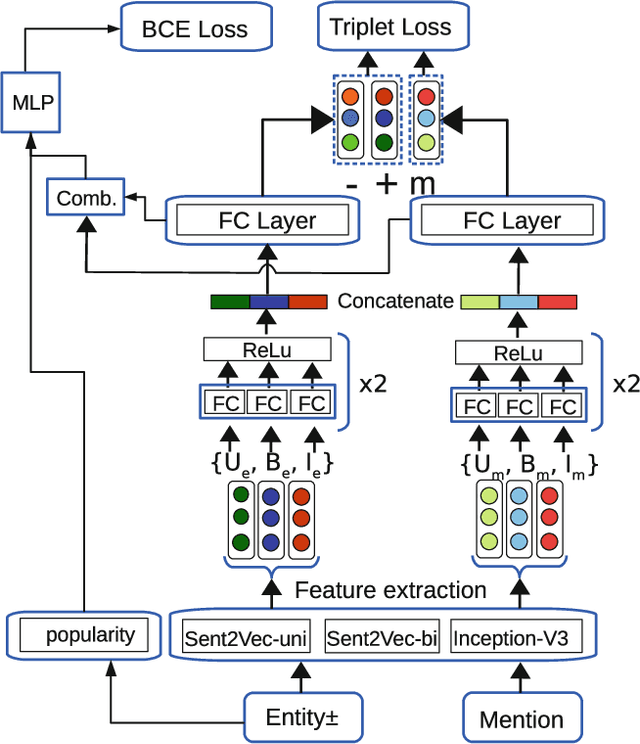
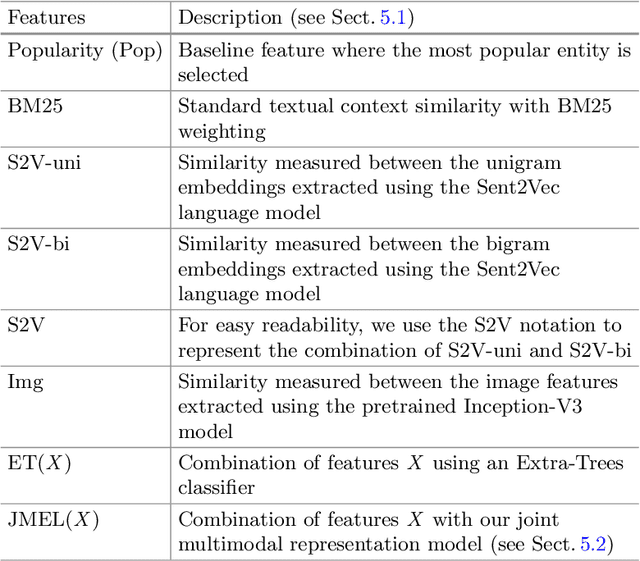
In many information extraction applications, entity linking (EL) has emerged as a crucial task that allows leveraging information about named entities from a knowledge base. In this paper, we address the task of multimodal entity linking (MEL), an emerging research field in which textual and visual information is used to map an ambiguous mention to an entity in a knowledge base (KB). First, we propose a method for building a fully annotated Twitter dataset for MEL, where entities are defined in a Twitter KB. Then, we propose a model for jointly learning a representation of both mentions and entities from their textual and visual contexts. We demonstrate the effectiveness of the proposed model by evaluating it on the proposed dataset and highlight the importance of leveraging visual information when it is available.