 Add to Chrome
 Add to Firefox
 Add to Edge
Hardware-Software Co-Design for Float16 On-Device Training on RISC-V Single-Core
Jul 23, 2026
By leveraging standard RISC-V extensions, namely Zfh (scalar float16) and Zvfh (vector float16), this work proposes an open-source framework to enable complete on-device training on resource-constrained RISC-V single-core. Our approach allows memory footprint reduction by about 50% as compared to using float32 and with minimal model performance degradation. We also facilitate transfer learning and fine-tuning scenarios by incorporating layer-freezing capabilities. Our work builds onto AIfES, an open-source, modular and generic DNN training and inference framework for embedded systems that can be extended with custom hardware-specific functions. The benefits of float16 is further emphasized by outlining the low area overhead of Zfh on a RV64GC super-scalar out-of-order FPGA softcore (+1.15% LUT6 and +0.05% FF at 175MHz). Finally, we discuss the architecture of a Zvfh implementation within the same RISC-V core.

Model Poisoning Against Federated Model Adaptation with Chain of Bit-Flips
Jun 08, 2026Federated Learning (FL) allows a set of clients to collectively train a global model without sharing local training data. Giving the responsibility of the training to decentralized actors may lead to poisoning attacks: clients controlled by malicious third party potentially poison the training dataset to install a backdoor in neural networks. In FL, these backdoor attacks rely solely on algorithmic approach, however, recent advances in hardware faults threats (e.g, Rowhammer) have widen the overall attack surface. In the context of federated model adaptation, we introduce a novel category of backdoor attack against FL systems that relies on model poisoning based on hardware-fault attacks. More precisely, we propose a task-agnostic backdoor attack that is implanted during the FL training time by inducing hardware faults (bit-flips) in parameters of a single local model. The backdoor is crafted during a previous offline phase from the pretrained model initially used by the FL system. Our results show that a backdoor can be successfully applied on different type of models and datasets. Typically, with up to 10 faults per malicious client occurrence and 19 total occurrences on a ResNet-18 are enough to reach 94% of attack success rate. Finally, we discuss the practicality and the robustness of the attack potential defenses, while putting into perspective the practical constraints of Rowhammer, which is the preferred attack vector for this type of threats.
Fault Injection on Embedded Neural Networks: Impact of a Single Instruction Skip
Aug 31, 2023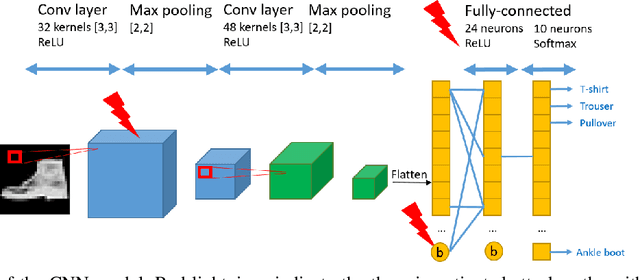
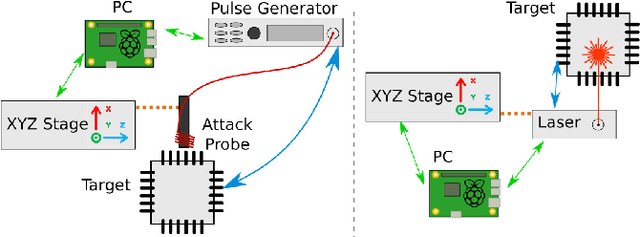
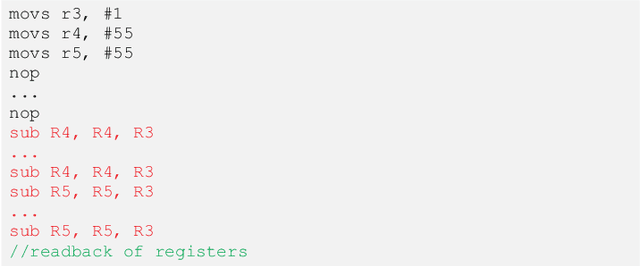
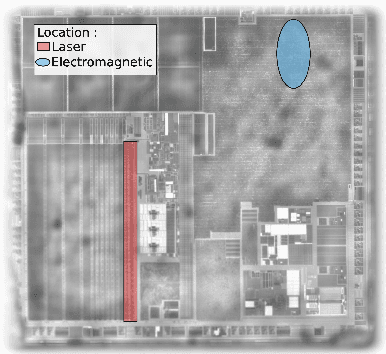
With the large-scale integration and use of neural network models, especially in critical embedded systems, their security assessment to guarantee their reliability is becoming an urgent need. More particularly, models deployed in embedded platforms, such as 32-bit microcontrollers, are physically accessible by adversaries and therefore vulnerable to hardware disturbances. We present the first set of experiments on the use of two fault injection means, electromagnetic and laser injections, applied on neural networks models embedded on a Cortex M4 32-bit microcontroller platform. Contrary to most of state-of-the-art works dedicated to the alteration of the internal parameters or input values, our goal is to simulate and experimentally demonstrate the impact of a specific fault model that is instruction skip. For that purpose, we assessed several modification attacks on the control flow of a neural network inference. We reveal integrity threats by targeting several steps in the inference program of typical convolutional neural network models, which may be exploited by an attacker to alter the predictions of the target models with different adversarial goals.