 Add to Chrome
 Add to Firefox
 Add to Edge
Perturbative Contrastive Physical Learning
Jun 08, 2026
Responses to perturbations are key to understanding physical systems. The ability to contrast such responses by comparing how a system reacts under slightly different conditions provides a mechanism for learning. Here, we introduce Perturbative Contrastive Physical Learning (PCPL), a general framework in which learning emerges from measurable contrasts between physical states produced by controlled changes to inputs, boundary conditions, parameters, or interpreter functions. PCPL unifies and extends prior approaches: Equilibrium Propagation is rooted in contrasts between free and nudged equilibria in energy-based systems, while Frequency Propagation corresponds to contrasts extracted from sinusoidally driven, frequency-demodulated responses. We show that contrast-driven updates can reflect either local sensitivities or global inverse-problem structure, yet do not require centralized gradient computation. Instead, effective learning geometry emerges implicitly from the system's own physical response, allowing learning behavior to arise without an external processor or explicit backpropagation. We demonstrate PCPL in two platforms: (i) spring networks that update bond stiffness using measured displacements and forces, and (ii) continuous-variable photonic circuits trained via x quadrature measurements and finite-difference estimates of the Jacobian. Both platforms successfully learn classification tasks. We further show that a continuous-variable photonic circuit can be trained to implement analog multiplication, illustrating a step toward more autonomous physical learning systems.

Laser interferometry as a robust neuromorphic platform for machine learning
Jan 26, 2026We present a method for implementing an optical neural network using only linear optical resources, namely field displacement and interferometry applied to coherent states of light. The nonlinearity required for learning in a neural network is realized via an encoding of the input into phase shifts allowing for far more straightforward experimental implementation compared to previous proposals for, and demonstrations of, $\textit{in situ}$ inference. Beyond $\textit{in situ}$ inference, the method enables $\textit{in situ}$ training by utilizing established techniques like parameter shift rules or physical backpropagation to extract gradients directly from measurements of the linear optical circuit. We also investigate the effect of photon losses and find the model to be very resilient to these.
Deep reinforcement learning for near-deterministic preparation of cubic- and quartic-phase gates in photonic quantum computing
Jun 09, 2025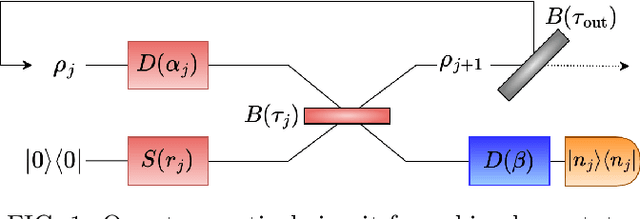
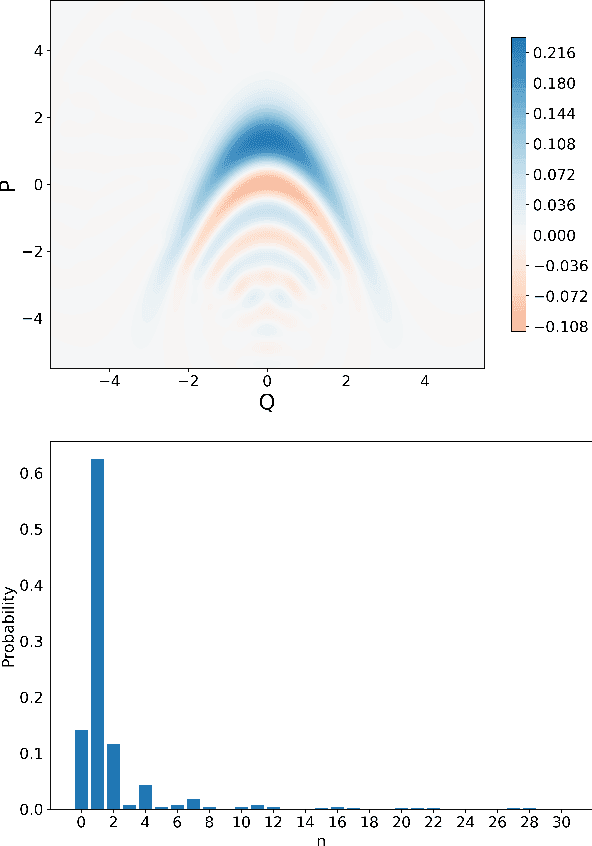
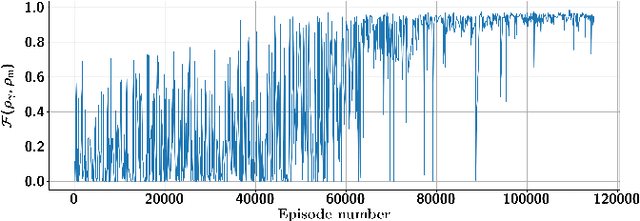
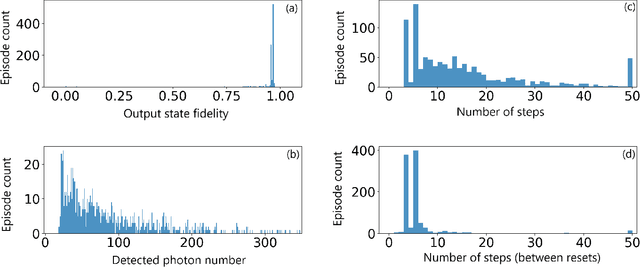
Cubic-phase states are a sufficient resource for universal quantum computing over continuous variables. We present results from numerical experiments in which deep neural networks are trained via reinforcement learning to control a quantum optical circuit for generating cubic-phase states, with an average success rate of 96%. The only non-Gaussian resource required is photon-number-resolving measurements. We also show that the exact same resources enable the direct generation of a quartic-phase gate, with no need for a cubic gate decomposition.