 Add to Chrome
 Add to Firefox
 Add to Edge
The Convergence Frontier: Integrating Machine Learning and High Performance Quantum Computing for Next-Generation Drug Discovery
Mar 19, 2026
Integrating quantum mechanics into drug discovery marks a decisive shift from empirical trial-and-error toward quantitative precision. However, the prohibitive cost of ab initio molecular dynamics has historically forced a compromise between chemical accuracy and computational scalability. This paper identifies the convergence of High-Performance Computing (HPC), Machine Learning (ML), and Quantum Computing (QC) as the definitive solution to this bottleneck. While ML foundation models, such as FeNNix-Bio1, enable quantum-accurate simulations, they remain tethered to the inherent limits of classical data generation. We detail how High-Performance Quantum Computing (HPQC), utilizing hybrid QPU-GPU architectures, will serve as the ultimate accelerator for quantum chemistry data. By leveraging Hilbert space mapping, these systems can achieve true chemical accuracy while bypassing the heuristics of classical approximations. We show how this tripartite convergence optimizes the drug discovery pipeline, spanning from initial system preparation to ML-driven, high-fidelity simulations. Finally, we position quantum-enhanced sampling as the beyond GPU frontier for modeling reactive cellular systems and pioneering next-generation materials.

Faster Molecular Dynamics with Neural Network Potentials via Distilled Multiple Time-Stepping and Non-Conservative Forces
Feb 16, 2026Following our previous work (J. Phys. Chem. Lett., 2026, 17, 5, 1288-1295), we propose the DMTS-NC approach, a distilled multi-time-step (DMTS) strategy using non conservative (NC) forces to further accelerate atomistic molecular dynamics simulations using foundation neural network models. There, a dual-level reversible reference system propagator algorithm (RESPA) formalism couples a target accurate conservative potential to a simplified distilled representation optimized for the production of non-conservative forces. Despite being non-conservative, the distilled architecture is designed to enforce key physical priors, such as equivariance under rotation and cancellation of atomic force components. These choices facilitate the distillation process and therefore improve drastically the robustness of simulation, significantly limiting the "holes" in the simpler potential, thus achieving excellent agreement with the forces data. Overall, the DMTS-NC scheme is found to be more stable and efficient than its conservative counterpart with additional speedups reaching 15-30% over DMTS. Requiring no finetuning steps, it is easier to implement and can be pushed to the limit of the systems physical resonances to maintain accuracy while providing maximum efficiency. As for DMTS, DMTS-NC is applicable to any neural network potential.
FeNNol: an Efficient and Flexible Library for Building Force-field-enhanced Neural Network Potentials
May 02, 2024
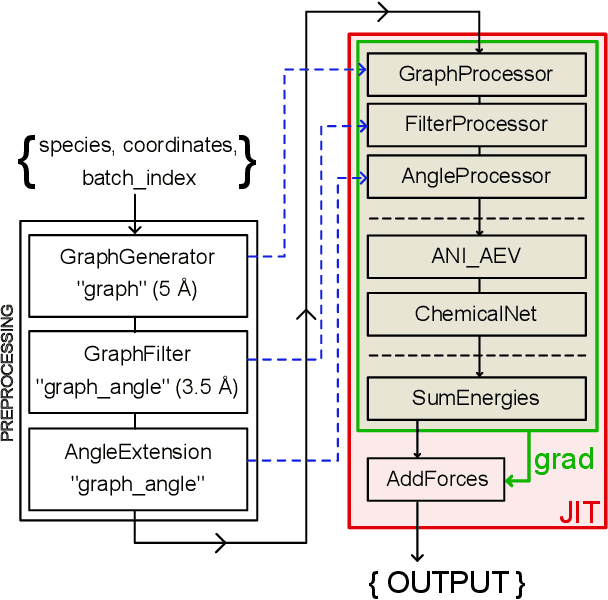


Neural network interatomic potentials (NNPs) have recently proven to be powerful tools to accurately model complex molecular systems while bypassing the high numerical cost of ab-initio molecular dynamics simulations. In recent years, numerous advances in model architectures as well as the development of hybrid models combining machine-learning (ML) with more traditional, physically-motivated, force-field interactions have considerably increased the design space of ML potentials. In this paper, we present FeNNol, a new library for building, training and running force-field-enhanced neural network potentials. It provides a flexible and modular system for building hybrid models, allowing to easily combine state-of-the-art embeddings with ML-parameterized physical interaction terms without the need for explicit programming. Furthermore, FeNNol leverages the automatic differentiation and just-in-time compilation features of the Jax Python library to enable fast evaluation of NNPs, shrinking the performance gap between ML potentials and standard force-fields. This is demonstrated with the popular ANI-2x model reaching simulation speeds nearly on par with the AMOEBA polarizable force-field on commodity GPUs (GPU=Graphics processing unit). We hope that FeNNol will facilitate the development and application of new hybrid NNP architectures for a wide range of molecular simulation problems.