 Add to Chrome
 Add to Firefox
 Add to Edge
Towards Reproducibility in Predictive Process Mining: SPICE -- A Deep Learning Library
Dec 19, 2025
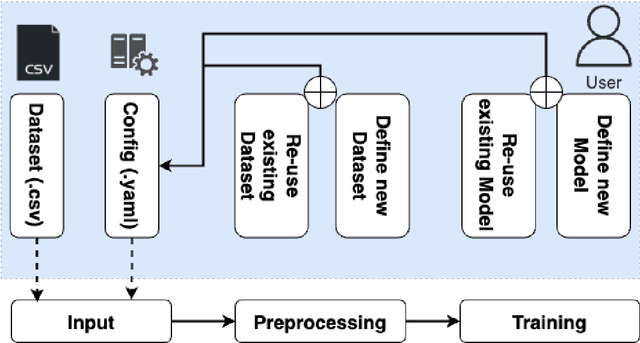
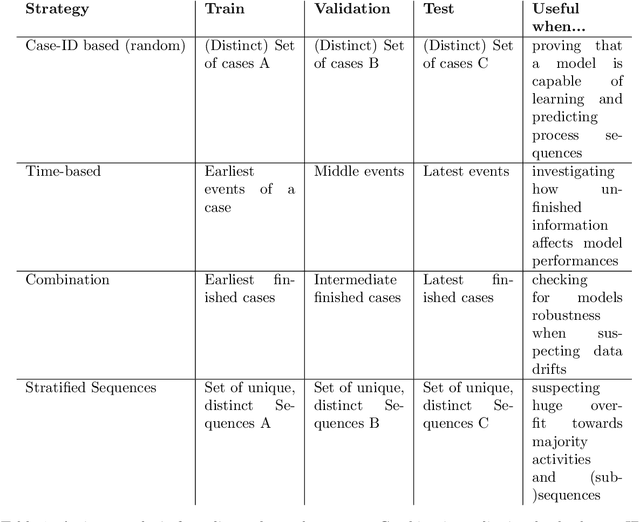
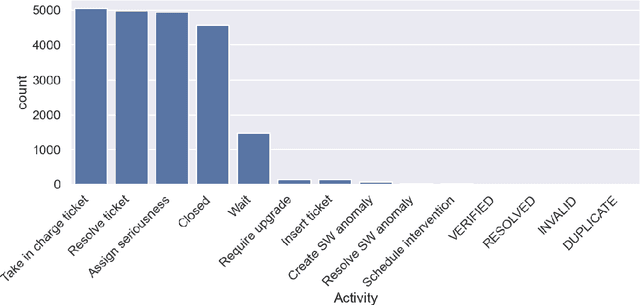
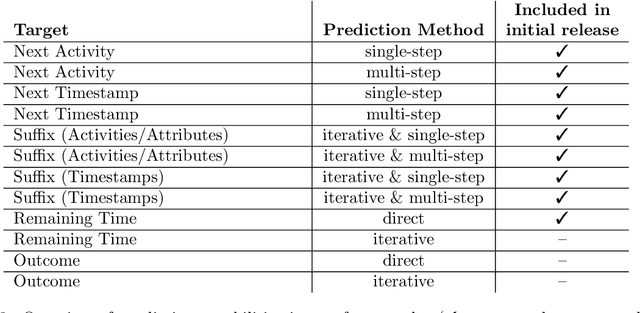
In recent years, Predictive Process Mining (PPM) techniques based on artificial neural networks have evolved as a method for monitoring the future behavior of unfolding business processes and predicting Key Performance Indicators (KPIs). However, many PPM approaches often lack reproducibility, transparency in decision making, usability for incorporating novel datasets and benchmarking, making comparisons among different implementations very difficult. In this paper, we propose SPICE, a Python framework that reimplements three popular, existing baseline deep-learning-based methods for PPM in PyTorch, while designing a common base framework with rigorous configurability to enable reproducible and robust comparison of past and future modelling approaches. We compare SPICE to original reported metrics and with fair metrics on 11 datasets.

Directly Follows Graphs Go Predictive Process Monitoring With Graph Neural Networks
Mar 05, 2025In the past years, predictive process monitoring (PPM) techniques based on artificial neural networks have evolved as a method to monitor the future behavior of business processes. Existing approaches mostly focus on interpreting the processes as sequences, so-called traces, and feeding them to neural architectures designed to operate on sequential data such as recurrent neural networks (RNNs) or transformers. In this study, we investigate an alternative way to perform PPM: by transforming each process in its directly-follows-graph (DFG) representation we are able to apply graph neural networks (GNNs) for the prediction tasks. By this, we aim to develop models that are more suitable for complex processes that are long and contain an abundance of loops. In particular, we present different ways to create DFG representations depending on the particular GNN we use. The tested GNNs range from classical node-based to novel edge-based architectures. Further, we investigate the possibility of using multi-graphs. By these steps, we aim to design graph representations that minimize the information loss when transforming traces into graphs.