 Add to Chrome
 Add to Firefox
 Add to Edge
BackTranslation2.0 -- A Linguistically Motivated Metric to Assess Sign Language Production
Jun 27, 2026
Sign Languages (SLs) are the primary means of communication for millions of deaf individuals, yet existing evaluation metrics for generated SL remain simplistic and poorly aligned with human judgements. We introduce BackTranslation2.0, a linguistically grounded evaluation metric for text-to-sign translation that moves beyond naïve backtranslation. Our approach adopts an agentic framework in which a deterministic pipeline orchestrates a suite of specialised tools to assess four scoring dimensions - grammatical correctness, phonological accuracy, motion fluency, and generation fidelity - aligned with human rater assessments. Tool outputs are not treated independently: a set of large language model (LLM)-based cross-referential comparison modules evaluates consistency across tools and checks outputs against linguistic expectations, enabling structured reasoning over grammatical, phonological, and motion-level evidence. Final dimension scores are computed through deterministic weighted formulas over validated tool outputs. To validate BackTranslation2.0, we introduce and evaluate on a British Sign Language (BSL) dataset rated in a human rater study across the same quality dimensions, following a protocol developed in collaboration between linguists and deaf experts, benchmarking against six baseline metrics. Our method demonstrates strong correlation with human judgements across all dimensions, providing a more comprehensive, interpretable, and linguistically principled evaluation framework for sign language production systems.

What's the Point? Spatial Grammar & Index Resolution for Sign Language Processing
Jun 06, 2026Sign language models are predominantly trained with gloss-sequence or text supervision, thereby under-modeling non-lexical and productive constructions. One comparatively tractable instance is spatial indexing: pointing gestures that assign discourse entities to spatial loci for subsequent co-reference, which lexicon-centric objectives largely fail to capture. We present a targeted evaluation of indexing in Sign Language Recognition, showing that despite comprising 10-15% of signing content, indexing is poorly recovered. We introduce a framework for training and evaluating indexing experts, establishing a baseline for index-aware sign language modeling. Our approach decomposes spatial reference resolution into index detection and discourse entity linking. The resulting mention representations enable automatic annotation and non-lexical structure modeling, and serve as an auxiliary indexing expert that augments a frozen SLR model at inference time.
3D-LEX v1.0: 3D Lexicons for American Sign Language and Sign Language of the Netherlands
Sep 03, 2024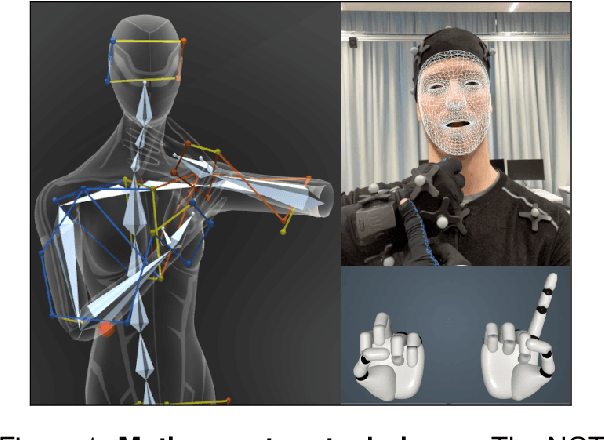
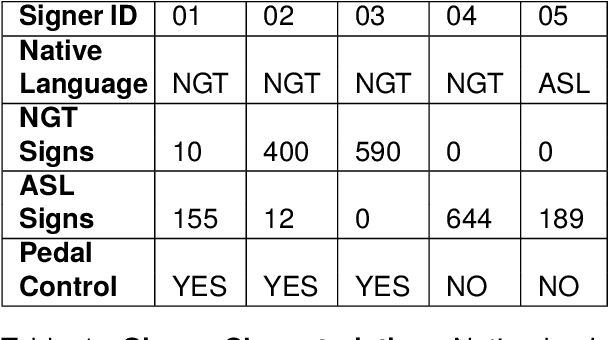
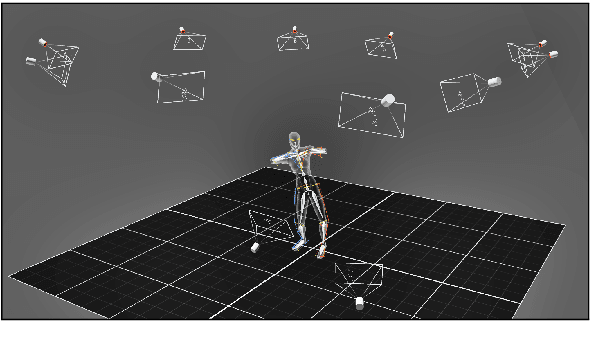
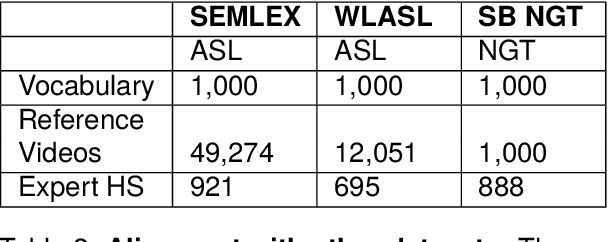
In this work, we present an efficient approach for capturing sign language in 3D, introduce the 3D-LEX v1.0 dataset, and detail a method for semi-automatic annotation of phonetic properties. Our procedure integrates three motion capture techniques encompassing high-resolution 3D poses, 3D handshapes, and depth-aware facial features, and attains an average sampling rate of one sign every 10 seconds. This includes the time for presenting a sign example, performing and recording the sign, and archiving the capture. The 3D-LEX dataset includes 1,000 signs from American Sign Language and an additional 1,000 signs from the Sign Language of the Netherlands. We showcase the dataset utility by presenting a simple method for generating handshape annotations directly from 3D-LEX. We produce handshape labels for 1,000 signs from American Sign Language and evaluate the labels in a sign recognition task. The labels enhance gloss recognition accuracy by 5% over using no handshape annotations, and by 1% over expert annotations. Our motion capture data supports in-depth analysis of sign features and facilitates the generation of 2D projections from any viewpoint. The 3D-LEX collection has been aligned with existing sign language benchmarks and linguistic resources, to support studies in 3D-aware sign language processing.