 Add to Chrome
 Add to Firefox
 Add to Edge
How to Correctly Make Mistakes: A Framework for Constructing and Benchmarking Mistake Aware Egocentric Procedural Videos
Apr 16, 2026
Reliable procedural monitoring in video requires exposure to naturally occurring human errors and the recoveries that follow. In egocentric recordings, mistakes are often partially occluded by hands and revealed through subtle object state changes, while existing procedural datasets provide limited and inconsistent mistake and correction traces. We present PIE-V (Psychologically Inspired Error injection for Videos), a framework for constructing and benchmarking mistake-aware egocentric procedural videos by augmenting clean keystep procedures with controlled, human-plausible deviations. PIE-V combines a psychology-informed error planner conditioned on procedure phase and semantic step load, a correction planner that models recovery behavior, an LLM writer that performs cascade-consistent rewrites, and an LLM judge that validates procedural coherence and repairs failures. For video segment edits, PIE-V synthesizes replacement clips with text-guided video generation and stitches them into the episode to preserve visual plausibility. Applied to 17 tasks and 50 Ego-Exo4D scenarios, PIE-V injects 102 mistakes and generates 27 recovery corrections. For benchmarking, we introduce a unified taxonomy and a human rubric with nine metrics that cover step-level and procedure-level quality, including plausibility, procedure logic with annotator confidence, state change coherence, and grounding between text and video. Using this protocol, we audit several existing resources and compare PIE-V against a freeform LLM generation baseline under the same criteria. Together, the framework and rubric support post-completion verification for egocentric procedural mistake detection and correction.

Addressing Blind Guessing: Calibration of Selection Bias in Multiple-Choice Question Answering by Video Language Models
Oct 18, 2024Evaluating Video Language Models (VLMs) is a challenging task. Due to its transparency, Multiple-Choice Question Answering (MCQA) is widely used to measure the performance of these models through accuracy. However, existing MCQA benchmarks fail to capture the full reasoning capabilities of VLMs due to selection bias, when models disproportionately favor certain answer options based on positional patterns observed during training. In this work, we conduct a comprehensive empirical analysis of several VLM architectures across major datasets designed to assess complex video-focused reasoning. We identify where the bias is most pronounced and demonstrate to what extent model responses reflect genuine understanding of video content and related questions, as opposed to reliance on arbitrary patterns or superficial cues, such as answer position. By decomposing the MCQA task and adapting fairness bias metrics to VLMs, we introduce a post-processing calibration technique BOLD to balance this bias. Our results show that reducing selection bias improves not only debiasing metrics but also overall model performance, including Accuracy and F1 Mean score. Our method, by suppressing "blind guessing", offers a more cost- and time-effective approach to mitigating selection bias compared to existing techniques. This study represents the first focused investigation of selection bias in video-to-text LLM-powered models.
CAST: Cross-modal Alignment Similarity Test for Vision Language Models
Sep 17, 2024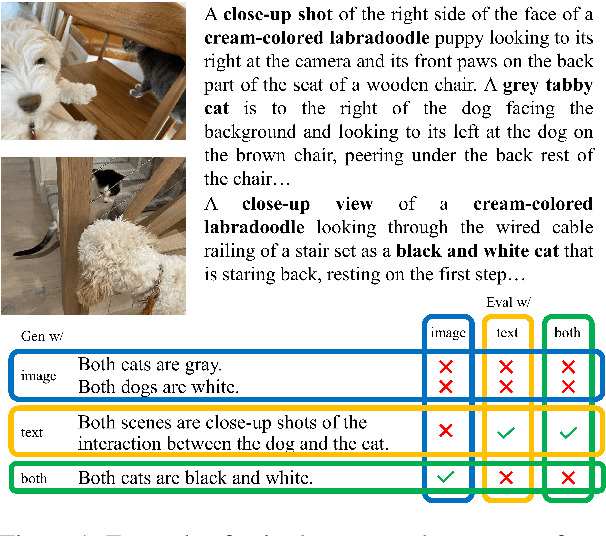
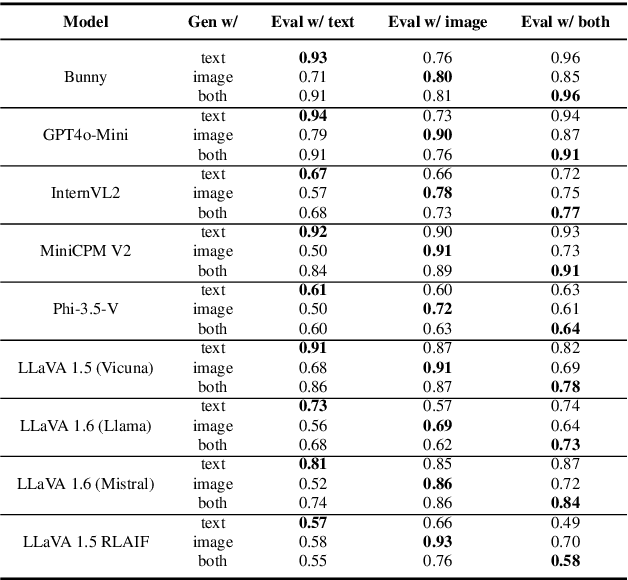
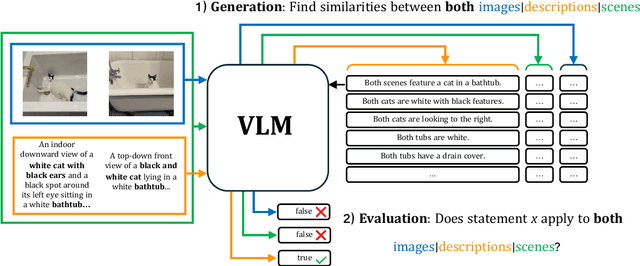

Vision Language Models (VLMs) are typically evaluated with Visual Question Answering (VQA) tasks which assess a model's understanding of scenes. Good VQA performance is taken as evidence that the model will perform well on a broader range of tasks that require both visual and language inputs. However, scene-aware VQA does not fully capture input biases or assess hallucinations caused by a misalignment between modalities. To address this, we propose a Cross-modal Alignment Similarity Test (CAST) to probe VLMs for self-consistency across modalities. This test involves asking the models to identify similarities between two scenes through text-only, image-only, or both and then assess the truthfulness of the similarities they generate. Since there is no ground-truth to compare against, this evaluation does not focus on objective accuracy but rather on whether VLMs are internally consistent in their outputs. We argue that while not all self-consistent models are capable or accurate, all capable VLMs must be self-consistent.