 Add to Chrome
 Add to Firefox
 Add to Edge
Learning to Look Benign: Targeted Evasion of Malware Detectors via API Import Injection
May 18, 2026
Machine learning-based malware detectors are widely deployed in antivirus and endpoint detection systems, yet their reliance on static features makes them vulnerable to adversarial manipulation. This paper investigates whether a malware sample can be intentionally misclassified as a specific benign software category, not merely as "not malware", by adding a small number of Win32 API imports characteristic of that selected category, without removing any existing imports or retraining the detector. We propose a framework centered on a Conditional Variational Autoencoder (CVAE) whose decoder is strictly additive. It can introduce new API calls but never remove existing ones, preserving malware functionality by design. For each malware sample, the framework automatically identifies which benign category it most closely resembles and uses that as the evasion target. A knowledge-distilled differentiable proxy enables gradient-based training against the non-differentiable ensemble detector. Experiments on a six-class dataset of binary Win32 API import vectors extracted from 3,799 Windows executables (five benign categories, one malware class) show that, against a detector achieving 87.5% malware recall, adding just 20 API imports reduces recall to 30%. At k=20, among samples that evaded detection, 99% are classified as the intended target category. The CVAE outperforms both a frequency-based baseline and random selection at every tested injection size (k = 5 to 50). Validation on real PE files submitted to VirusTotal confirms that the attack transfers to commercial static detection engines, with an average 54.5% reduction in flagging engines. These findings expose a concrete vulnerability in API-based malware classifiers and demonstrate that targeted evasion into a chosen benign category is achievable with minimal, functionality-preserving modifications.

Evaluation Cards for XAI Metrics
May 06, 2026The evaluation of explainable AI (XAI) methods is affected by a lack of standardization. Metrics are inconsistently defined, incompletely reported, and rarely validated against common baselines. In this paper, we identify transparency of evaluation reporting as a central, under-addressed problem. We propose the XAI Evaluation Card, a documentation template analogous to model cards, designed to accompany any study that introduces an XAI evaluation metric. The card covers explicit declaration of target properties, grounding levels, metric assumptions, validation evidence, gaming risks, and known failure cases. We argue that adopting this template as a community norm would reduce evaluation fragmentation, support meta-analysis, and improve accountability in XAI research.
Explainable AI (XAI) in Image Segmentation in Medicine, Industry, and Beyond: A Survey
May 02, 2024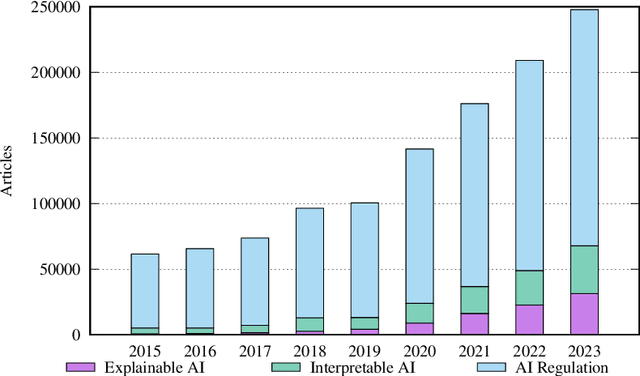
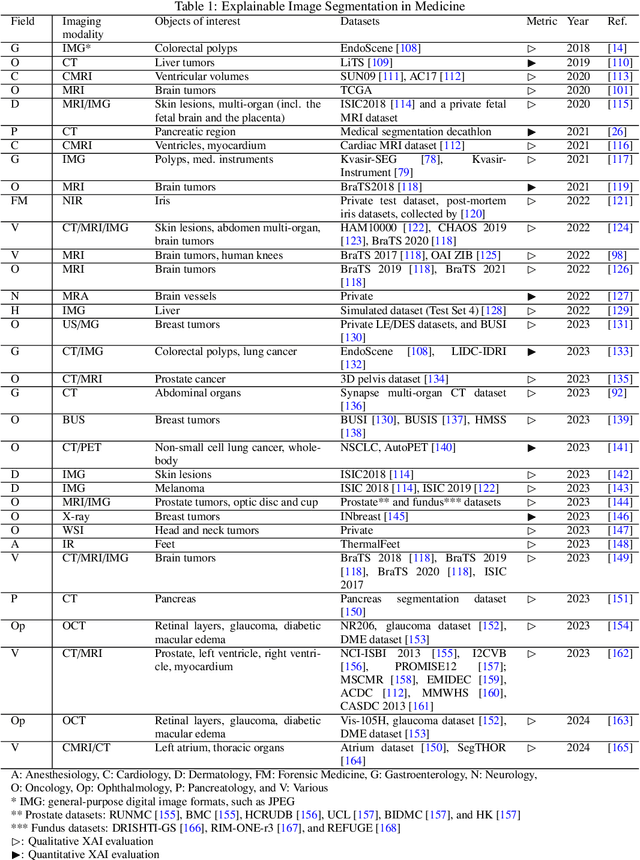

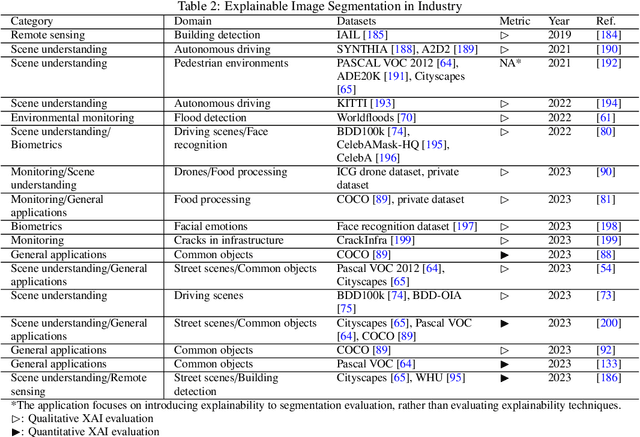
Artificial Intelligence (XAI) has found numerous applications in computer vision. While image classification-based explainability techniques have garnered significant attention, their counterparts in semantic segmentation have been relatively neglected. Given the prevalent use of image segmentation, ranging from medical to industrial deployments, these techniques warrant a systematic look. In this paper, we present the first comprehensive survey on XAI in semantic image segmentation. This work focuses on techniques that were either specifically introduced for dense prediction tasks or were extended for them by modifying existing methods in classification. We analyze and categorize the literature based on application categories and domains, as well as the evaluation metrics and datasets used. We also propose a taxonomy for interpretable semantic segmentation, and discuss potential challenges and future research directions.