 Add to Chrome
 Add to Firefox
 Add to Edge
The Digital Twin Counterfactual Framework: A Validation Architecture for Simulated Potential Outcomes
Apr 01, 2026
The fundamental problem of causal inference - that the counterfactual outcome for any individual is never observed - has shaped the entire methodology of the field. Every existing approach substitutes assumptions for missing data: ignorability, parallel trends, exclusion restrictions. None produces the counterfactual itself. This paper proposes the Digital Twin Counterfactual Framework (DTCF): rather than estimating the counterfactual statistically, we simulate it using a digital twin and subject the simulation to a hierarchical validation regime. We formalize the digital twin simulator as a stochastic mapping within the potential outcomes framework and introduce a hierarchy of twin fidelity assumptions - from marginal fidelity through joint fidelity to structural fidelity - each unlocking a progressively richer class of estimands. The central contribution is threefold. First, a five-level validation architecture converts the unfalsifiable claim that the simulator produces correct counterfactuals into falsifiable tests against observable data. Second, a formal decomposition separates causal quantities into those that are marginally validated (ATE, CATE, QTE - testable through observable-arm comparison) and those that are copula-dependent (the ITE distribution, probability of benefit/harm, variance of treatment effects - permanently reliant on the unobservable within-individual dependence structure). Third, bounding, sensitivity, and uncertainty quantification tools make the copula dependence explicit. The DTCF does not resolve the fundamental problem of causal inference. What it provides is a framework in which marginal causal claims become increasingly testable, joint causal claims become explicitly assumption-indexed, and the gap between the two is formally characterized.

Churn analysis using deep convolutional neural networks and autoencoders
Apr 18, 2016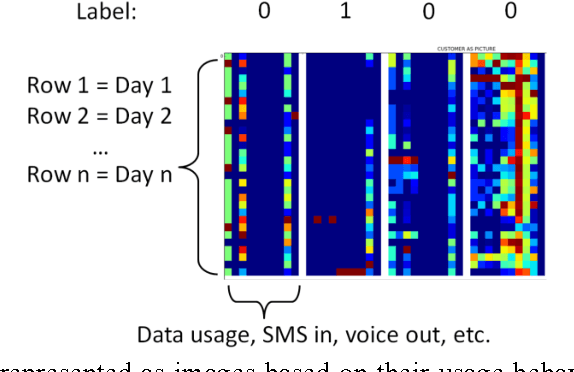
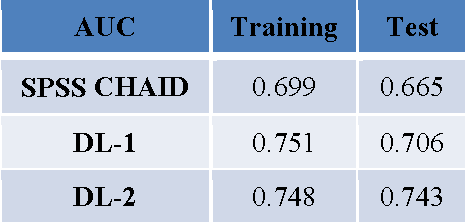
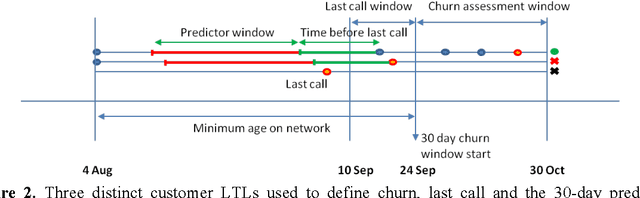
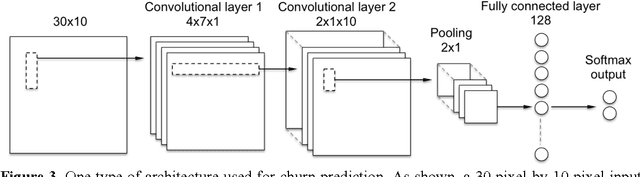
Customer temporal behavioral data was represented as images in order to perform churn prediction by leveraging deep learning architectures prominent in image classification. Supervised learning was performed on labeled data of over 6 million customers using deep convolutional neural networks, which achieved an AUC of 0.743 on the test dataset using no more than 12 temporal features for each customer. Unsupervised learning was conducted using autoencoders to better understand the reasons for customer churn. Images that maximally activate the hidden units of an autoencoder trained with churned customers reveal ample opportunities for action to be taken to prevent churn among strong data, no voice users.