 Add to Chrome
 Add to Firefox
 Add to Edge
Structural Disentanglement in Bilinear MLPs via Architectural Inductive Bias
Feb 05, 2026
Selective unlearning and long-horizon extrapolation remain fragile in modern neural networks, even when tasks have underlying algebraic structure. In this work, we argue that these failures arise not solely from optimization or unlearning algorithms, but from how models structure their internal representations during training. We explore if having explicit multiplicative interactions as an architectural inductive bias helps in structural disentanglement, through Bilinear MLPs. We show analytically that bilinear parameterizations possess a `non-mixing' property under gradient flow conditions, where functional components separate into orthogonal subspace representations. This provides a mathematical foundation for surgical model modification. We validate this hypothesis through a series of controlled experiments spanning modular arithmetic, cyclic reasoning, Lie group dynamics, and targeted unlearning benchmarks. Unlike pointwise nonlinear networks, multiplicative architectures are able to recover true operators aligned with the underlying algebraic structure. Our results suggest that model editability and generalization are constrained by representational structure, and that architectural inductive bias plays a central role in enabling reliable unlearning.

Amortized Spectral Kernel Discovery via Prior-Data Fitted Network
Jan 29, 2026Prior-Data Fitted Networks (PFNs) enable efficient amortized inference but lack transparent access to their learned priors and kernels. This opacity hinders their use in downstream tasks, such as surrogate-based optimization, that require explicit covariance models. We introduce an interpretability-driven framework for amortized spectral discovery from pre-trained PFNs with decoupled attention. We perform a mechanistic analysis on a trained PFN that identifies attention latent output as the key intermediary, linking observed function data to spectral structure. Building on this insight, we propose decoder architectures that map PFN latents to explicit spectral density estimates and corresponding stationary kernels via Bochner's theorem. We study this pipeline in both single-realization and multi-realization regimes, contextualizing theoretical limits on spectral identifiability and proving consistency when multiple function samples are available. Empirically, the proposed decoders recover complex multi-peak spectral mixtures and produce explicit kernels that support Gaussian process regression with accuracy comparable to PFNs and optimization-based baselines, while requiring only a single forward pass. This yields orders-of-magnitude reductions in inference time compared to optimization-based baselines.
IMAGE-ALCHEMY: Advancing subject fidelity in personalised text-to-image generation
May 15, 2025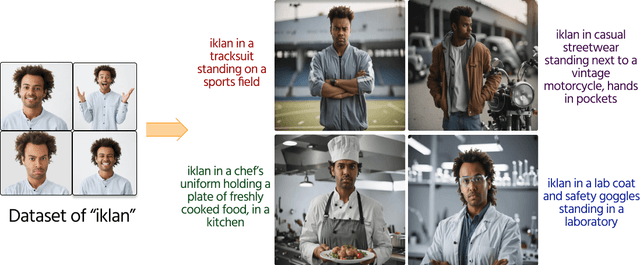
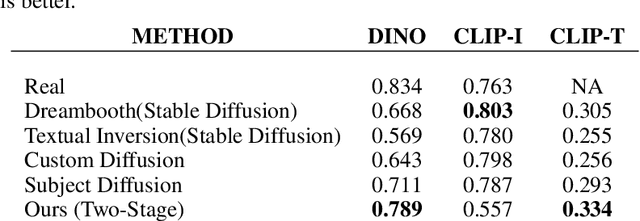
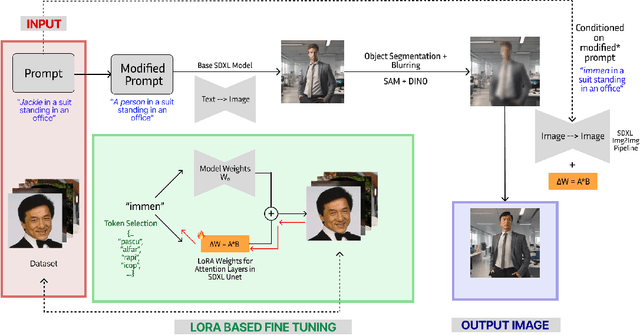
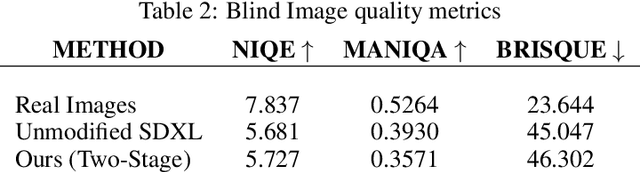
Recent advances in text-to-image diffusion models, particularly Stable Diffusion, have enabled the generation of highly detailed and semantically rich images. However, personalizing these models to represent novel subjects based on a few reference images remains challenging. This often leads to catastrophic forgetting, overfitting, or large computational overhead.We propose a two-stage pipeline that addresses these limitations by leveraging LoRA-based fine-tuning on the attention weights within the U-Net of the Stable Diffusion XL (SDXL) model. First, we use the unmodified SDXL to generate a generic scene by replacing the subject with its class label. Then, we selectively insert the personalized subject through a segmentation-driven image-to-image (Img2Img) pipeline that uses the trained LoRA weights.This framework isolates the subject encoding from the overall composition, thus preserving SDXL's broader generative capabilities while integrating the new subject in a high-fidelity manner. Our method achieves a DINO similarity score of 0.789 on SDXL, outperforming existing personalized text-to-image approaches.