 Add to Chrome
 Add to Firefox
 Add to Edge
A Synchronized Audio-Visual Multi-View Capture System
Mar 24, 2026
Multi-view capture systems have been an important tool in research for recording human motion under controlling conditions. Most existing systems are specified around video streams and provide little or no support for audio acquisition and rigorous audio-video alignment, despite both being essential for studying conversational interaction where timing at the level of turn-taking, overlap, and prosody matters. In this technical report, we describe an audio-visual multi-view capture system that addresses this gap by treating synchronized audio and synchronized video as first-class signals. The system combines a multi-camera pipeline with multi-channel microphone recording under a unified timing architecture and provides a practical workflow for calibration, acquisition, and quality control that supports repeatable recordings at scale. We quantify synchronization performance in deployment and show that the resulting recordings are temporally consistent enough to support fine-grained analysis and data-driven modeling of conversation behavior.

MindForge: Empowering Embodied Agents with Theory of Mind for Lifelong Collaborative Learning
Nov 20, 2024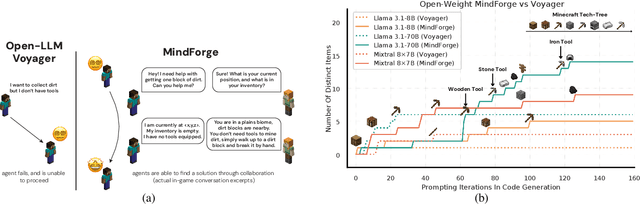
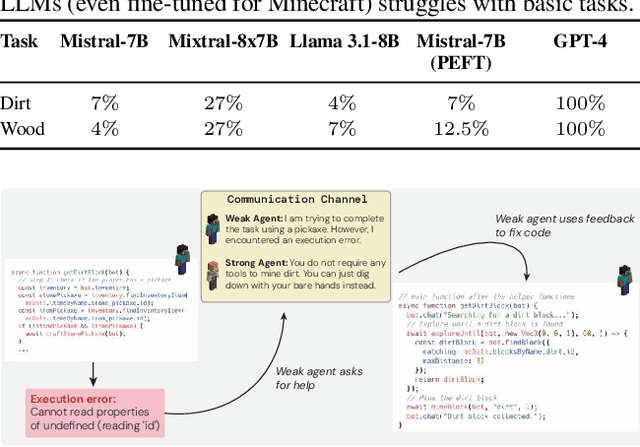
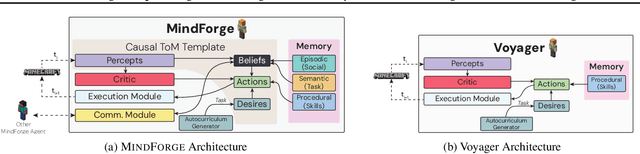
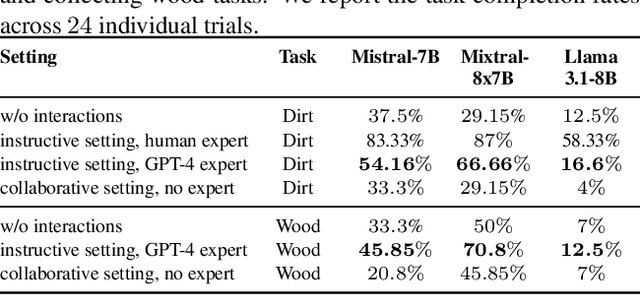
Contemporary embodied agents, such as Voyager in Minecraft, have demonstrated promising capabilities in open-ended individual learning. However, when powered with open large language models (LLMs), these agents often struggle with rudimentary tasks, even when fine-tuned on domain-specific knowledge. Inspired by human cultural learning, we present \collabvoyager, a novel framework that enhances Voyager with lifelong collaborative learning through explicit perspective-taking. \collabvoyager introduces three key innovations: (1) theory of mind representations linking percepts, beliefs, desires, and actions; (2) natural language communication between agents; and (3) semantic memory of task and environment knowledge and episodic memory of collaboration episodes. These advancements enable agents to reason about their and others' mental states, empirically addressing two prevalent failure modes: false beliefs and faulty task executions. In mixed-expertise Minecraft experiments, \collabvoyager agents outperform Voyager counterparts, significantly improving task completion rate by $66.6\% (+39.4\%)$ for collecting one block of dirt and $70.8\% (+20.8\%)$ for collecting one wood block. They exhibit emergent behaviors like knowledge transfer from expert to novice agents and collaborative code correction. \collabvoyager agents also demonstrate the ability to adapt to out-of-distribution tasks by using their previous experiences and beliefs obtained through collaboration. In this open-ended social learning paradigm, \collabvoyager paves the way for the democratic development of embodied AI, where agents learn in deployment from both peer and environmental feedback.