 Add to Chrome
 Add to Firefox
 Add to Edge
From Reviews to Requirements: Can LLMs Generate Human-Like User Stories?
Mar 30, 2026
App store reviews provide a constant flow of real user feedback that can help improve software requirements. However, these reviews are often messy, informal, and difficult to analyze manually at scale. Although automated techniques exist, many do not perform well when replicated and often fail to produce clean, backlog-ready user stories for agile projects. In this study, we evaluate how well large language models (LLMs) such as GPT-3.5 Turbo, Gemini 2.0 Flash, and Mistral 7B Instruct can generate usable user stories directly from raw app reviews. Using the Mini-BAR dataset of 1,000+ health app reviews, we tested zero-shot, one-shot, and two-shot prompting methods. We evaluated the generated user stories using both human judgment (via the RUST framework) and a RoBERTa classifier fine-tuned on UStAI to assess their overall quality. Our results show that LLMs can match or even outperform humans in writing fluent, well-formatted user stories, especially when few-shot prompts are used. However, they still struggle to produce independent and unique user stories, which are essential for building a strong agile backlog. Overall, our findings show how LLMs can reliably turn unstructured app reviews into actionable software requirements, providing developers with clear guidance to turn user feedback into meaningful improvements.

From Chat to Checkup: Can Large Language Models Assist in Diabetes Prediction?
Jun 17, 2025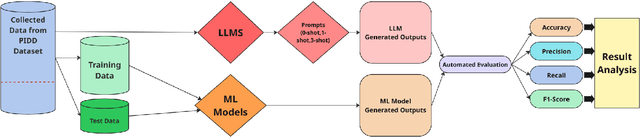
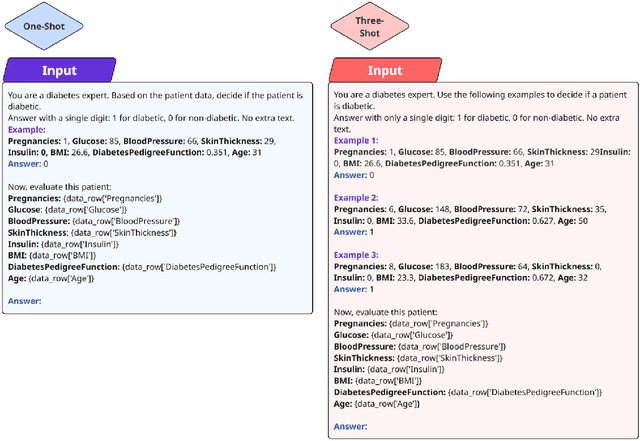
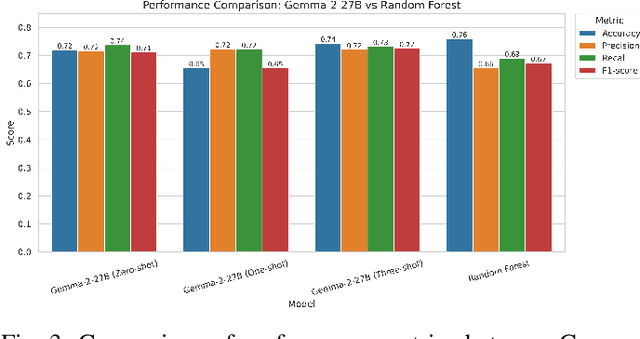
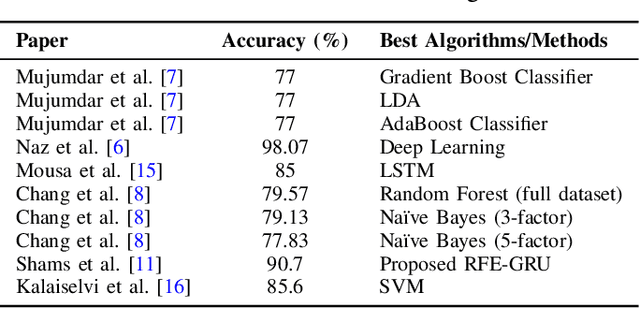
While Machine Learning (ML) and Deep Learning (DL) models have been widely used for diabetes prediction, the use of Large Language Models (LLMs) for structured numerical data is still not well explored. In this study, we test the effectiveness of LLMs in predicting diabetes using zero-shot, one-shot, and three-shot prompting methods. We conduct an empirical analysis using the Pima Indian Diabetes Database (PIDD). We evaluate six LLMs, including four open-source models: Gemma-2-27B, Mistral-7B, Llama-3.1-8B, and Llama-3.2-2B. We also test two proprietary models: GPT-4o and Gemini Flash 2.0. In addition, we compare their performance with three traditional machine learning models: Random Forest, Logistic Regression, and Support Vector Machine (SVM). We use accuracy, precision, recall, and F1-score as evaluation metrics. Our results show that proprietary LLMs perform better than open-source ones, with GPT-4o and Gemma-2-27B achieving the highest accuracy in few-shot settings. Notably, Gemma-2-27B also outperforms the traditional ML models in terms of F1-score. However, there are still issues such as performance variation across prompting strategies and the need for domain-specific fine-tuning. This study shows that LLMs can be useful for medical prediction tasks and encourages future work on prompt engineering and hybrid approaches to improve healthcare predictions.