 Add to Chrome
 Add to Firefox
 Add to Edge
Unsupervised Learning of Efficient Exploration: Pre-training Adaptive Policies via Self-Imposed Goals
Jan 27, 2026
Unsupervised pre-training can equip reinforcement learning agents with prior knowledge and accelerate learning in downstream tasks. A promising direction, grounded in human development, investigates agents that learn by setting and pursuing their own goals. The core challenge lies in how to effectively generate, select, and learn from such goals. Our focus is on broad distributions of downstream tasks where solving every task zero-shot is infeasible. Such settings naturally arise when the target tasks lie outside of the pre-training distribution or when their identities are unknown to the agent. In this work, we (i) optimize for efficient multi-episode exploration and adaptation within a meta-learning framework, and (ii) guide the training curriculum with evolving estimates of the agent's post-adaptation performance. We present ULEE, an unsupervised meta-learning method that combines an in-context learner with an adversarial goal-generation strategy that maintains training at the frontier of the agent's capabilities. On XLand-MiniGrid benchmarks, ULEE pre-training yields improved exploration and adaptation abilities that generalize to novel objectives, environment dynamics, and map structures. The resulting policy attains improved zero-shot and few-shot performance, and provides a strong initialization for longer fine-tuning processes. It outperforms learning from scratch, DIAYN pre-training, and alternative curricula.

Black box meta-learning intrinsic rewards for sparse-reward environments
Jul 31, 2024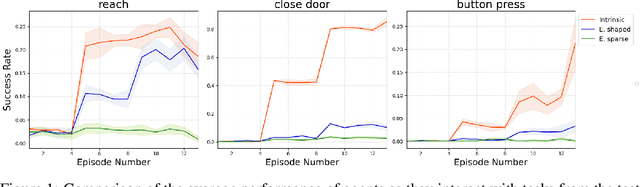
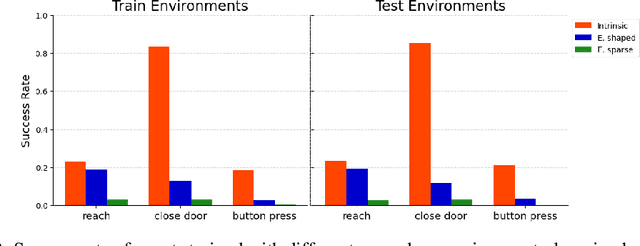
Despite the successes and progress of deep reinforcement learning over the last decade, several challenges remain that hinder its broader application. Some fundamental aspects to improve include data efficiency, generalization capability, and ability to learn in sparse-reward environments, which often require human-designed dense rewards. Meta-learning has emerged as a promising approach to address these issues by optimizing components of the learning algorithm to meet desired characteristics. Additionally, a different line of work has extensively studied the use of intrinsic rewards to enhance the exploration capabilities of algorithms. This work investigates how meta-learning can improve the training signal received by RL agents. The focus is on meta-learning intrinsic rewards under a framework that doesn't rely on the use of meta-gradients. We analyze and compare this approach to the use of extrinsic rewards and a meta-learned advantage function. The developed algorithms are evaluated on distributions of continuous control tasks with both parametric and non-parametric variations, and with only sparse rewards accessible for the evaluation tasks.