 Add to Chrome
 Add to Firefox
 Add to Edge
Half a Link can Be Enough to Predict a Whole Link: Understanding Generalization in Knowledge Graph Foundation Models
Jun 16, 2026
Knowledge graph (KG) foundation models (KGFMs) are zero-shot generalizers: trained once, they can predict links on unseen graphs without retraining. However, understanding when and how they can robustly generalize across KGs is still an open question. In this paper, we shed some light on their generalization mechanisms highlighting how their performance on unseen KGs is not uniform when it comes to partially seen links, which we call half-links. In fact, we show that to predict a test triple $(h,r,t)$ it might suffice in practice to have observed the half-link $(h,r)$ or $(r,t)$ in the inference graph. This yields a taxonomy of four scenarios when combinations of these half-links are observed or not. In a rigorous stratified analysis over these scenarios, we reveal that SoTA KGFMs use seen half links for predictions, while unseen half-links pose different challenges. As such, our finer-grained taxonomy can be a diagnostic protocol for robust KGFM generalization and highlights where novel KGFMs can improve.

Sky Imager-Based Forecast of Solar Irradiance Using Machine Learning
Oct 26, 2023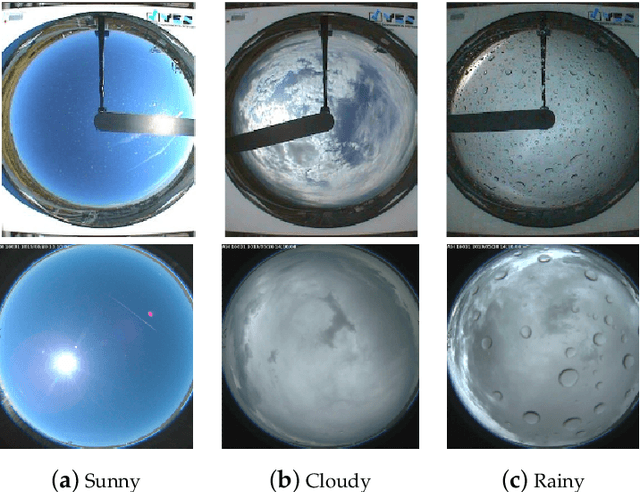
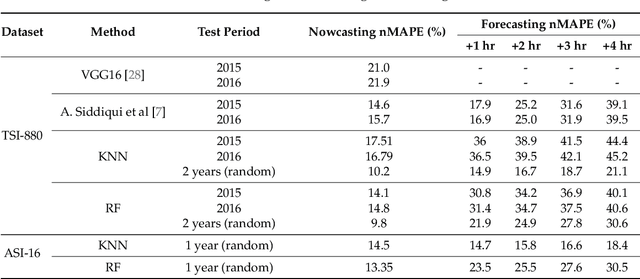
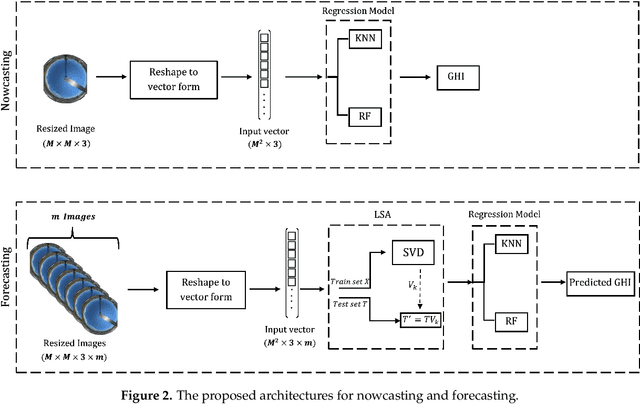
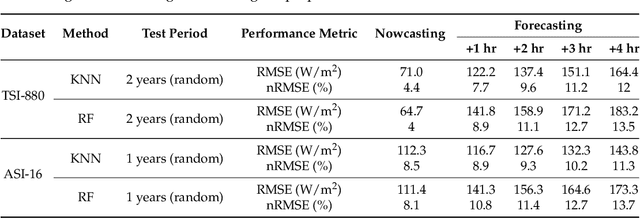
Ahead-of-time forecasting of the output power of power plants is essential for the stability of the electricity grid and ensuring uninterrupted service. However, forecasting renewable energy sources is difficult due to the chaotic behavior of natural energy sources. This paper presents a new approach to estimate short-term solar irradiance from sky images. The~proposed algorithm extracts features from sky images and use learning-based techniques to estimate the solar irradiance. The~performance of proposed machine learning (ML) algorithm is evaluated using two publicly available datasets of sky images. The~datasets contain over 350,000 images for an interval of 16 years, from 2004 to 2020, with the corresponding global horizontal irradiance (GHI) of each image as the ground truth. Compared to the state-of-the-art computationally heavy algorithms proposed in the literature, our approach achieves competitive results with much less computational complexity for both nowcasting and forecasting up to 4 h ahead of time.
* Published in MDPI Electronics Journal