 Add to Chrome
 Add to Firefox
 Add to Edge
MOSAIC-FL, a micro-service based privacy-preserving framework with application to genomics
Jul 27, 2026
Security and privacy are primordial requirements for Federated Learning (FL), especially in fields such as healthcare and genomics where sensitive information has to be analyzed. Our FL framework is designed to address these challenges while proposing a modular, flexible and micro-service architecture. More precisely, it integrates an efficient gRPC communication layer and a Finite State Machine to ensure robust component synchronization and threat detection, while relying on a fault-tolerant secure aggregation protocol using a Threshold variant of the CKKS homomorphic cryptosystem. This allows blind model aggregation by an orchestration server, requiring a minimum of $t$-out-of-$N$ active clients for decryption while minimizing communication overhead thanks to both cryptographic and network protocols. We ensure IND-CPA-D security through noise flooding and mitigate the recent key-recovery attack on synchronized decryptors by renewing the collective key material at every round. We demonstrate the framework's effectiveness through diverse use cases, ranging from standard image recognition (EMNIST) to complex genomic classification including breast cancer subtyping on TCGA, evaluating system performance across different threshold values and model scales.

When approximate design for fast homomorphic computation provides differential privacy guarantees
Apr 06, 2023While machine learning has become pervasive in as diversified fields as industry, healthcare, social networks, privacy concerns regarding the training data have gained a critical importance. In settings where several parties wish to collaboratively train a common model without jeopardizing their sensitive data, the need for a private training protocol is particularly stringent and implies to protect the data against both the model's end-users and the actors of the training phase. Differential privacy (DP) and cryptographic primitives are complementary popular countermeasures against privacy attacks. Among these cryptographic primitives, fully homomorphic encryption (FHE) offers ciphertext malleability at the cost of time-consuming operations in the homomorphic domain. In this paper, we design SHIELD, a probabilistic approximation algorithm for the argmax operator which is both fast when homomorphically executed and whose inaccuracy is used as a feature to ensure DP guarantees. Even if SHIELD could have other applications, we here focus on one setting and seamlessly integrate it in the SPEED collaborative training framework from "SPEED: Secure, PrivatE, and Efficient Deep learning" (Grivet S\'ebert et al., 2021) to improve its computational efficiency. After thoroughly describing the FHE implementation of our algorithm and its DP analysis, we present experimental results. To the best of our knowledge, it is the first work in which relaxing the accuracy of an homomorphic calculation is constructively usable as a degree of freedom to achieve better FHE performances.
Protecting Data from all Parties: Combining FHE and DP in Federated Learning
May 09, 2022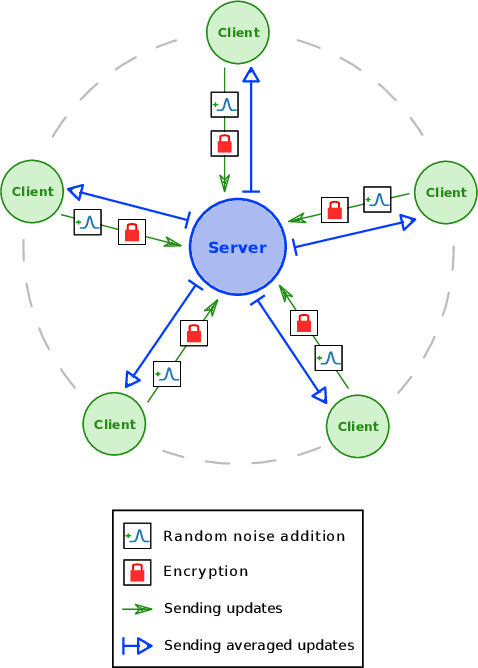
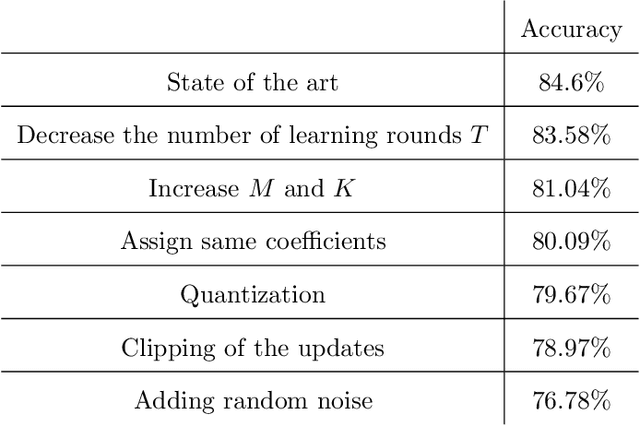
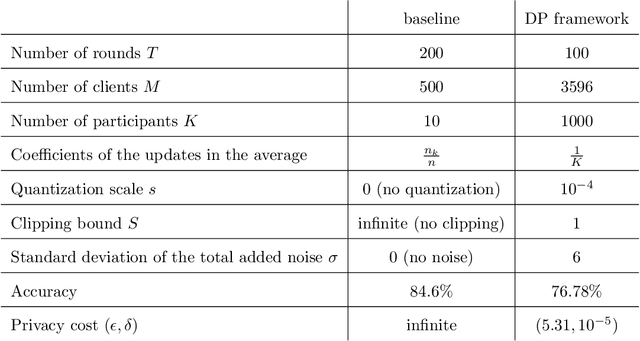
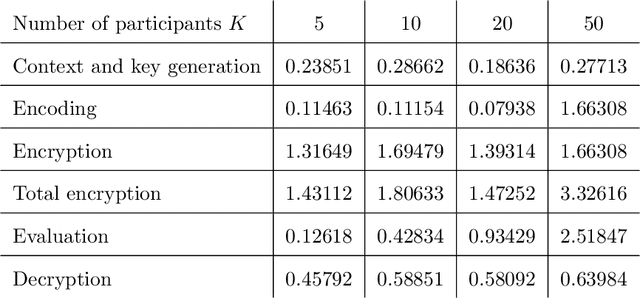
This paper tackles the problem of ensuring training data privacy in a federated learning context. Relying on Fully Homomorphic Encryption (FHE) and Differential Privacy (DP), we propose a secure framework addressing an extended threat model with respect to privacy of the training data. Notably, the proposed framework protects the privacy of the training data from all participants, namely the training data owners and an aggregating server. In details, while homomorphic encryption blinds a semi-honest server at learning stage, differential privacy protects the data from semi-honest clients participating in the training process as well as curious end-users with black-box or white-box access to the trained model. This paper provides with new theoretical and practical results to enable these techniques to be effectively combined. In particular, by means of a novel stochastic quantization operator, we prove differential privacy guarantees in a context where the noise is quantified and bounded due to the use of homomorphic encryption. The paper is concluded by experiments which show the practicality of the entire framework in spite of these interferences in terms of both model quality (impacted by DP) and computational overheads (impacted by FHE).