 Add to Chrome
 Add to Firefox
 Add to Edge
An Approach for Detection of Entities in Dynamic Media Contents
Dec 09, 2025
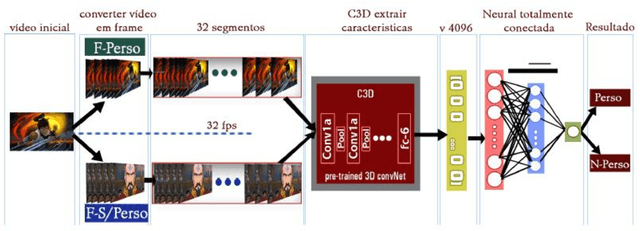
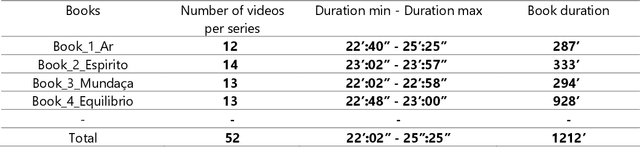
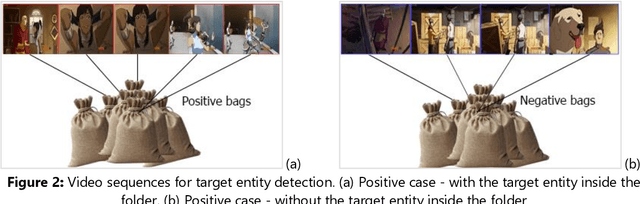

The notion of learning underlies almost every evolution of Intelligent Agents. In this paper, we present an approach for searching and detecting a given entity in a video sequence. Specifically, we study how the deep learning technique by artificial neuralnetworks allows us to detect a character in a video sequence. The technique of detecting a character in a video is a complex field of study, considering the multitude of objects present in the data under analysis. From the results obtained, we highlight the following, compared to state of the art: In our approach, within the field of Computer Vision, the structuring of supervised learning algorithms allowed us to achieve several successes from simple characteristics of the target character. Our results demonstrate that is new approach allows us to locate, in an efficient way, wanted individuals from a private or public image base. For the case of Angola, the classifier we propose opens the possibility of reinforcing the national security system based on the database of target individuals (disappeared, criminals, etc.) and the video sequences of the Integrated Public Security Centre (CISP).
* 12 pages, 8 figures

DetReIDX: A Stress-Test Dataset for Real-World UAV-Based Person Recognition
May 07, 2025Person reidentification (ReID) technology has been considered to perform relatively well under controlled, ground-level conditions, but it breaks down when deployed in challenging real-world settings. Evidently, this is due to extreme data variability factors such as resolution, viewpoint changes, scale variations, occlusions, and appearance shifts from clothing or session drifts. Moreover, the publicly available data sets do not realistically incorporate such kinds and magnitudes of variability, which limits the progress of this technology. This paper introduces DetReIDX, a large-scale aerial-ground person dataset, that was explicitly designed as a stress test to ReID under real-world conditions. DetReIDX is a multi-session set that includes over 13 million bounding boxes from 509 identities, collected in seven university campuses from three continents, with drone altitudes between 5.8 and 120 meters. More important, as a key novelty, DetReIDX subjects were recorded in (at least) two sessions on different days, with changes in clothing, daylight and location, making it suitable to actually evaluate long-term person ReID. Plus, data were annotated from 16 soft biometric attributes and multitask labels for detection, tracking, ReID, and action recognition. In order to provide empirical evidence of DetReIDX usefulness, we considered the specific tasks of human detection and ReID, where SOTA methods catastrophically degrade performance (up to 80% in detection accuracy and over 70% in Rank-1 ReID) when exposed to DetReIDXs conditions. The dataset, annotations, and official evaluation protocols are publicly available at https://www.it.ubi.pt/DetReIDX/