 Add to Chrome
 Add to Firefox
 Add to Edge
Is Inference Mediated by Distinct Semantic Structures in LLMs? A Mechanistic Interpretation
May 25, 2026
Predicting a label correctly does not necessarily require representing the operation that produces it. Transformer representations are known to carry label-level information, but whether they encode semantic operations producing those labels is unclear. We investigate this in Natural Language Inference using controlled premise-hypothesis pairs that differ by a single semantic transformation. Using layer-wise activations, we estimate operation-level subspaces via SVD and test their causal relevance through activation steering in four open-weight decoder models. Transformation effects are decodable with $84.8$-$99\%$ accuracy and occupy partially distinct but overlapping subspaces, exceeding random-subspace baselines. Steering experiments show that these directions causally influence predictions, though steerability varies across models; cross-operation steering further reveals structured interference and a dissociation between subspace selectivity and cross-operation independence. These findings indicate that the models encode not only that a hypothesis relates to a premise but also, in part, how it does so, implying that mechanistic analysis and control should operate at the level of semantic operations rather than predicted labels alone.

From Circuit Evidence to Mechanistic Theory: An Inductive Logic Approach
May 20, 2026Mechanistic interpretability produces circuit-level causal analyses of neural network behaviour, but discovered circuits often remain isolated experimental artefacts: there is no shared formal representation for what circuits compute, how they relate, or when two findings provide evidence for the same mechanism. This work provides a formal infrastructure for cumulative mechanistic science by treating circuit interpretation as inductive theory construction. Each circuit is characterised at two levels: a Causal Functional Signature (CFS), which grounds component behaviour in causal attribution evidence and token role profiles, and an architectural signature $τ_{\mathrm{arch}}$, learned by inductive logic programming (ILP) from scale-invariant structural predicates. Together, these constitute a formal coherence layer that makes mechanistic claims explicit, comparable via $θ$-subsumption, and portable across model scales. CFS reveals qualitatively distinct computational strategies across task types, including attention-mediated copying versus MLP-mediated binding. ILP signatures achieve substantially better structural separation than graph kernel and feature-vector baselines, and support principled transfer across model scales and architecture families.
TRACE for Tracking the Emergence of Semantic Representations in Transformers
May 23, 2025Modern transformer models exhibit phase transitions during training, distinct shifts from memorisation to abstraction, but the mechanisms underlying these transitions remain poorly understood. Prior work has often focused on endpoint representations or isolated signals like curvature or mutual information, typically in symbolic or arithmetic domains, overlooking the emergence of linguistic structure. We introduce TRACE (Tracking Representation Abstraction and Compositional Emergence), a diagnostic framework combining geometric, informational, and linguistic signals to detect phase transitions in Transformer-based LMs. TRACE leverages a frame-semantic data generation method, ABSynth, that produces annotated synthetic corpora with controllable complexity, lexical distributions, and structural entropy, while being fully annotated with linguistic categories, enabling precise analysis of abstraction emergence. Experiments reveal that (i) phase transitions align with clear intersections between curvature collapse and dimension stabilisation; (ii) these geometric shifts coincide with emerging syntactic and semantic accuracy; (iii) abstraction patterns persist across architectural variants, with components like feedforward networks affecting optimisation stability rather than fundamentally altering trajectories. This work advances our understanding of how linguistic abstractions emerge in LMs, offering insights into model interpretability, training efficiency, and compositional generalisation that could inform more principled approaches to LM development.
Interpreting token compositionality in LLMs: A robustness analysis
Oct 16, 2024Understanding the internal mechanisms of large language models (LLMs) is integral to enhancing their reliability, interpretability, and inference processes. We present Constituent-Aware Pooling (CAP), a methodology designed to analyse how LLMs process compositional linguistic structures. Grounded in principles of compositionality, mechanistic interpretability, and information gain theory, CAP systematically intervenes in model activations through constituent-based pooling at various model levels. Our experiments on inverse definition modelling, hypernym and synonym prediction reveal critical insights into transformers' limitations in handling compositional abstractions. No specific layer integrates tokens into unified semantic representations based on their constituent parts. We observe fragmented information processing, which intensifies with model size, suggesting that larger models struggle more with these interventions and exhibit greater information dispersion. This fragmentation likely stems from transformers' training objectives and architectural design, preventing systematic and cohesive representations. Our findings highlight fundamental limitations in current transformer architectures regarding compositional semantics processing and model interpretability, underscoring the critical need for novel approaches in LLM design to address these challenges.
The Mechanics of Conceptual Interpretation in GPT Models: Interpretative Insights
Aug 05, 2024
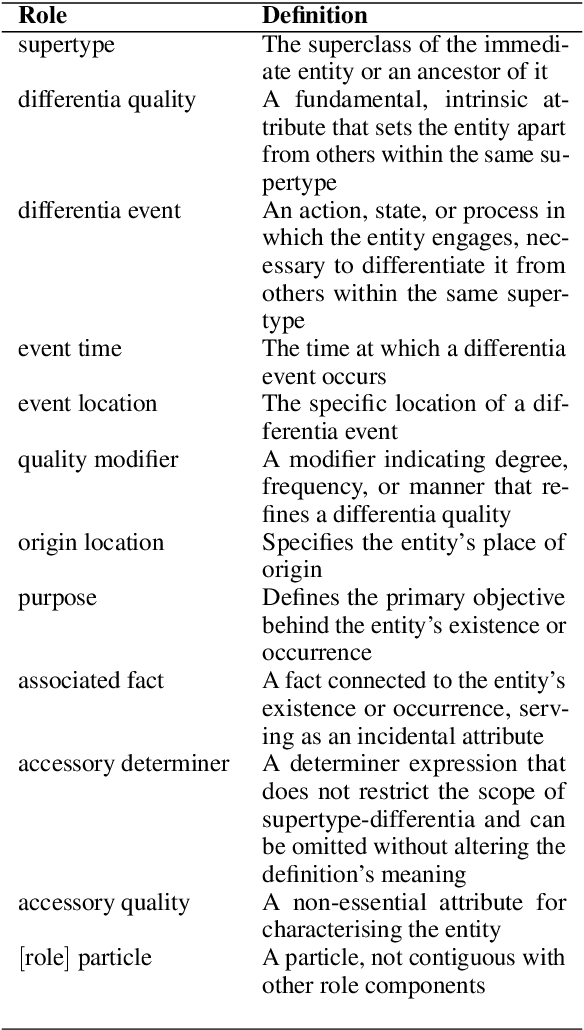
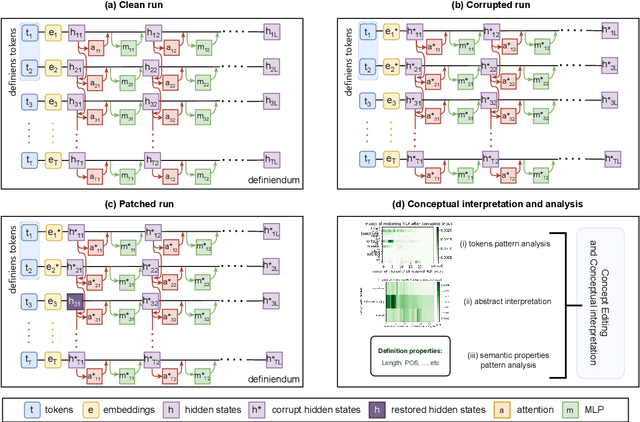
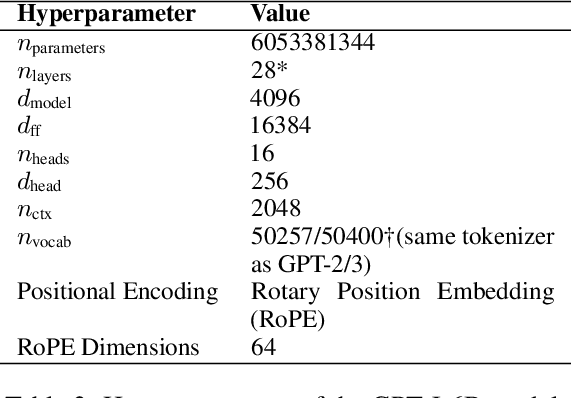
Locating and editing knowledge in large language models (LLMs) is crucial for enhancing their accuracy, safety, and inference rationale. We introduce ``concept editing'', an innovative variation of knowledge editing that uncovers conceptualisation mechanisms within these models. Using the reverse dictionary task, inference tracing, and input abstraction, we analyse the Multi-Layer Perceptron (MLP), Multi-Head Attention (MHA), and hidden state components of transformer models. Our results reveal distinct patterns: MLP layers employ key-value retrieval mechanism and context-dependent processing, which are highly associated with relative input tokens. MHA layers demonstrate a distributed nature with significant higher-level activations, suggesting sophisticated semantic integration. Hidden states emphasise the importance of the last token and top layers in the inference process. We observe evidence of gradual information building and distributed representation. These observations elucidate how transformer models process semantic information, paving the way for targeted interventions and improved interpretability techniques. Our work highlights the complex, layered nature of semantic processing in LLMs and the challenges of isolating and modifying specific concepts within these models.
Genetic Algorithm-Based Dynamic Backdoor Attack on Federated Learning-Based Network Traffic Classification
Sep 27, 2023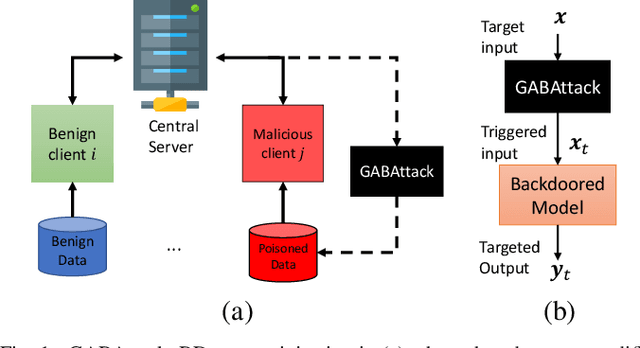
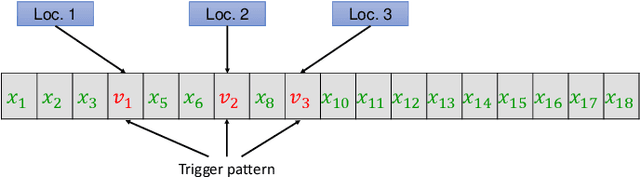
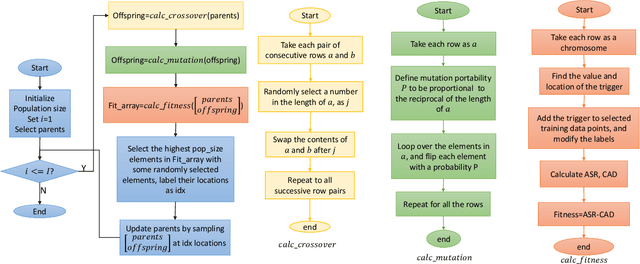

Federated learning enables multiple clients to collaboratively contribute to the learning of a global model orchestrated by a central server. This learning scheme promotes clients' data privacy and requires reduced communication overheads. In an application like network traffic classification, this helps hide the network vulnerabilities and weakness points. However, federated learning is susceptible to backdoor attacks, in which adversaries inject manipulated model updates into the global model. These updates inject a salient functionality in the global model that can be launched with specific input patterns. Nonetheless, the vulnerability of network traffic classification models based on federated learning to these attacks remains unexplored. In this paper, we propose GABAttack, a novel genetic algorithm-based backdoor attack against federated learning for network traffic classification. GABAttack utilizes a genetic algorithm to optimize the values and locations of backdoor trigger patterns, ensuring a better fit with the input and the model. This input-tailored dynamic attack is promising for improved attack evasiveness while being effective. Extensive experiments conducted over real-world network datasets validate the success of the proposed GABAttack in various situations while maintaining almost invisible activity. This research serves as an alarming call for network security experts and practitioners to develop robust defense measures against such attacks.