 Add to Chrome
 Add to Firefox
 Add to Edge
CASS-RTL: Correctness-Aware Subspace Steering for RTL Generation with LLMs
Jun 04, 2026
Recent advances in large language models (LLMs) have enabled the automatic synthesis (generation) of register-transfer level (RTL) code from natural language instructions, offering a promising pathway to accelerate chip design. Unlike typical natural language (and software coding) tasks, LLM-based RTL code generation demands strict cycle accuracy with concurrency, where minor logical errors can render a circuit unusable or insecure. While prior work has explored hallucination mitigation via external verification, self-evaluation prompts, retrieval-augmented prompting, domain specific fine-tuning, agentic solutions, and reasoning, these approaches largely overlook the attention-oriented internal mechanisms of LLMs that may inherently correlate with RTL correctness. This work proposes CASS-RTL, a first-of-its-kind framework for discovering and leveraging LLMs' correctness-aware components to guide RTL generation toward functionally accurate outputs. We (i) identify attention heads whose activation patterns consistently differentiate correct from incorrect RTL; (ii) construct a low-dimensional subspace capturing correctness-relevant signals; and (iii) design a lightweight, geometry-aware intervention that steers the model at inference time. CASS-RTL is fully model-agnostic, requires no additional supervision or retraining, and readily integrates into existing models. Empirically, we evaluate CASS-RTL on multiple models and observe 10%-20% improvement in pass@1/5/10 accuracy on VerilogEval and 5% improvement on CVDP, demonstrating the effectiveness of our method in enhancing reliability without sacrificing model efficiency or requiring a large labeled dataset for fine-tuning.

Locality Sensitive Hashing for Network Traffic Fingerprinting
Feb 12, 2024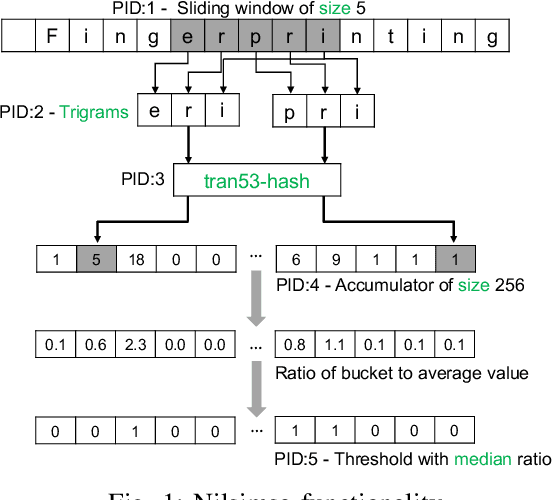
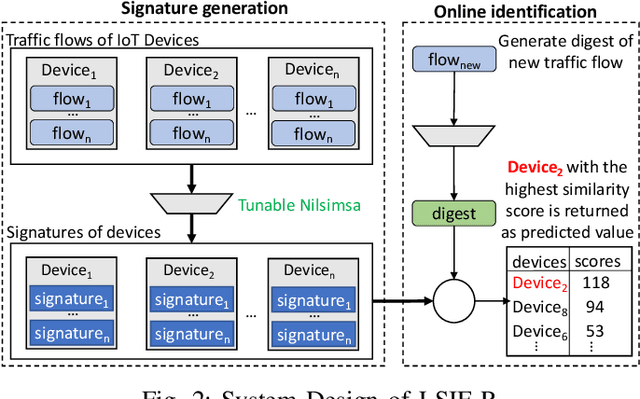
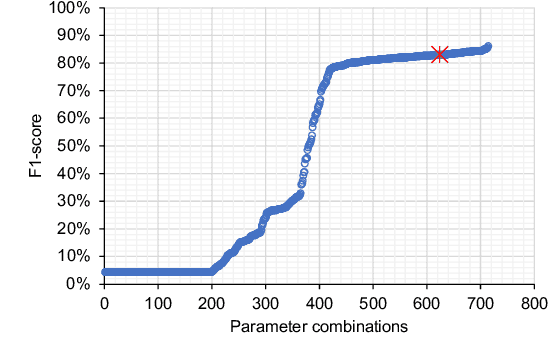
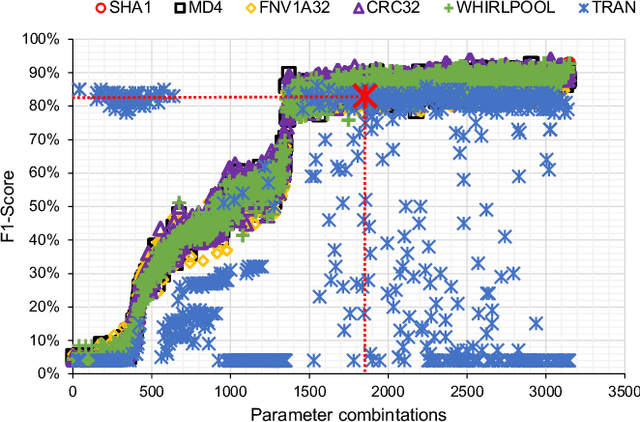
The advent of the Internet of Things (IoT) has brought forth additional intricacies and difficulties to computer networks. These gadgets are particularly susceptible to cyber-attacks because of their simplistic design. Therefore, it is crucial to recognise these devices inside a network for the purpose of network administration and to identify any harmful actions. Network traffic fingerprinting is a crucial technique for identifying devices and detecting anomalies. Currently, the predominant methods for this depend heavily on machine learning (ML). Nevertheless, machine learning (ML) methods need the selection of features, adjustment of hyperparameters, and retraining of models to attain optimal outcomes and provide resilience to concept drifts detected in a network. In this research, we suggest using locality-sensitive hashing (LSH) for network traffic fingerprinting as a solution to these difficulties. Our study focuses on examining several design options for the Nilsimsa LSH function. We then use this function to create unique fingerprints for network data, which may be used to identify devices. We also compared it with ML-based traffic fingerprinting and observed that our method increases the accuracy of state-of-the-art by 12% achieving around 94% accuracy in identifying devices in a network.