 Add to Chrome
 Add to Firefox
 Add to Edge
Investigating Permutation-Invariant Discrete Representation Learning for Spatially Aligned Images
Apr 02, 2026
Vector quantization approaches (VQ-VAE, VQ-GAN) learn discrete neural representations of images, but these representations are inherently position-dependent: codes are spatially arranged and contextually entangled, requiring autoregressive or diffusion-based priors to model their dependencies at sample time. In this work, we ask whether positional information is necessary for discrete representations of spatially aligned data. We propose the permutation-invariant vector-quantized autoencoder (PI-VQ), in which latent codes are constrained to carry no positional information. We find that this constraint encourages codes to capture global, semantic features, and enables direct interpolation between images without a learned prior. To address the reduced information capacity of permutation-invariant representations, we introduce matching quantization, a vector quantization algorithm based on optimal bipartite matching that increases effective bottleneck capacity by $3.5\times$ relative to naive nearest-neighbour quantization. The compositional structure of the learned codes further enables interpolation-based sampling, allowing synthesis of novel images in a single forward pass. We evaluate PI-VQ on CelebA, CelebA-HQ and FFHQ, obtaining competitive precision, density and coverage metrics for images synthesised with our approach. We discuss the trade-offs inherent to position-free representations, including separability and interpretability of the latent codes, pointing to numerous directions for future work.

Controllable Image Generation With Composed Parallel Token Prediction
May 10, 2024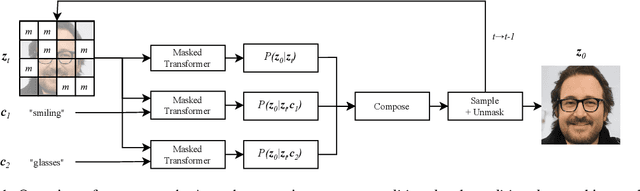
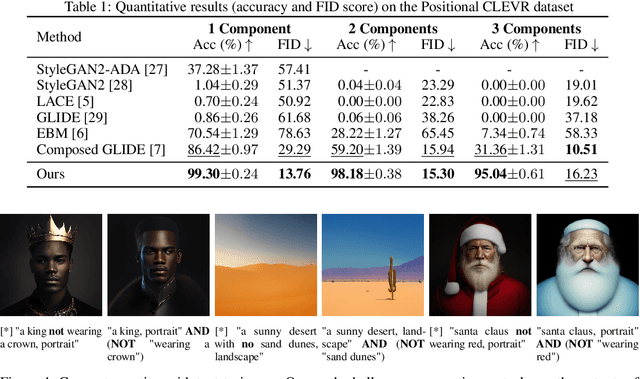
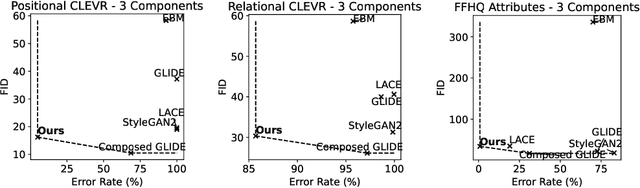

Compositional image generation requires models to generalise well in situations where two or more input concepts do not necessarily appear together in training (compositional generalisation). Despite recent progress in compositional image generation via composing continuous sampling processes such as diffusion and energy-based models, composing discrete generative processes has remained an open challenge, with the promise of providing improvements in efficiency, interpretability and simplicity. To this end, we propose a formulation for controllable conditional generation of images via composing the log-probability outputs of discrete generative models of the latent space. Our approach, when applied alongside VQ-VAE and VQ-GAN, achieves state-of-the-art generation accuracy in three distinct settings (FFHQ, Positional CLEVR and Relational CLEVR) while attaining competitive Fr\'echet Inception Distance (FID) scores. Our method attains an average generation accuracy of $80.71\%$ across the studied settings. Our method also outperforms the next-best approach (ranked by accuracy) in terms of FID in seven out of nine experiments, with an average FID of $24.23$ (an average improvement of $-9.58$). Furthermore, our method offers a $2.3\times$ to $12\times$ speedup over comparable continuous compositional methods on our hardware. We find that our method can generalise to combinations of input conditions that lie outside the training data (e.g. more objects per image) in addition to offering an interpretable dimension of controllability via concept weighting. We further demonstrate that our approach can be readily applied to an open pre-trained discrete text-to-image model without any fine-tuning, allowing for fine-grained control of text-to-image generation.
Exploring Racial Bias within Face Recognition via per-subject Adversarially-Enabled Data Augmentation
Apr 19, 2020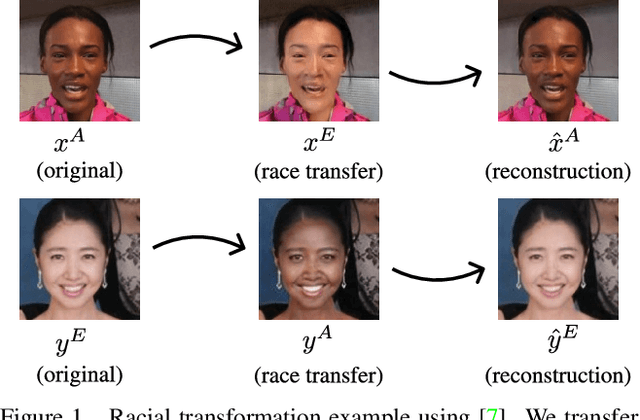
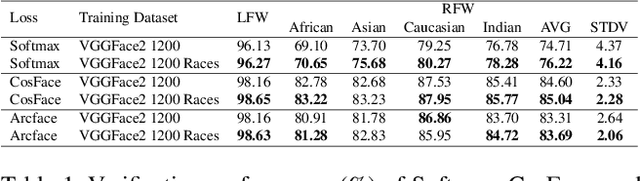
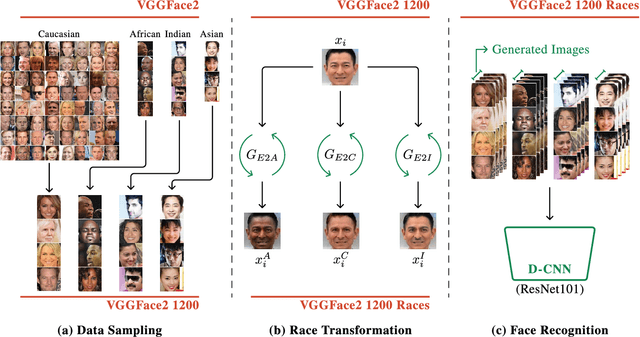

Whilst face recognition applications are becoming increasingly prevalent within our daily lives, leading approaches in the field still suffer from performance bias to the detriment of some racial profiles within society. In this study, we propose a novel adversarial derived data augmentation methodology that aims to enable dataset balance at a per-subject level via the use of image-to-image transformation for the transfer of sensitive racial characteristic facial features. Our aim is to automatically construct a synthesised dataset by transforming facial images across varying racial domains, while still preserving identity-related features, such that racially dependant features subsequently become irrelevant within the determination of subject identity. We construct our experiments on three significant face recognition variants: Softmax, CosFace and ArcFace loss over a common convolutional neural network backbone. In a side-by-side comparison, we show the positive impact our proposed technique can have on the recognition performance for (racial) minority groups within an originally imbalanced training dataset by reducing the pre-race variance in performance.