 Add to Chrome
 Add to Firefox
 Add to Edge
SEABAD: A Tropical Bird Activity Detection Dataset for Passive Acoustic Monitoring
May 20, 2026
Passive acoustic monitoring (PAM) enables large-scale biodiversity assessment, but continuous recording generates large amounts of non-informative audio, creating challenges for storage, power consumption, and long-term edge deployment. Bird audio detection (BAD), which identifies bird vocalizations, can reduce this burden by filtering irrelevant recordings before downstream analysis. However, most BAD systems are trained on temperate datasets despite tropical soundscapes being denser, more species-rich, and acoustically unpredictable. To address this gap, we introduce SEABAD (Southeast Asian Bird Activity Detection), a dataset of 50,000 curated three-second clips from Southeast Asian soundscapes, evenly balanced between bird-present and bird-absent samples. The dataset spans 1,677 bird species and is standardized to 16 kHz mono audio for embedded and low-power inference. We developed a dual-branch curation pipeline: a six-stage positive-label workflow applied to Xeno-Canto recordings, alongside six source-specific negative-label extractions from environmental datasets. These procedures reduced class imbalance by 13.7% (Gini coefficient: 0.601 to 0.519). A manual audit of 1,000 positive clips confirmed 97.8% +/- 0.9% labeling accuracy. Baseline experiments using MobileNetV3-Small achieved 99.57% +/- 0.25% accuracy and 0.9985 +/- 0.0002 AUC across three random seeds. SEABAD and the full curation pipeline are publicly released to support tropical BAD research and energy-efficient acoustic monitoring.

MicarVLMoE: A Modern Gated Cross-Aligned Vision-Language Mixture of Experts Model for Medical Image Captioning and Report Generation
Apr 29, 2025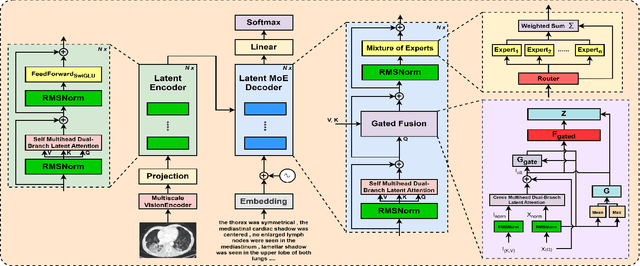
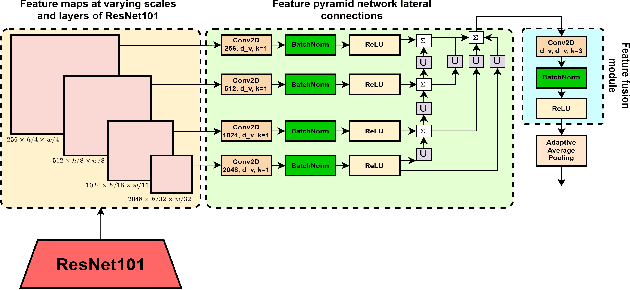
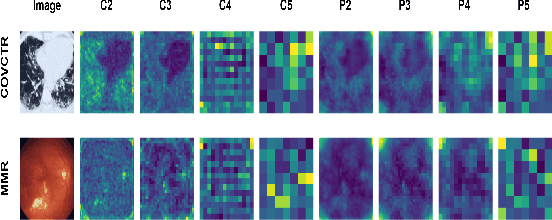
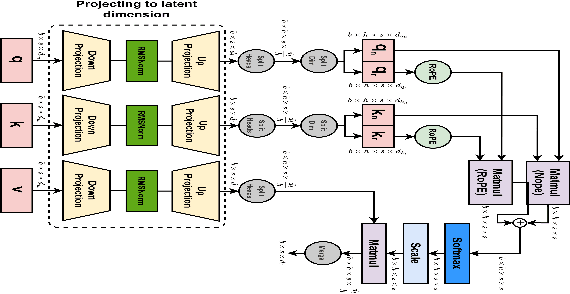
Medical image reporting (MIR) aims to generate structured clinical descriptions from radiological images. Existing methods struggle with fine-grained feature extraction, multimodal alignment, and generalization across diverse imaging types, often relying on vanilla transformers and focusing primarily on chest X-rays. We propose MicarVLMoE, a vision-language mixture-of-experts model with gated cross-aligned fusion, designed to address these limitations. Our architecture includes: (i) a multiscale vision encoder (MSVE) for capturing anatomical details at varying resolutions, (ii) a multihead dual-branch latent attention (MDLA) module for vision-language alignment through latent bottleneck representations, and (iii) a modulated mixture-of-experts (MoE) decoder for adaptive expert specialization. We extend MIR to CT scans, retinal imaging, MRI scans, and gross pathology images, reporting state-of-the-art results on COVCTR, MMR, PGROSS, and ROCO datasets. Extensive experiments and ablations confirm improved clinical accuracy, cross-modal alignment, and model interpretability. Code is available at https://github.com/AI-14/micar-vl-moe.