 Add to Chrome
 Add to Firefox
 Add to Edge
Generative climate downscaling enables high-resolution compound risk assessment by preserving multivariate dependencies
May 12, 2026
Physics-based climate projections using general circulation models are essential for assessing future risks, but their coarse resolution limits regional decision-making. Statistical downscaling can efficiently add detail, yet many methods treat variables independently, degrading inter-variable relationships that govern compound hazards such as heat stress, drought, and wildfire. Here we show that a diffusion-based multivariate generative framework, combined with bias correction, recovers degraded inter-variable correlations even under a 50$\times$ increase in linear resolution. When applied to five meteorological variables over Japan, the framework reduces inter-variable correlation errors by more than fourfold relative to existing baselines while improving both univariate and spatial accuracy, leading to more accurate detection of severe drought. These results demonstrate that multivariate generative downscaling improves the reliability of compound risk assessment under large resolution gaps.

Deep generative model super-resolves spatially correlated multiregional climate data
Sep 26, 2022Super-resolving the coarse outputs of global climate simulations, termed downscaling, is crucial in making political and social decisions on systems requiring long-term climate change projections. Existing fast super-resolution techniques, however, have yet to preserve the spatially correlated nature of climatological data, which is particularly important when we address systems with spatial expanse, such as the development of transportation infrastructure. Herein, we show an adversarial network-based machine learning enables us to correctly reconstruct the inter-regional spatial correlations in downscaling with high magnification up to fifty, while maintaining the pixel-wise statistical consistency. Direct comparison with the measured meteorological data of temperature and precipitation distributions reveals that integrating climatologically important physical information is essential for the accurate downscaling, which prompts us to call our approach $\pi$SRGAN (Physics Informed Super-Resolution Generative Adversarial Network). The present method has a potential application to the inter-regionally consistent assessment of the climate change impact.
What Do Deep Neural Networks Find in Disordered Structures of Glasses?
Jul 31, 2022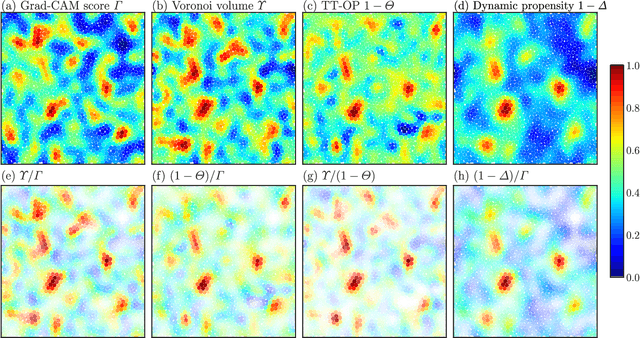
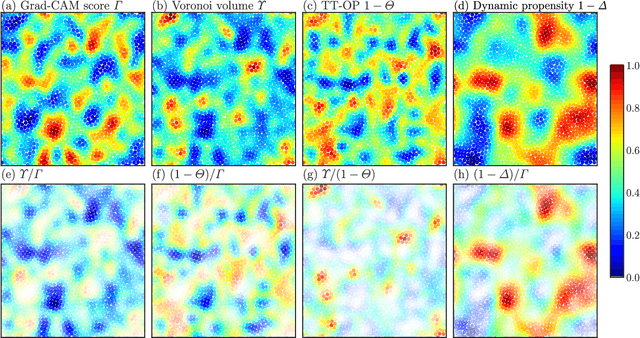
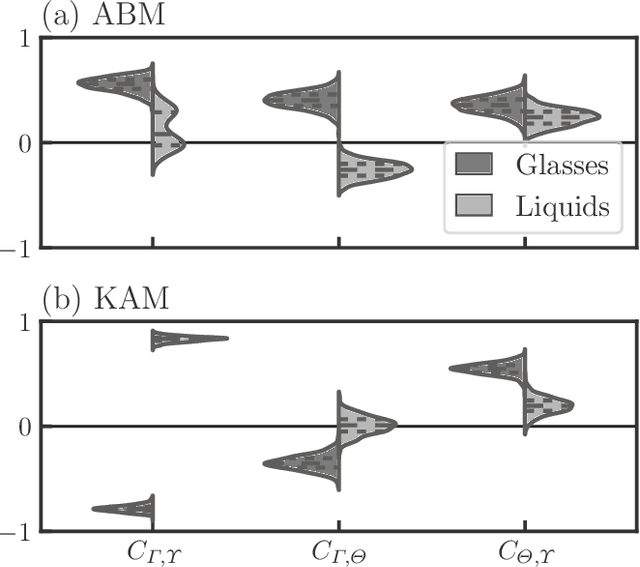
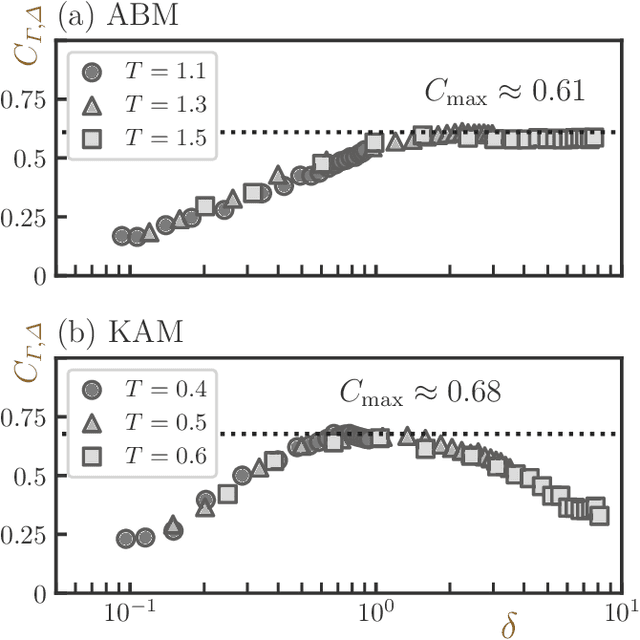
Glass transitions are widely observed in a range of types of soft matter systems. However, the physical mechanism of these transitions remains unknown, despite years of ambitious research. In particular, an important unanswered question is whether the glass transition is accompanied by a divergence of the correlation lengths of the characteristic static structures. Recently, a method that can predict long-time dynamics from purely static information with high accuracy was proposed; however, even this method is not universal and does not work well for the Kob--Andersen system, which is a typical model of glass-forming liquids. In this study, we developed a method to extract the characteristic structures of glasses using machine learning or, specifically, a convolutional neural network. In particular, we extracted the characteristic structures by quantifying the grounds for the decisions made by the network. We considered two qualitatively different glass-forming binary systems and, through comparisons with several established structural indicators, we demonstrate that our system can identify characteristic structures that depend on the details of the systems. Surprisingly, the extracted structures were strongly correlated with the nonequilibrium aging dynamics on thermal fluctuation.