 Add to Chrome
 Add to Firefox
 Add to Edge
Causal Concept Graphs in LLM Latent Space for Stepwise Reasoning
Mar 11, 2026
Sparse autoencoders can localize where concepts live in language models, but not how they interact during multi-step reasoning. We propose Causal Concept Graphs (CCG): a directed acyclic graph over sparse, interpretable latent features, where edges capture learned causal dependencies between concepts. We combine task-conditioned sparse autoencoders for concept discovery with DAGMA-style differentiable structure learning for graph recovery and introduce the Causal Fidelity Score (CFS) to evaluate whether graph-guided interventions induce larger downstream effects than random ones. On ARC-Challenge, StrategyQA, and LogiQA with GPT-2 Medium, across five seeds ($n{=}15$ paired runs), CCG achieves $\CFS=5.654\pm0.625$, outperforming ROME-style tracing ($3.382\pm0.233$), SAE-only ranking ($2.479\pm0.196$), and a random baseline ($1.032\pm0.034$), with $p<0.0001$ after Bonferroni correction. Learned graphs are sparse (5-6\% edge density), domain-specific, and stable across seeds.

Regularized Meta-Learning for Improved Generalization
Feb 12, 2026Deep ensemble methods often improve predictive performance, yet they suffer from three practical limitations: redundancy among base models that inflates computational cost and degrades conditioning, unstable weighting under multicollinearity, and overfitting in meta-learning pipelines. We propose a regularized meta-learning framework that addresses these challenges through a four-stage pipeline combining redundancy-aware projection, statistical meta-feature augmentation, and cross-validated regularized meta-models (Ridge, Lasso, and ElasticNet). Our multi-metric de-duplication strategy removes near-collinear predictors using correlation and MSE thresholds ($τ_{\text{corr}}=0.95$), reducing the effective condition number of the meta-design matrix while preserving predictive diversity. Engineered ensemble statistics and interaction terms recover higher-order structure unavailable to raw prediction columns. A final inverse-RMSE blending stage mitigates regularizer-selection variance. On the Playground Series S6E1 benchmark (100K samples, 72 base models), the proposed framework achieves an out-of-fold RMSE of 8.582, improving over simple averaging (8.894) and conventional Ridge stacking (8.627), while matching greedy hill climbing (8.603) with substantially lower runtime (4 times faster). Conditioning analysis shows a 53.7\% reduction in effective matrix condition number after redundancy projection. Comprehensive ablations demonstrate consistent contributions from de-duplication, statistical meta-features, and meta-ensemble blending. These results position regularized meta-learning as a stable and deployment-efficient stacking strategy for high-dimensional ensemble systems.
A Robust Epipolar-Domain Regularization Algorithm for Light Field Depth Estimation
Aug 12, 2025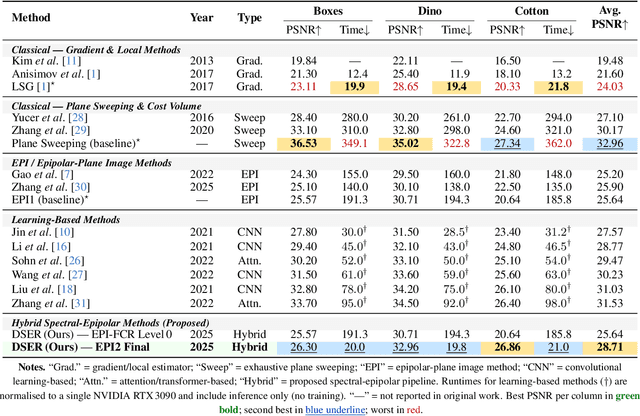
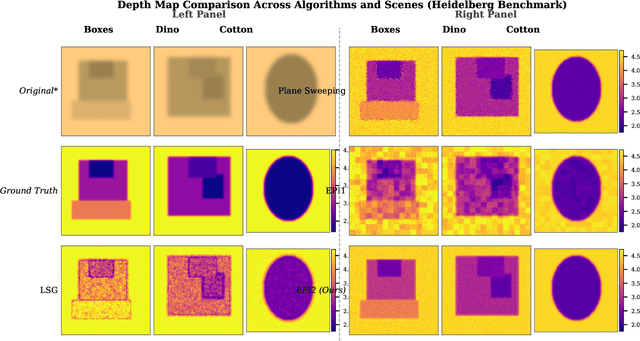
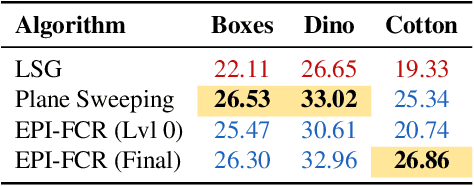
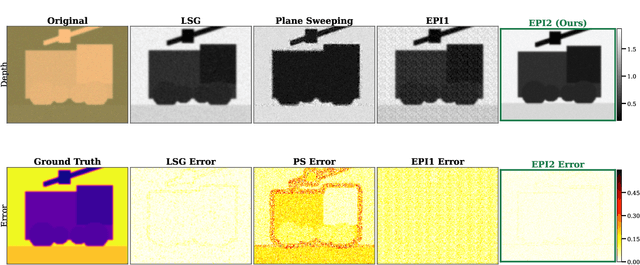
Robust depth estimation in light field imaging remains a critical challenge for pattern recognition applications such as augmented reality, biomedical imaging, and scene reconstruction. While existing approaches often rely heavily on deep convolutional neural networks, they tend to incur high computational costs and struggle in noisy real-world environments. This paper proposes a novel lightweight depth estimation pipeline that integrates light field-based disparity information with a directed random walk refinement algorithm. Unlike traditional CNN-based methods, our approach enhances depth map consistency without requiring extensive training or large-scale datasets. The proposed method was evaluated on the 4D Light Field Benchmark dataset and a diverse set of real-world images. Experimental results indicate that while performance slightly declines under uncontrolled conditions, the algorithm consistently maintains low computational complexity and competitive accuracy compared to state-of-the-art deep learning models. These findings highlight the potential of our method as a robust and efficient alternative for depth estimation and segmentation in light field imaging. The work provides insights into practical algorithm design for light field-based pattern recognition and opens new directions for integrating probabilistic graph models with depth sensing frameworks.