 Add to Chrome
 Add to Firefox
 Add to Edge
Good flavor search in $SU(5)$: a machine learning approach
Nov 11, 2025

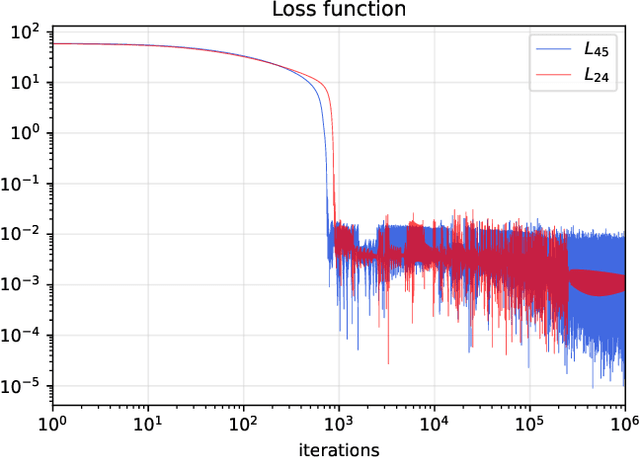
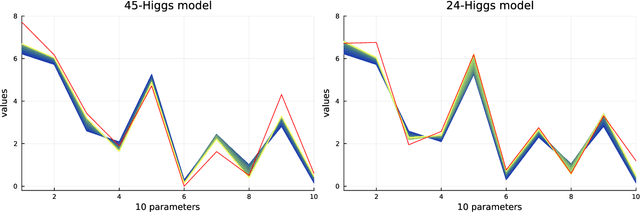
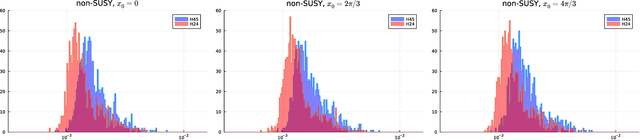
We revisit the fermion mass problem of the $SU(5)$ grand unified theory using machine learning techniques. The original $SU(5)$ model proposed by Georgi and Glashow is incompatible with the observed fermion mass spectrum. Two remedies are known to resolve this discrepancy, one is through introducing a new interaction via a 45-dimensional field, and the other via a 24-dimensional field. We investigate which modification is more natural, defining naturalness as proximity to the original Georgi-Glashow $SU(5)$ model. Our analysis shows that, in both supersymmetric and non-supersymmetric scenarios, the model incorporating the interaction with the 24-dimensional field is more natural under this criterion. We then generalise these models by introducing a continuous parameter $y$, which takes the value 3 for the 45-dimensional field and 1.5 for the 24-dimensional field. Numerical optimisation reveals that $y \approx 0.8$ yields the closest match to the original $SU(5)$ model, indicating that this value corresponds to the most natural model according to our definition.

Truth, beauty, and goodness in grand unification: a machine learning approach
Nov 11, 2024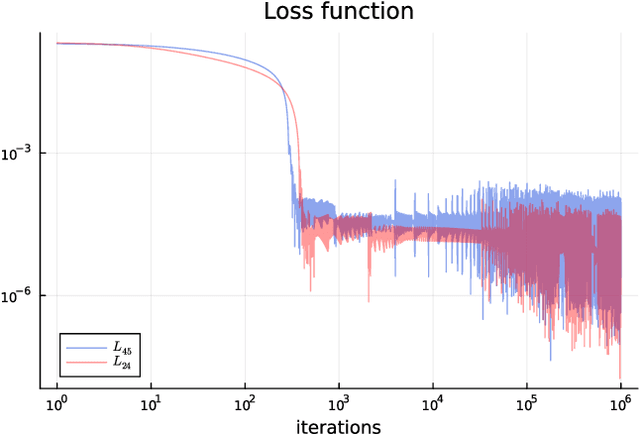

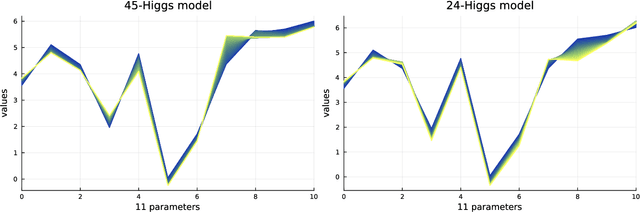

We investigate the flavour sector of the supersymmetric $SU(5)$ Grand Unified Theory (GUT) model using machine learning techniques. The minimal $SU(5)$ model is known to predict fermion masses that disagree with observed values in nature. There are two well-known approaches to address this issue: one involves introducing a 45-representation Higgs field, while the other employs a higher-dimensional operator involving the 24-representation GUT Higgs field. We compare these two approaches by numerically optimising a loss function, defined as the ratio of determinants of mass matrices. Our findings indicate that the 24-Higgs approach achieves the observed fermion masses with smaller modifications to the original minimal $SU(5)$ model.