 Add to Chrome
 Add to Firefox
 Add to Edge
Leveraging Digitized Newspapers to Collect Summarization Data in Low-Resource Languages
Nov 18, 2025
High quality summarization data remains scarce in under-represented languages. However, historical newspapers, made available through recent digitization efforts, offer an abundant source of untapped, naturally annotated data. In this work, we present a novel method for collecting naturally occurring summaries via Front-Page Teasers, where editors summarize full length articles. We show that this phenomenon is common across seven diverse languages and supports multi-document summarization. To scale data collection, we develop an automatic process, suited to varying linguistic resource levels. Finally, we apply this process to a Hebrew newspaper title, producing HEBTEASESUM, the first dedicated multi-document summarization dataset in Hebrew.

The State and Fate of Summarization Datasets
Nov 07, 2024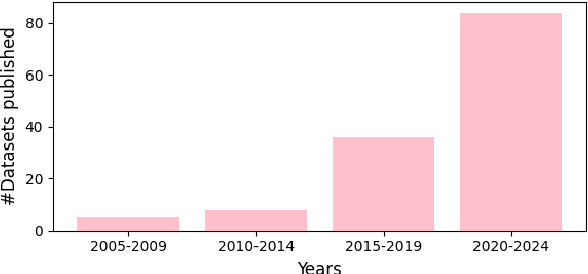
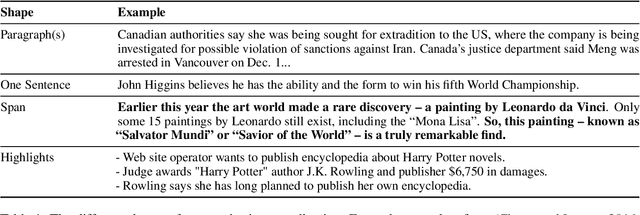
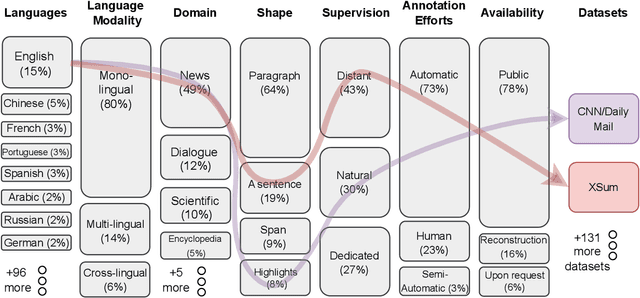

Automatic summarization has consistently attracted attention, due to its versatility and wide application in various downstream tasks. Despite its popularity, we find that annotation efforts have largely been disjointed, and have lacked common terminology. Consequently, it is challenging to discover existing resources or identify coherent research directions. To address this, we survey a large body of work spanning 133 datasets in over 100 languages, creating a novel ontology covering sample properties, collection methods and distribution. With this ontology we make key observations, including the lack in accessible high-quality datasets for low-resource languages, and the field's over-reliance on the news domain and on automatically collected distant supervision. Finally, we make available a web interface that allows users to interact and explore our ontology and dataset collection, as well as a template for a summarization data card, which can be used to streamline future research into a more coherent body of work.