 Add to Chrome
 Add to Firefox
 Add to Edge
Transformer-based Koopman Autoencoder for Linearizing Fisher's Equation
Dec 03, 2024
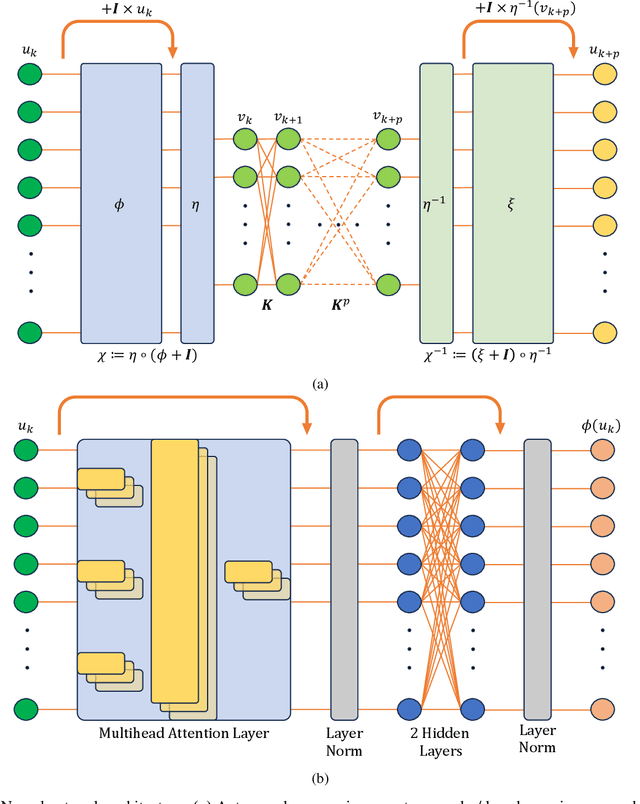


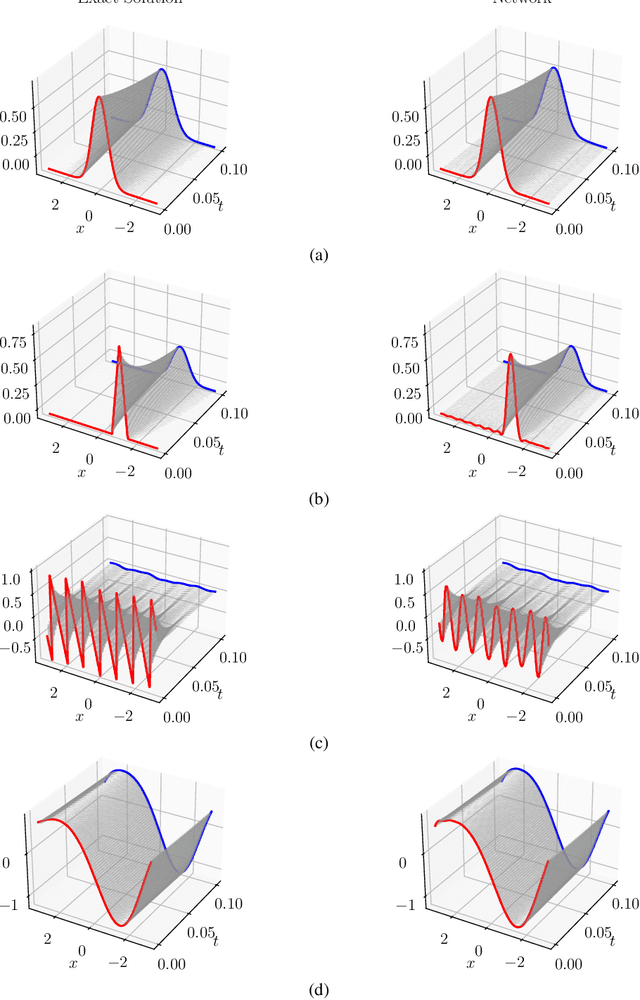
A Transformer-based Koopman autoencoder is proposed for linearizing Fisher's reaction-diffusion equation. The primary focus of this study is on using deep learning techniques to find complex spatiotemporal patterns in the reaction-diffusion system. The emphasis is on not just solving the equation but also transforming the system's dynamics into a more comprehensible, linear form. Global coordinate transformations are achieved through the autoencoder, which learns to capture the underlying dynamics by training on a dataset with 60,000 initial conditions. Extensive testing on multiple datasets was used to assess the efficacy of the proposed model, demonstrating its ability to accurately predict the system's evolution as well as to generalize. We provide a thorough comparison study, comparing our suggested design to a few other comparable methods using experiments on various PDEs, such as the Kuramoto-Sivashinsky equation and the Burger's equation. Results show improved accuracy, highlighting the capabilities of the Transformer-based Koopman autoencoder. The proposed architecture in is significantly ahead of other architectures, in terms of solving different types of PDEs using a single architecture. Our method relies entirely on the data, without requiring any knowledge of the underlying equations. This makes it applicable to even the datasets where the governing equations are not known.

What is India speaking: The "Hinglish" invasion
Dec 18, 2015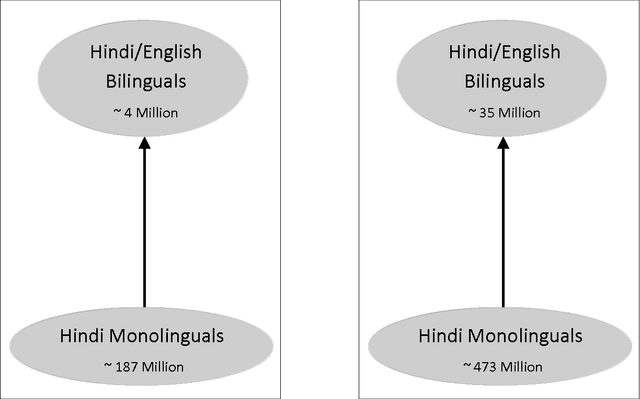
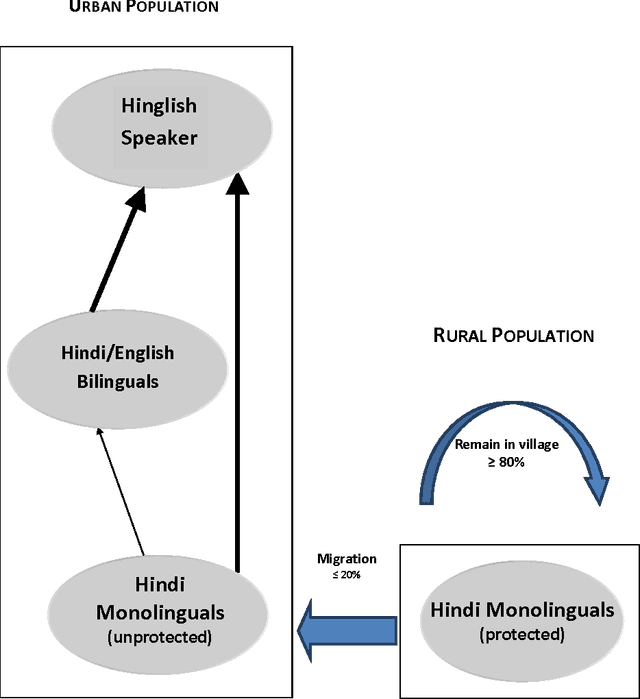
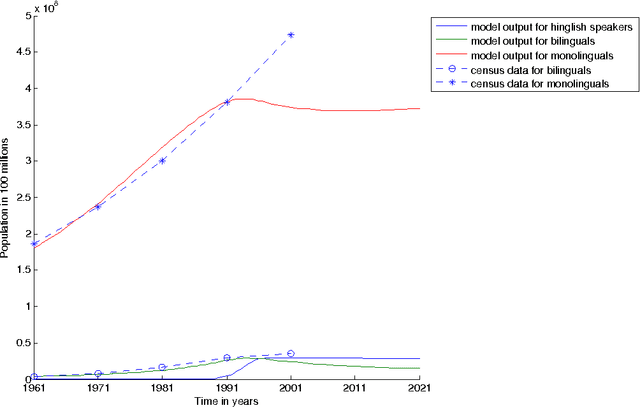
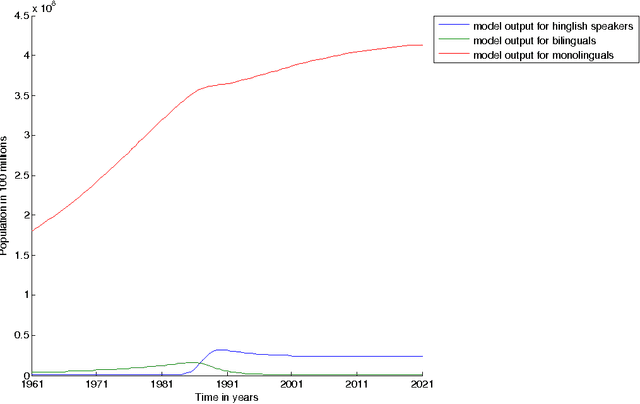
While language competition models of diachronic language shift are increasingly sophisticated, drawing on sociolinguistic components like variable language prestige, distance from language centers and intermediate bilingual transitionary populations, in one significant way they fall short. They fail to consider contact-based outcomes resulting in mixed language practices, e.g. outcome scenarios such as creoles or unmarked code switching as an emergent communicative norm. On these lines something very interesting is uncovered in India, where traditionally there have been monolingual Hindi speakers and Hindi/English bilinguals, but virtually no monolingual English speakers. While the Indian census data reports a sharp increase in the proportion of Hindi/English bilinguals, we argue that the number of Hindi/English bilinguals in India is inaccurate, given a new class of urban individuals speaking a mixed lect of Hindi and English, popularly known as "Hinglish". Based on predator-prey, sociolinguistic theories, salient local ecological factors and the rural-urban divide in India, we propose a new mathematical model of interacting monolingual Hindi speakers, Hindi/English bilinguals and Hinglish speakers. The model yields globally asymptotic stable states of coexistence, as well as bilingual extinction. To validate our model, sociolinguistic data from different Indian classes are contrasted with census reports: We see that purported urban Hindi/English bilinguals are unable to maintain fluent Hindi speech and instead produce Hinglish, whereas rural speakers evidence monolingual Hindi. Thus we present evidence for the first time where an unrecognized mixed lect involving English but not "English", has possibly taken over a sizeable faction of a large global population.