 Add to Chrome
 Add to Firefox
 Add to Edge
Bridging the Rural Healthcare Gap: A Cascaded Edge-Cloud Architecture for Automated Retinal Screening
May 13, 2026
Diabetic Retinopathy (DR) is one of the leading causes of preventable blindness, yet rural regions often lack the specialists and infrastructure needed for early detection. Although cloud-based deep learning systems offer high accuracy, they face significant challenges in these settings due to high latency, limited bandwidth, and high data transmission costs. To address these challenges, we propose a two-tier edge-cloud cascade on the public APTOS 2019 Blindness Detection dataset. Tier 1 runs a lightweight MobileNetV3-small model on a local clinic device to perform a binary triage between Referable DR (Classes 2-4) and Non-referable DR (Classes 0-1). Tier 2 runs a RETFoundDINOv2 model in the cloud for ordinal severity grading, but only on the subset of images flagged as referable by Tier 1. On a stratified APTOS test split of 733 images, Tier 1 reaches 98.99% sensitivity and 84.37% specificity at a validation-tuned high-sensitivity threshold. The default cascade forwards 49.52% of test images to Tier 2, reducing cloud calls by 50.48% relative to using a cloud-based model for all images. In the deployed 4-class output space (Class 0-1 / Class 2 / Class 3 / Class 4), the cascade obtains 80.49% accuracy and 0.8167 quadratic weighted kappa; the cloud-only baseline obtains 80.76% accuracy and 0.8184 quadratic weighted kappa. On APTOS, the cascade cuts cloud use by about half with a modest drop in grading performance. Index Terms: Diabetic Retinopathy, Edge-Cloud Cascade, MobileNetV3-small, RETFound-DINOv2, Retinal Screening, tele-ophthalmology

Data Driven and Visualization based Strategization for University Rank Improvement using Decision Trees
Oct 18, 2021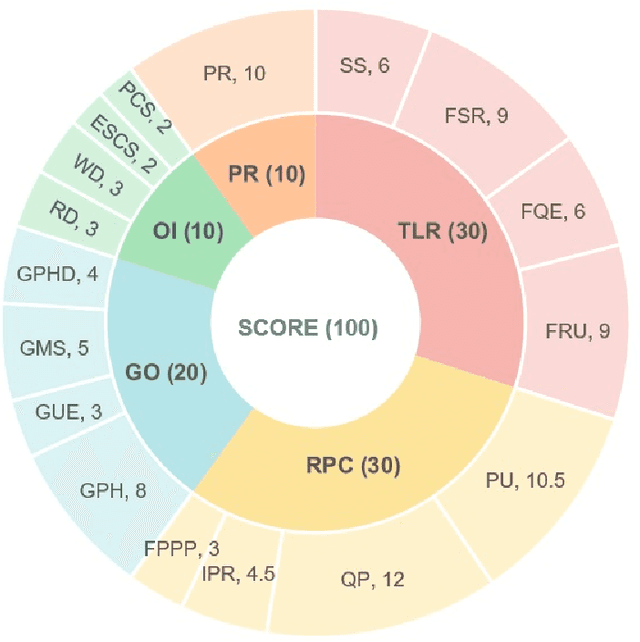
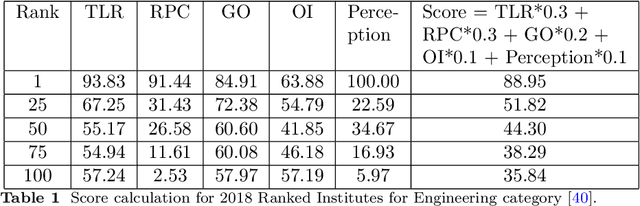
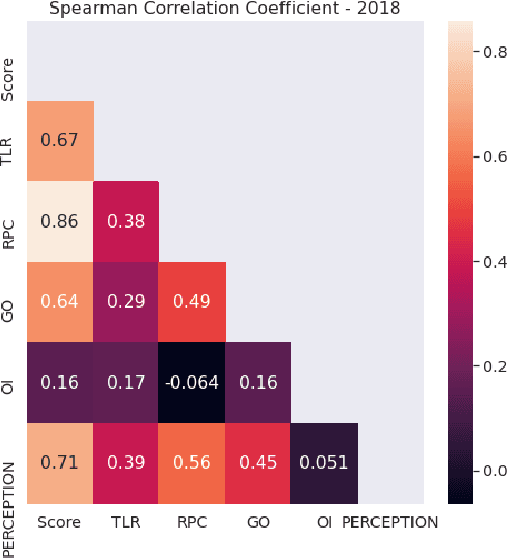
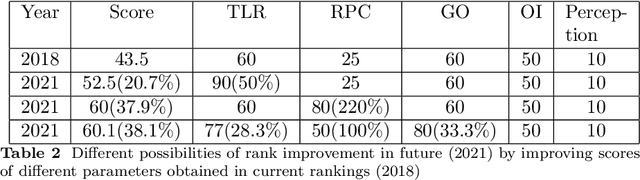
Annual ranking of higher educational institutes (HEIs) is a global phenomena and past research shows that they have significant impact on higher education landscape. In spite of criticisms regarding the goals, methodologies and outcomes of such ranking systems, previous studies reveal that most of the universities pay close attention to ranking results and look forward to improving their ranks. Generally, each ranking framework uses its own set of parameters and the data for individual metrics are condensed into a single final score for determining the rank thereby making it a complex multivariate problem. Maintaining a good rank and ascending in the rankings is a difficult task because it requires considerable resources, efforts and accurate planning. In this work, we show how exploratory data analysis (EDA) using correlation heatmaps and box plots can aid in understanding the broad trends in the ranking data, however it is challenging to make institutional decisions for rank improvements completely based on EDA. We present a novel idea of classifying the rankings data using Decision Tree (DT) based algorithms and retrieve decision paths for rank improvement using data visualization techniques. Using Laplace correction to the probability estimate, we quantify the amount of certainty attached with different decision paths obtained from interpretable DT models . The proposed methodology can aid HEIs to quantitatively asses the scope of improvement, adumbrate a fine-grained long-term action plan and prepare a suitable road-map.
Image Aesthetics Assessment using Multi Channel Convolutional Neural Networks
Nov 21, 2019


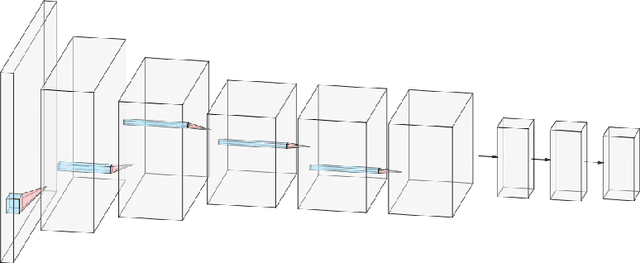
Image Aesthetics Assessment is one of the emerging domains in research. The domain deals with classification of images into categories depending on the basis of how pleasant they are for the users to watch. In this article, the focus is on categorizing the images in high quality and low quality image. Deep convolutional neural networks are used to classify the images. Instead of using just the raw image as input, different crops and saliency maps of the images are also used, as input to the proposed multi channel CNN architecture. The experiments reported on widely used AVA database show improvement in the aesthetic assessment performance over existing approaches.