 Add to Chrome
 Add to Firefox
 Add to Edge
Safe2Drive: Evaluating Safe Driving Behaviors of E2E Autonomous Driving Models
May 29, 2026
Recent end-to-end (E2E) autonomous driving policies achieve high driving scores in closed-loop simulations. Yet it remains unclear whether these policies handle common safety-critical scenarios. We present Safe2Drive (S2D), a set of Bench2Drive-aligned scenario extensions focused on three frequent families of road hazards: work zones, pedestrian jaywalking, and occluded vulnerable road users (VRUs). Safe2Drive adds 100 common but challenging scenarios and introduces SafeDriving Score (SDS), a safety-centric metric that augments prior evaluators with pre-crash braking, work zone-object contact, lane centering, and smoothness checks. Evaluating two state-of-the-art policies (LEAD and SimLingo) on S2D, we find that their driving scores drop sharply relative to their reported Bench2Drive baselines (LEAD: from 94.70 DS on Bench2Drive to 39.95 DS on S2D; SimLingo: from 85.07 DS on Bench2Drive to 41.00 DS on S2D) and that SDS on S2D is low (11.85 for LEAD and 15.27 for Sim-Lingo). These results are consistent with brittle safe-driving behaviors such as poor work-zone understanding, red-light violations, and late or absent braking for pedestrians. This study highlights a lack of safe behavioral reasoning in E2E models even when tested on CARLA towns that are part of the training set. We plan to release the code and videos for all 100 S2D scenarios.

ContextualFusion: Context-Based Multi-Sensor Fusion for 3D Object Detection in Adverse Operating Conditions
Apr 23, 2024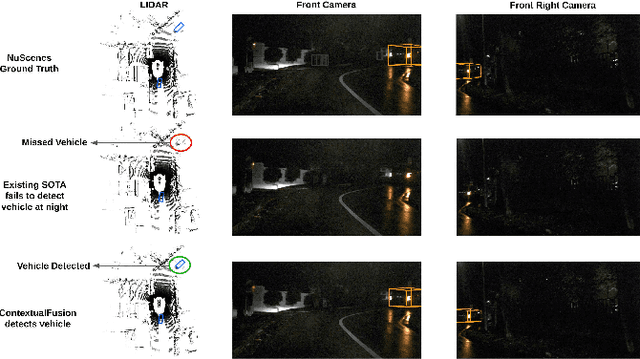
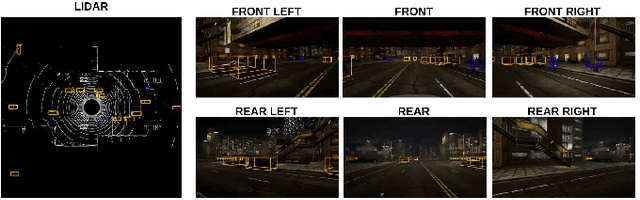
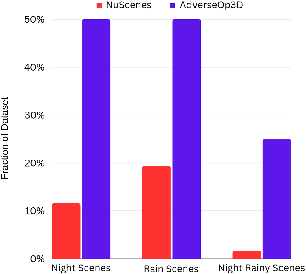
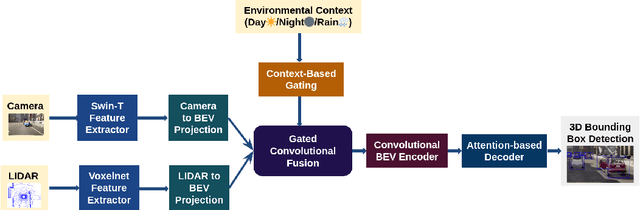
The fusion of multimodal sensor data streams such as camera images and lidar point clouds plays an important role in the operation of autonomous vehicles (AVs). Robust perception across a range of adverse weather and lighting conditions is specifically required for AVs to be deployed widely. While multi-sensor fusion networks have been previously developed for perception in sunny and clear weather conditions, these methods show a significant degradation in performance under night-time and poor weather conditions. In this paper, we propose a simple yet effective technique called ContextualFusion to incorporate the domain knowledge about cameras and lidars behaving differently across lighting and weather variations into 3D object detection models. Specifically, we design a Gated Convolutional Fusion (GatedConv) approach for the fusion of sensor streams based on the operational context. To aid in our evaluation, we use the open-source simulator CARLA to create a multimodal adverse-condition dataset called AdverseOp3D to address the shortcomings of existing datasets being biased towards daytime and good-weather conditions. Our ContextualFusion approach yields an mAP improvement of 6.2% over state-of-the-art methods on our context-balanced synthetic dataset. Finally, our method enhances state-of-the-art 3D objection performance at night on the real-world NuScenes dataset with a significant mAP improvement of 11.7%.