 Add to Chrome
 Add to Firefox
 Add to Edge
Clinical Reasoning Graphs: Structured Evaluation of LLM Diagnostic Reasoning Reveals Competence Without Consistency
Jun 29, 2026
Modern large language models (LLMs) reach 60-70% diagnostic accuracy on complex clinical case benchmarks, but accuracy alone cannot distinguish stable clinically-grounded reasoning from pattern matching. We introduce clinical reasoning graphs, structured graph representations extracted from free-text LLM diagnostic traces using a domain-grounded ontology with 5 node types and 7 edge types. We apply this pipeline to 750 traces from five LLMs across 50 New England Journal of Medicine Clinicopathological Conference cases and three prompt conditions, and test whether diagnostic traces show stable structured reasoning patterns, or diagnostic schemas, for clinically similar cases. We operationalize this as higher graph similarity among clinically similar cases than among clinically dissimilar ones. Across 15 model-condition comparisons, within-cluster and between-cluster composite similarity are nearly equal, and no comparison survives multiple-testing correction; a component-level analysis finds any residual content signal far below schema scale. Graph similarity is also nearly identical for pairs of models that are both correct (0.488) and both incorrect (0.484), suggesting that graph structure captures a dimension not reflected in diagnostic accuracy. Structured reflection prompting increases explicit discriminating-feature analysis within traces (+33%) but does not increase cross-case consistency. These results show diagnostic competence without schema-scale reasoning consistency, and indicate that final-answer accuracy should be complemented by process-level evaluation. We release the ontology, extraction pipeline, validation protocol, and the extracted reasoning graphs and similarity artifacts as resources for structured evaluation of LLM clinical reasoning.

A Biologically Plausible Benchmark for Contextual Bandit Algorithms in Precision Oncology Using in vitro Data
Nov 11, 2019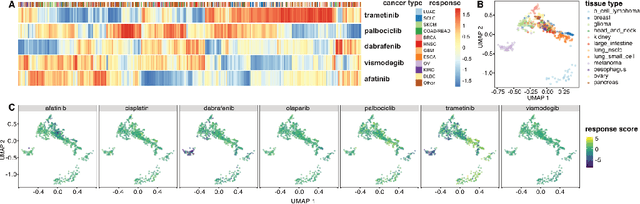
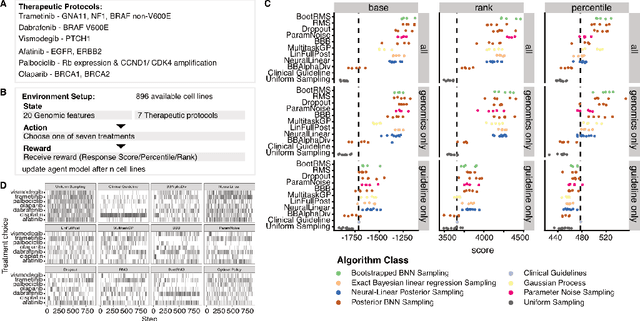
Precision oncology, the genetic sequencing of tumors to identify druggable targets, has emerged as the standard of care in the treatment of many cancers. Nonetheless, due to the pace of therapy development and variability in patient information, designing effective protocols for individual treatment assignment in a sample-efficient way remains a major challenge. One promising approach to this problem is to frame precision oncology treatment as a contextual bandit problem and to apply sequential decision-making algorithms designed to minimize regret in this setting. However, a clear prerequisite for considering this methodology in high-stakes clinical decisions is careful benchmarking to understand realistic costs and benefits. Here, we propose a benchmark dataset to evaluate contextual bandit algorithms based on real in vitro drug response of approximately 900 cancer cell lines. Specifically, we curated a dataset of complete treatment responses for a subset of 7 treatments from prior in vitro studies. This allows us to compute the regret of proposed decision policies using biologically plausible counterfactuals. We ran a suite of Bayesian bandit algorithms on our benchmark, and found that the methods accumulate less regret over a sequence of treatment assignment tasks than a rule-based baseline derived from current clinical practice. This effect was more pronounced when genomic information was included as context. We expect this work to be a starting point for evaluation of both the unique structural requirements and ethical implications for real-world testing of bandit based clinical decision support.