 Add to Chrome
 Add to Firefox
 Add to Edge
Robust Near-Field Beam Focusing Under Imperfect Localization
Aug 19, 2026
The transition to 6G-and-beyond wireless systems with large-scale antenna arrays and high-frequency deployments significantly extends the near-field region, where channels exhibit a strong dependence on user location. While this enables location-based beam focusing as a low-overhead alternative to conventional channel estimation, its performance is highly sensitive to localization errors. In this paper, we study robust near-field beam focusing under imperfect user localization. We explicitly characterize the impact of localization errors on the line-of-sight-dominated channel by deriving a tractable uncertainty model via a first-order Taylor approximation, which captures the coupled effects of distance and angle in near-field propagation. Building on this model, we formulate a max-min signal-to-interference-plus-noise ratio optimization problem that guarantees performance under worst-case channel realizations induced by bounded localization errors. The resulting problem is reformulated into a feasibility problem using semidefinite relaxation. Numerical results demonstrate that the proposed robust design significantly improves the worst-user rate compared to non-robust beam focusing, particularly under high total transmit power levels and large localization error ranges.

Localization-Based Beam Focusing in Near-Field Communications
Jun 26, 2025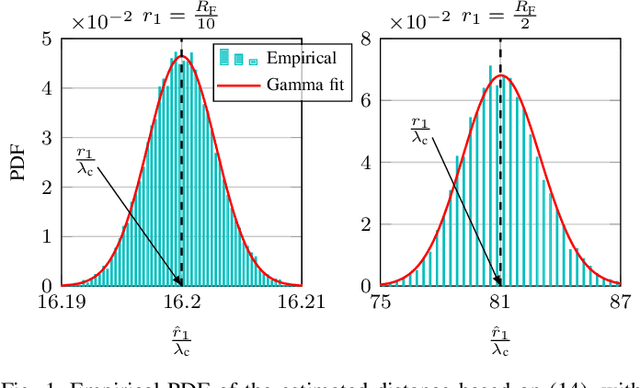


Shifting 6G-and-beyond wireless communication systems to higher frequency bands and the utilization of massive multiple-input multiple-output arrays will extend the near-field region, affecting beamforming and user localization schemes. In this paper, we propose a localization-based beam-focusing strategy that leverages the dominant line-of-sight (LoS) propagation arising at mmWave and sub-THz frequencies. To support this approach, we analyze the 2D-MUSIC algorithm for distance estimation by examining its spectrum in simplified, tractable setups with minimal numbers of antennas and users. Lastly, we compare the proposed localization-based beam focusing, with locations estimated via 2D-MUSIC, with zero forcing with pilot-based channel estimation in terms of uplink sum spectral efficiency. Our numerical results show that the proposed method becomes more effective under LoS-dominated propagation, short coherence blocks, and strong noise power arising at high carrier frequencies and with large bandwidths.